Login
 Blog
Labeller OEE: Web Breaks, Reel Splices and Label Rejects on the Line

Key takeaways
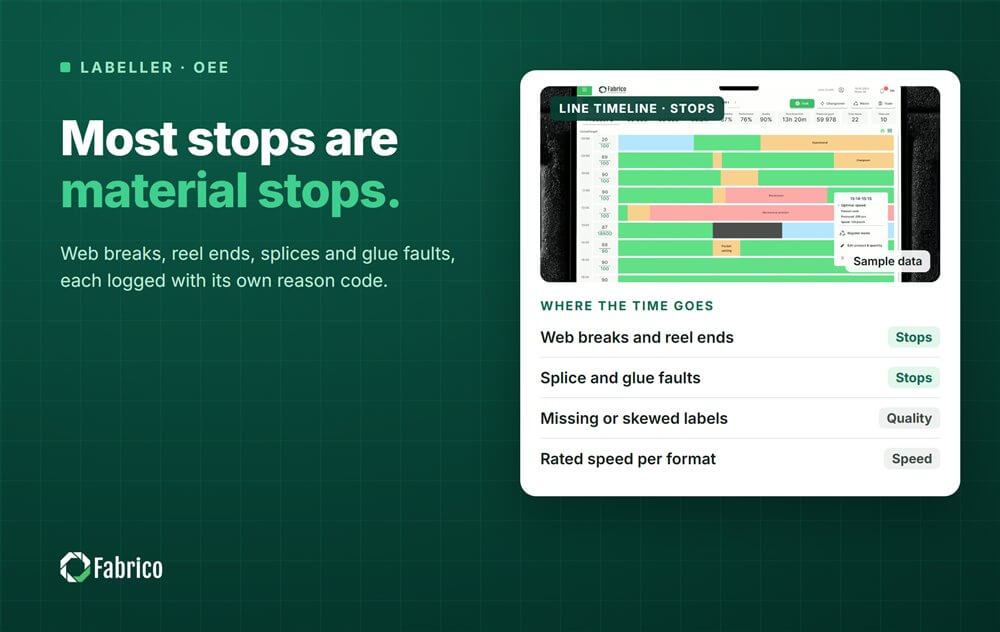
- Labeller stops are mostly material stops: web breaks, reel ends, splices and glue faults.
- Decide once whether a reel change is a short stop or downtime, then log each one with its own code.
- Missing, skewed and wrinkled labels are Quality losses, and relabelled bottles are not first-time good.
- The ideal rate is the labeller's own rated speed for the format, not the filler's speed.
- A labeller stop costs line output only when it outlasts the buffer in front of it.
The labeller on line 4 stops: the web broke at the peel plate. The operator threads the reel again, the machine restarts, and nobody writes it down because it took two minutes. By the end of the shift it has happened six times, and the OEE report shows only a slightly lower Performance figure.
Labellers rarely break down in the classic sense. They lose time in small, repeating stops tied to labels, reels and glue, and they lose quality in labels that are missing, skewed or wrinkled. This guide covers where labeller time goes, how to treat reel changes, how to set the rated speed, how to count rejects, and when a labeller stop actually costs the line.
Where the labeller's time goes
The stops depend on the method. Pressure sensitive labellers run self-adhesive labels on a backing web from a reel. Wet glue labellers pick cut labels from a magazine and apply cold glue. Roll-fed wraparound labellers cut labels from a reel and apply hot melt.
| Stop | Typical cause | OEE factor | Signal |
|---|---|---|---|
| Web break | Backing web tears at the peel plate or at a splice | Availability or short stop | Web break sensor |
| Reel end and change | Reel runs out, manual change and threading | Short stop or Availability, by threshold | Reel end sensor |
| Splice failure | Auto splice misses or tears | Availability | Fault code |
| Glue fault | Glue at the wrong temperature or viscosity, dirty roller or nozzle | Availability, plus rejects | Temperature alarm, often none |
| Magazine empty | Wet glue label magazine not refilled in time | Short stop | Magazine low sensor |
| Infeed jam | Fallen or damaged bottle at the infeed screw or starwheel | Short stop | Often just stopped |
| Starved or blocked | Filler upstream stopped, packer downstream full | Not the labeller's loss | Table sensors |
| Format change | Change parts, label size, height and position | Availability, minutes over standard | Changeover mode |
Condensation is a classic problem on cold filled products: a wet bottle surface makes labels slip, flag or fail to stick. It shows up as rejects and short stops at the labeller, but the fix is upstream, in drying or product temperature.

Reel changes and splices: short stops or downtime?
A reel change is expected, but it is not planned time. The machine is scheduled to run, so the minutes are a loss. The only question is whether they land in Availability or Performance. Minor stops are short, and no standard sets the cutoff, so agree your own limit and keep it. OEE stays the same either way; only the diagnosis changes.
What matters is that each reel change has its own reason code, separate from web breaks and splice failures. Then the arithmetic is easy: if a reel holds N labels and the labeller applies R labels a minute, a reel lasts N / R minutes, and the number of changes per shift follows. A labeller with an automatic splicer should show close to no reel change time; if it does not, the splicer is the problem. Our guide to micro stops on packing lines shows how these short stops add up.
Setting the labeller's rated speed
Use the labeller's own rated speed for the format and label, from the nameplate or the maximum demonstrated speed, not the filler's speed. On a V-curve line the labeller is fed at the filler's pace and has extra speed to recover after a stop. Against its own rated speed it will show Performance below one even on a perfect day. That is by design, so do not chase it.
Some label materials or bottle shapes need a lower speed to apply cleanly. Record that as a format-specific rated speed under change control, not as an operator's habit, or the speed loss becomes invisible. And watch what matters most on the labeller: its own stops per hour and its rejects, because those are what block the filler and waste full bottles.
Missing, skewed and wrinkled labels: the Quality factor
Label inspection after the labeller rejects bottles with a missing label, a skewed or flagged label, a wrinkle or a missing code. Each reject is a full bottle with product in it.
Two rules keep Quality honest. Count rejects at the labeller against the labeller, so a glue problem shows where it started. And do not count relabelled bottles as first-time good: a bottle that went to a rework table and came back is rework. More in our guide to the OEE Quality factor.
Look at the timing too. Rejects that follow restarts point to glue temperature or web tension settling. Rejects that follow one SKU point to a label material or a setting. Rejects that drift through the shift point to condensation or glue.
When a labeller stop costs the line
A labeller stop costs line output only when it lasts longer than the buffer between filler and labeller. A table holding B bottles, fed at R bottles a minute, protects the filler for B / R minutes. Short stops inside that window cost nothing at the filler, as long as the labeller's extra speed drains the table before the next stop. Long stops, or short stops too close together, block the filler. Our guide to starvation and blocking covers how to charge those minutes.
Sample line (illustrative numbers, not a customer): a filler at 250 bottles a minute, a labeller with a recovery speed of 275 a minute, and a table between them that holds 500 bottles.
- Protection time: 500 / 250 = 2 minutes.
- A 90 second reel change fills the table with 1.5 x 250 = 375 bottles. The filler is not blocked. With 25 bottles a minute of extra speed, the labeller drains the table in 375 / 25 = 15 minutes.
- A 4 minute web break fills the table after 2 minutes, then blocks the filler for the other 2 minutes: 2 x 250 = 500 bottles lost at the filler.
- Six web breaks a shift: 6 x 500 = 3,000 bottles.
- At a contribution of $0.08 a bottle: 3,000 x $0.08 = $240 a shift, or €240 in a euro plant at €0.08 a bottle.
- Over 750 shifts a year: $180,000, or €180,000.
Twelve reel changes on the same shift cost the filler nothing, as long as each one lands on a drained table. The labeller report should show both numbers: minutes stopped, and minutes the labeller blocked the filler.
Data sources at the labeller
- PLC fault codes: web break, reel end, splice fault, glue temperature, magazine low.
- Counters: bottles in, labelled bottles out, inspection rejects by reason.
- Table sensors: starved from the filler, blocked by the packer.
- Camera: where a camera watches the label station or the infeed, the clip shows a flagged label, a torn web or a fallen bottle when the PLC only says stopped.
- Operator input: the reason confirmed in one tap, for stops the PLC cannot name.
Keep web break, reel end, splice failure and glue as separate reason codes, so the Pareto can tell them apart. See our guide to downtime reason code design.
Mistakes plants make with labeller OEE
- Lumping web breaks, reel changes and splice failures under one code called label.
- Using the filler's speed as the labeller's ideal, so its own speed loss disappears.
- Counting relabelled bottles as good.
- Charging the labeller with starved time when the filler upstream stopped.
- Treating condensation rejects as a labeller fault when the cause is product temperature.
Where Fabrico fits
Fabrico is a computer vision enabled Manufacturing Performance Platform. OEE and light MES come first: automatic downtime logging at the labeller, so web breaks, reel changes and splice faults are counted instead of forgotten, and OEE live by line and shift.
- The operator confirms the reason in one tap, so a web break and a reel end do not end up under the same code.
- A camera clip as evidence for a stop, where a camera watches the label station.
- Losses priced in money and ranked, so a web break that blocks the filler outranks a reel change that does not.
- One view across plants for the same labeller type on different sites.
- A work order with its cost to the right technician when a stop is a breakdown.
You start on one line, with a baseline and a decision date agreed in advance. Each plant gets a quote after a review of its lines. See how a stop gets its evidence on our computer vision for OEE page.
Frequently asked questions
How do you calculate labeller OEE?
Availability is run time over planned production time, Performance is bottles labelled over what the labeller could label at its rated speed in that run time, and Quality is first-time good bottles over bottles labelled. Multiply the three.
Is a label reel change planned or unplanned downtime?
It is a loss, not planned time, because the machine is scheduled to run. Whether it counts as a short stop or as downtime depends on the plant's threshold. Log each one with its own code.
How do you reduce label web breaks?
Log each break with the reel, the label material and the time since the last restart. Breaks that cluster on one material, one splice or after restarts point to the cause, such as tension settings or a damaged peel plate edge.
Should label rejects count in OEE Quality?
Yes. A bottle rejected for a missing or skewed label is not first-time good, and a relabelled bottle is rework. Count both at the labeller so the loss shows where it started.
Why does my labeller OEE look lower than the filler's?
Because the line feeds the labeller at the filler's pace while its rated speed is higher. Read line OEE at the filler and judge the labeller by its own stops, rejects and the minutes it blocked the filler.
See your labeller's losses in a demo
Bring one line and its current downtime log. We will show its web breaks, reel changes and blocked minutes, logged automatically and priced in money.
Latest from our blog