


 Login
 Blog
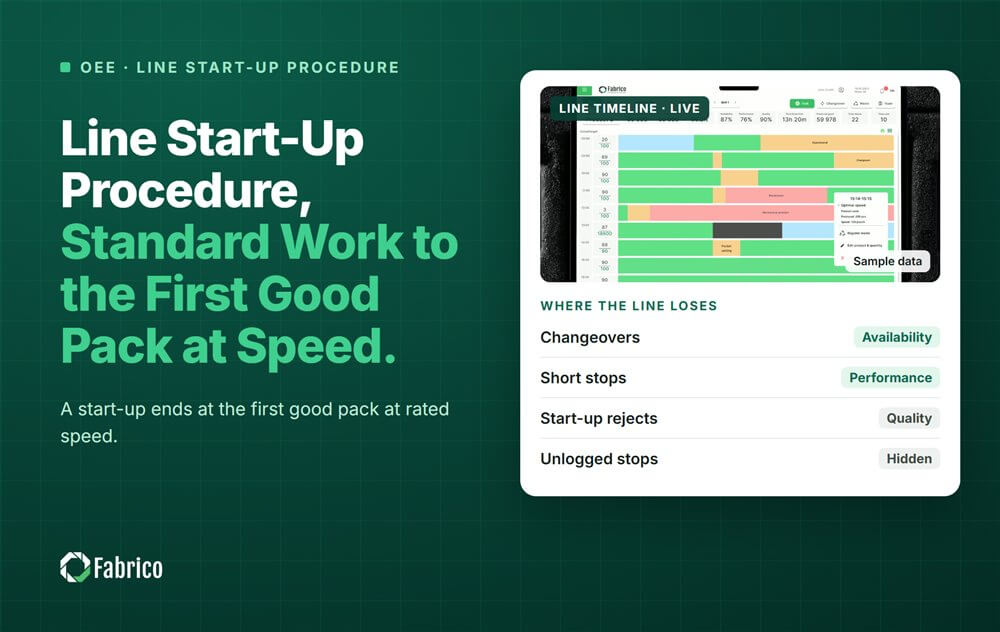
Line Start-Up Procedure: Standard Work to the First Good Pack at Speed

Key takeaways
- A line start-up ends at the first good product at rated speed, not when the first pack comes out.
- Start-up losses land in all three OEE (overall equipment effectiveness) factors: Availability, Performance and Quality.
- Write one standard work sheet for each start type: after a short stop, after a weekend and after a changeover.
- Stage materials before the planned start and run warm-ups in parallel. Keep safety and quality checks at full time.
- In the worked example, a Monday start-up drops from 51 to 18 minutes of lost output, and shift OEE rises from 73.6% to 80.9%.
A line start-up procedure is standard work that takes a line from a stop to the first good product at rated speed. It lists each step in order, who does it, its target minutes and the check that ends it.
This guide is from Fabrico, the OEE and light MES platform. It gives a start-up sheet for an FMCG (fast moving consumer goods) packaging line. It shows where each lost minute lands in OEE and works through one Monday start-up. For how start-up rejects differ from running rejects, see our guide to startup loss vs reduced yield loss.
When does a line start-up begin and end?
The start-up begins at the planned start of production. It ends at the first good product made at rated speed.
- Start the clock at the planned start, not when someone presses the button. Late materials and late warm-ups count.
- Stop the clock at rated speed, not at the first pack out. A line at half speed is still starting up.
- Count the rejects made on the way. A pack thrown away is output lost.
Some plants plan warm-up as planned downtime. If yours does, keep measuring it. Moving it out of planned time hides the loss without removing it. Our guide to planned and unplanned downtime covers that rule.
Where do start-up losses land in OEE?
| Start-up phase | What you see | OEE factor |
|---|---|---|
| Planned start to first pack out | Line stopped: waiting for material, warm-ups, checks | Availability |
| First pack to rated speed | Line running below rated speed | Performance |
| Rejects made during start-up | Weak seals, wrong codes, light packs | Quality |
Start-up rejects count as reduced yield in the six big losses, a Quality loss. A start-up review that looks only at stopped time misses two of the three. Our guide to OEE Availability shows how the stopped minutes feed the formula.
What are the steps of a line start-up procedure?
Here is a start-up sheet for a biscuit flow wrap line after a weekend. Change the steps to fit your line, but keep the order: prep, safety, warm-up, checks, ramp.
- Before the planned start, stage materials. Film, cartons, cases and labels for the first SKU wait at the line, checked against the order.
- Safety and line clearance. Guards closed, tools out, no packs or labels from the last run. Keep this at full time.
- Power up and start the warm-ups together. Seal jaws, glue guns and coders heat at the same time, not one after another.
- Run device checks while the line warms. Metal detector test pieces, checkweigher weights and the date code. Keep these at full time.
- Run slow and check the first packs. Seal, code and weight, signed off by the team leader.
- Ramp to rated speed in set steps, with a quick check of seals and codes at each step.
- Log the result. Minutes to first pack, minutes to rated speed and start-up rejects go on the shift record.
The first-off check works the same way as after a changeover. Our first-off approval guide covers who signs and what they check.
How does the procedure change by start type?
One sheet rarely fits every kind of start. A packaging line usually needs three versions.
- After a short stop, such as a jam or a break: clear the cause, check the guards, restart at rated speed. No warm-up, so the sheet is short.
- After a weekend or a long stop: the full sheet above, with warm-ups, device checks and a ramp.
- After a changeover: the changeover standard covers parts and settings. The start-up part is the first-off check and the ramp.
Set each target from your own best start-ups of that type, not from a guess. For the basics of writing the sheet, see our guide to standard work.
What does a worked start-up example look like?
Sample line (illustrative numbers, not a customer): a biscuit flow wrap line with a cartoner and a case packer. The wrapper is the slowest machine, rated at 120 packs a minute. The Monday morning shift starts at 06:00 with 450 minutes of planned production time. Each pack earns a contribution of $0.10, or €0.10 in a euro plant.
The team logged an average Monday start-up, wrote the sheet, then logged the start-ups after it.
| Start-up loss | Before the sheet | After the sheet | OEE factor |
|---|---|---|---|
| Planned start to first pack out | 36 min | 15 min | Availability |
| Ramp to rated speed | 24 min at 60 packs a minute | 8 min at 90 packs a minute | Performance |
| Output lost in the ramp | 1,440 packs, or 12 min | 240 packs, or 2 min | Performance |
| Start-up rejects | 360 packs, or 3 min | 120 packs, or 1 min | Quality |
| Lost output, in minutes at rated speed | 51 | 18 | All three |
The 21 minutes saved before the first pack came from three fixes:
- 9 minutes waiting for film and cartons, now staged before 06:00.
- 7 minutes from warm-ups run one after another, now run together.
- 5 minutes from a wrong date code found late, now checked during the warm-up.
Line clearance and the device checks kept their full time. The shift's other losses stayed the same: 40 minutes of other stops, 25 minutes of other slow running and 360 other rejects.
| Item | Before | After |
|---|---|---|
| Stopped time | 36 + 40 = 76 min | 15 + 40 = 55 min |
| Run time | 450 minus 76 = 374 min | 450 minus 55 = 395 min |
| Availability | 374 / 450 = 83.1% | 395 / 450 = 87.8% |
| Packs made | (374 minus 12 minus 25) x 120 = 40,440 | (395 minus 2 minus 25) x 120 = 44,160 |
| Performance | 337 / 374 = 90.1% | 368 / 395 = 93.2% |
| Good packs | 40,440 minus 720 = 39,720 | 44,160 minus 480 = 43,680 |
| Quality | 39,720 / 40,440 = 98.2% | 43,680 / 44,160 = 98.9% |
| OEE | 39,720 / 120 / 450 = 73.6% | 43,680 / 120 / 450 = 80.9% |
- The sheet gives 3,960 more good packs on a Monday: 33 minutes at 120 a minute.
- At $0.10 a pack, that is $396 a start-up, or €396.
- A line with 48 weekend start-ups a year gains $19,008, or €19,008, if the packs sell.
How do you make the start-up standard stick?
- Post the sheet at the line, on one page, with target minutes for each step.
- Log three numbers for each start-up: minutes to first pack, minutes to rated speed and start-up rejects.
- Review the slowest start-up at the daily meeting, and ask which step overran.
- Tighten the targets when the line beats them for a run of start-ups.
- Train each shift, nights too.
When a start-up overruns, ask which step and why, not who. Measure the process, never the person.
What mistakes make start-up losses look smaller than they are?
- Stopping the clock at the first pack out, so the ramp disappears.
- Logging start-up rejects with running rejects, so nobody sees the pattern.
- Moving warm-up into planned downtime, so it drops out of OEE.
- Rushing line clearance or device checks to save minutes.
- Setting targets from a guess instead of the line's own best start-ups.
Where Fabrico fits
Fabrico is a computer vision enabled Manufacturing Performance Platform. OEE and light MES come first: stops are logged automatically, and OEE is live by line and shift.
- Start-up stops logged as they happen, from the planned start to the first pack.
- The operator confirms the reason in one tap, so waiting for film and warm-up become separate bars.
- A camera clip as evidence for a long start-up stop, where a camera watches the machine.
- Losses priced in money and ranked, so start-ups compete fairly with breakdowns and changeovers.
Fabrico measures the start-up. Your team writes and runs the standard. You start on one line, with a baseline and a decision date agreed in advance. There is no free plan and there are no tiers: each plant gets a quote. See how stops are captured on our computer vision OEE page.
Frequently asked questions
What is a line start-up procedure?
It is standard work for bringing a production line from a stop to the first good product at rated speed. It lists the steps in order, who does each one, the target minutes and the check that ends each step. Most lines need a version for each: short stops, weekends and changeovers.
What is start-up loss in OEE?
It is the output lost while a line comes back to normal running. Time before the first pack is an Availability loss. Running below rated speed during the ramp is a Performance loss. Rejects made during start-up are reduced yield, a Quality loss. Count all three.
How long should a line start-up take?
There is no standard number. It depends on the line, the products and the warm-ups. Set the target from your own best start-ups of each type, then tighten it as the line beats it. Track minutes to first pack and minutes to rated speed separately.
Should warm-up time count as downtime?
If the line is planned to run, warm-up time is a loss and belongs in Availability. Some plants plan it as planned downtime instead. That is a choice, but keep measuring it either way. Moving it out of planned time hides the loss without removing it.
See your start-ups in a demo
Bring one line and its last few start-ups. We will show the minutes to first pack, the ramp and the rejects, priced in money.
Latest from our blog


Real Fabrico tiles, sample data.