Login
 Blog
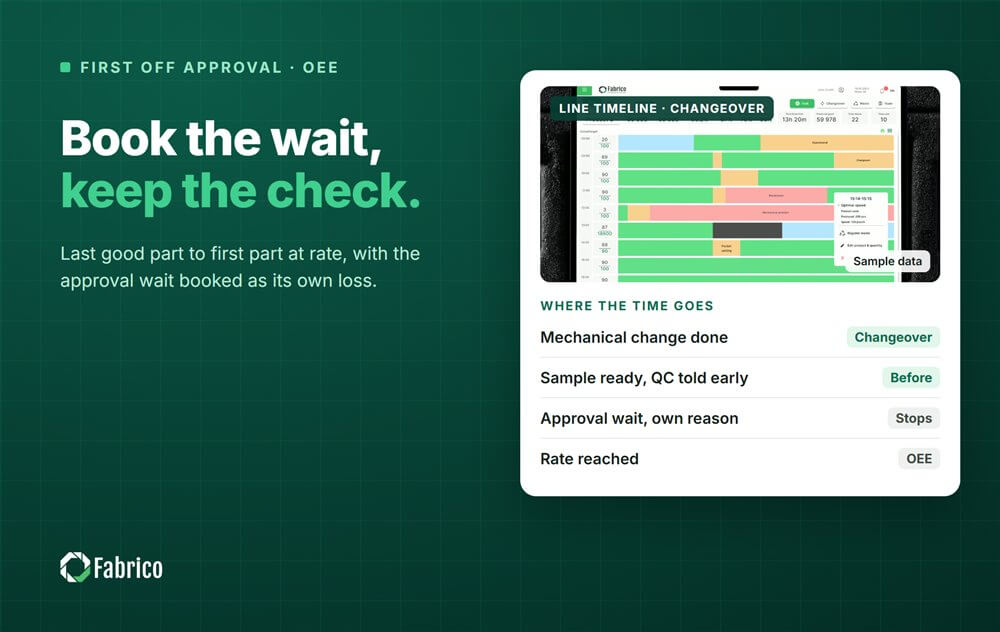
First Off Approval After Changeover: The Hidden Wait in OEE

Key takeaways
- A changeover ends at the first good part at rate, not when the last bolt is tight, so the wait for first off approval is part of it.
- Split the changeover into timed steps: last good part, mechanical change done, first part made, sample ready, approval, rate reached.
- Book the approval wait inside the changeover, as an Availability loss with its own reason, so it shows up on its own line.
- Shorten the wait by moving work out of it, not by skipping checks: tell QC before the first part, prepare the checks, agree the criteria.
- Price the wait like any other lost minute on the constraint, and it stops being invisible.
The format change on line 4 is finished at 10:05. The fitter steps back, the operator runs a few packs, adjusts the guides, and at 10:12 carries the first samples to the lab. QC is on another line. Approval comes at 10:44, and the line reaches full speed at 10:52. The changeover sheet says 35 minutes. The OEE system says the line was down for 82.
That gap is first off approval: the checks on the first parts after a setup, and the time spent waiting for someone to do them. It is real, it is necessary, and in many plants it is the least measured part of the changeover.
This guide covers what first off approval is, how to time it, how to book it in OEE, what makes the wait long and how to shorten it without weakening a single check.
What first off approval is
After a changeover, the first parts off the line are checked before the line runs at rate. The checks depend on the product: fill weight across lanes, seal integrity, label position, date and batch code, print quality, cap torque, dimensions on a machined part. The plant's quality system, and sometimes the customer, sets what is checked and who may sign.
The purpose is sound. A wrong label or a bad seal found on the first pack costs a few packs. Found two hours later, it costs a pallet, a rework shift or a recall. Nothing in this article argues for fewer checks. It argues for less waiting around them.

Where the changeover time actually goes
Most changeover sheets stop the clock when the mechanical work is done. The line does not make good product at that moment. A changeover runs from the last good part of the old product to the first good part of the new one at rate, and several steps sit between the spanner and the steady state.
| Step | Starts | Ends | Who is busy | Who waits |
|---|---|---|---|---|
| Run out and clear | Last good part | Line empty and cleared | Operators | Line |
| Mechanical change and settings | Line cleared | Change parts fitted, settings loaded | Fitter, operators | Line |
| First parts and adjustment | First restart | Sample judged ready by the operator | Operators | Line |
| Waiting for first off approval | Sample ready | QC starts the checks | Nobody on this line | Line and crew |
| Checks and sign-off | QC starts | Approved, or rejected and adjusted again | QC | Line |
| Ramp-up | Approval | Line at rated speed | Operators | Downstream |
The fourth row is the one to watch. Nobody is working on the line and nobody is looking at it, so nobody owns it. For the wider picture of the whole changeover, see our guide to changeover time.
How to measure the approval wait
You need four timestamps for each changeover: last good part, first restart, sample ready, approval. Machine data gives you the first two and the end of ramp-up without anyone writing anything: the count stops, the count restarts, the speed reaches rate. The two in the middle need an event at the line.
The simplest way is a reason. When the line stands after the first parts, the stop is logged automatically and the operator confirms it in one tap as waiting for first off approval. When QC approves, the line restarts and the stop closes. The wait now has a start, an end and a name, on every changeover where it happens.
Time ten changeovers that way before you change anything. Note the shortest, the longest and the typical wait, and what was different on the long ones: shift, product family, how many lines changed over at once.
How to book it in OEE
In the six big losses, a changeover is a setup and adjustment loss, and that hits Availability. The approval wait belongs inside it, with its own reason, so the changeover total stays honest and the wait can be read on its own. Ramp-up below rated speed can be booked inside the changeover too, or as a Performance loss, as long as the plant picks one rule and keeps it. Rejects made while setting the line up are a startup Quality loss, covered in our guide to startup and shutdown losses. More on the factor in our guide to OEE availability.
Many plants give each changeover a standard time and treat that part as planned. If so, include a planned allowance for approval in the standard. Every minute over it is unplanned, with a reason, and the wait cannot hide in the planned bucket.
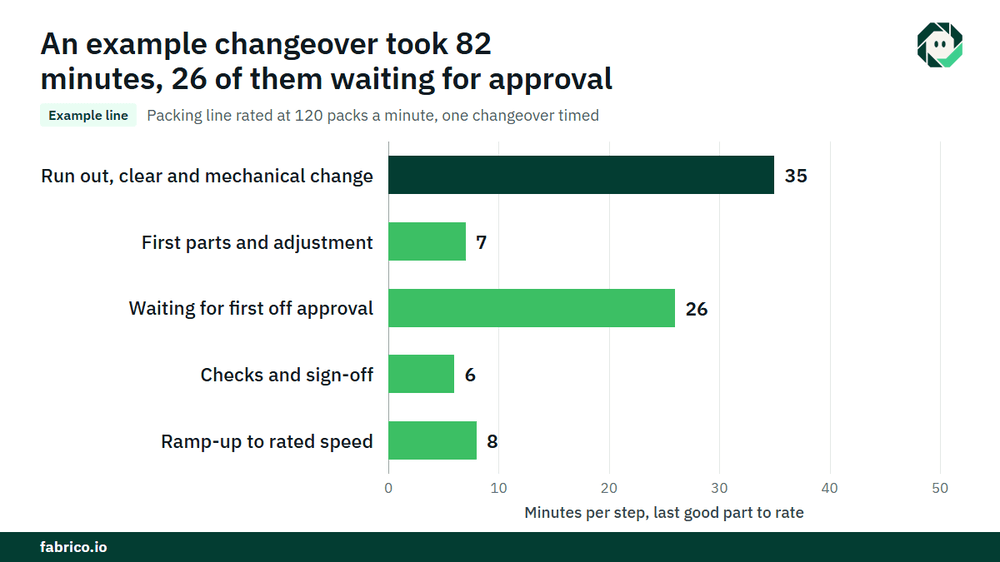
Sample line (illustrative numbers, not a customer): a packing line is rated at 120 packs a minute. It is the constraint and sold out, and each pack carries $0.08 of contribution, €0.08 in a euro plant, so a lost minute is worth 120 x $0.08 = $9.60 (€9.60). One changeover, timed:
- Run out, clear and mechanical change: 09:30 to 10:05, 35 minutes
- First parts and adjustment: 10:05 to 10:12, 7 minutes
- Waiting for first off approval: 10:12 to 10:38, 26 minutes
- Checks and sign-off: 10:38 to 10:44, 6 minutes
- Ramp-up to rated speed: 10:44 to 10:52, 8 minutes
- Total, last good part to rate: 35 + 7 + 26 + 6 + 8 = 82 minutes
The line changes over twice a day on 250 production days, so 500 changeovers a year. The wait alone is 26 x 500 = 13,000 minutes, worth 13,000 x $9.60 = $124,800 (€124,800) a year. Cutting the typical wait from 26 to 8 minutes frees 18 x 500 = 9,000 minutes, worth $86,400 (€86,400), with every check still done. If the line had spare capacity, the same minutes would be priced at the cost of catching up instead.
Why the wait is long
The wait is rarely about the checks themselves. It is about the queue in front of them. The usual causes:
- QC finds out late. The first call comes when the sample is in someone's hand.
- One technician, several lines. Changeovers bunch at the start of a shift, and the lab works through them one at a time.
- The walk. Samples travel to a lab at the other end of the hall, then the answer travels back.
- Unclear criteria. Without a reference sample or a clear limit, a borderline result turns into a discussion, then a second sample.
- The reject loop. A rejected sample means adjust, run, sample and wait again, often for the full queue.
- Paperwork before release. The check is done, but the line waits for a signature.
How to shorten the wait without skipping checks
The SMED idea applies to QC as well as to change parts: move every step that does not need the first part out of the wait. Our guide on how to reduce changeover time covers the mechanical side.
- Book the check before the changeover starts. QC gets the expected time of the first part, not a phone call when it exists.
- Prepare everything in advance. Check sheet, specification, approved artwork and reference sample at the line before the last good part.
- Bring the gauges to the line. A scale, a torque tester or a code reader at the station removes the walk.
- Stagger changeovers across lines. Two lines asking for QC at 06:15 means one of them waits.
- Agree the criteria and the reject path. A clear limit and a clear next step shorten the second loop.
- Train and authorise where the quality system allows. Some checks can be done by trained operators under QC rules. That is the quality manager's decision, not the line's.
Two things stay as they are. A validated allergen clean is not shortened to win minutes, and line clearance is not rushed. Our article on line clearance explains why that step protects the next product.
What each data source sees
| Source | What it sees | What it misses |
|---|---|---|
| PLC or machine signal | Stopped, restarted, speed back at rate | Why the line is standing |
| Counter | Last good part, first parts, rejects | Whether the parts are approved |
| Operator, one tap | Waiting for first off approval as the reason | Nothing, if the reason list holds it |
| Camera, where it watches the station | A clip of the line standing with the first parts ready | The lab and what happens there |
| QC record | Check results and approval time | How long the line waited before the check began |
Mistakes plants make
- Stopping the clock at mechanical finish. The changeover looks short and the loss moves to some other bucket.
- Booking the wait as other. Without its own reason, it never reaches a Pareto.
- Blaming QC. The queue is a planning problem. Staggered changeovers and early notice fix more than pressure does.
- Skipping checks to meet a target. A missed label error costs far more than the minutes saved.
- No standard for approval. If the standard changeover has no allowance for the check, every approval looks like an overrun.
Where Fabrico fits
Fabrico is a computer vision enabled Manufacturing Performance Platform. OEE and light MES come first: automatic downtime logging shows the changeover from the last good part to the line back at rate, and OEE live by line and shift shows what it did to the shift.
The operator confirms the reason in one tap, so waiting for first off approval becomes its own line in the changeover instead of a gap. Where a camera watches the station, a camera clip is kept as evidence for a stop. Losses are priced in money and ranked by money, so the approval wait competes for attention with jams and breakdowns on equal terms. If a stop turns out to be a breakdown, a work order goes to the right technician with its cost. Groups with several plants get one view across plants, and you can start on one line.
Each plant gets a quote after a review of its lines.
Frequently asked questions
What is first off approval in manufacturing?
It is the check of the first parts made after a setup or changeover, before the line runs at rate. Depending on the product it covers weight, seals, labels, codes, print, torque or dimensions, and it is signed off by QC or by a trained, authorised person.
Is first off approval part of changeover time?
Yes. Changeover time runs from the last good part of the old product to the first good part of the new one at rate, so the wait for approval and the checks sit inside it.
How is first off approval booked in OEE?
As part of the changeover, which is a setup loss in Availability. Give the wait its own reason so it can be measured, and decide once whether ramp-up counts inside the changeover or as a Performance loss.
How can we reduce the waiting time for QC after a changeover?
Tell QC the expected time of the first part in advance, prepare the check sheet and reference samples before the line stops, put gauges at the line, stagger changeovers across lines and agree clear reject criteria.
See your changeover from last part to rate
Bring a few recent changeovers to a demo. We will show where the minutes went, including the wait nobody wrote down, and what that wait costs.
Latest from our blog