






 Login
 Blog
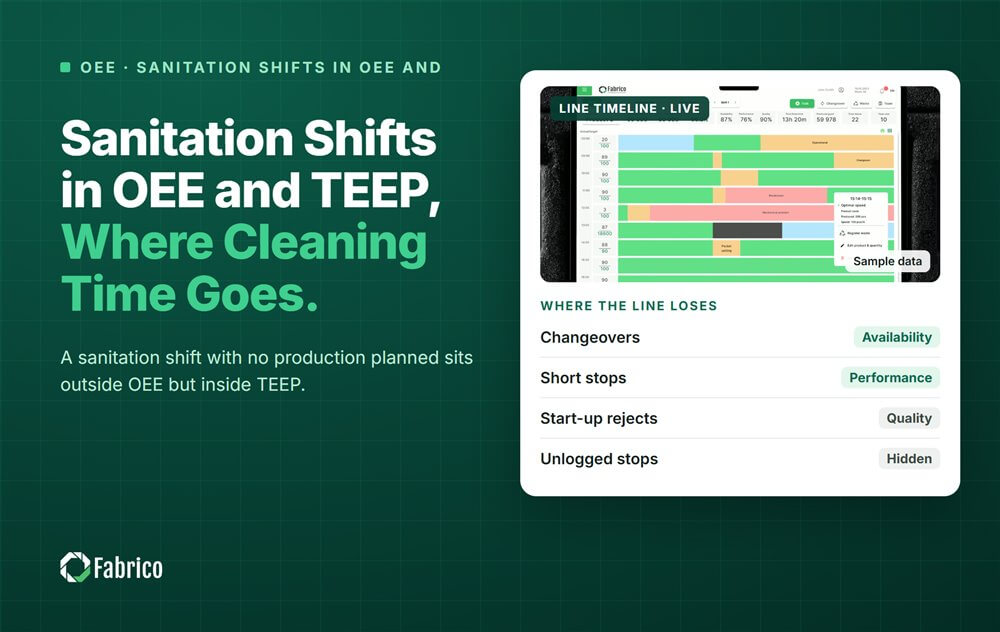
Sanitation Shifts in OEE and TEEP: Where Cleaning Time Goes

Key takeaways
- A clean during a production shift is an Availability loss in OEE.
- A sanitation shift with no production planned sits outside OEE but inside TEEP.
- TEEP uses every hour of the year, 8,760 of them, so it shows the true cost of cleaning windows.
- Report sanitation hours next to OEE, so nobody forgets they exist.
- Never move cleaning in and out of planned time to make a week look better.
Where cleaning time lands depends on one question: was production planned in that window? A clean inside a production shift costs Availability. A sanitation shift with no production planned is outside OEE's time base, but TEEP still sees it.
Fabrico, OEE and light MES software with AI cameras, logs each stop automatically and keeps OEE live by line and shift. Your sanitation schedule itself stays with your food safety and sanitation teams.
What are OEE, OOE and TEEP measured against?
All three use the same three factors: Availability, Performance and Quality. What changes is the time they are measured against.
| Measure | Time base | What it shows |
|---|---|---|
| OEE | Planned production time | How well the line runs when it is scheduled |
| OOE | Operating time: the shifts the plant is open | How well the open hours are used |
| TEEP | All time: 8,760 hours a year | How much of the calendar makes good product |
TEEP = loading x OEE, where loading is the share of all time that is planned for production. So TEEP is always the smallest of the three. Our guide to TEEP shows the formula in more detail.
Where does a sanitation shift land?
- Cleans during production shifts: a wipe-down, a CIP or an allergen clean while production is planned. Count them as Availability losses with their own reason codes.
- A sanitation shift with no production planned: for example, a full wash-down every Saturday. It is outside planned production time, so OEE does not see it.
- TEEP sees both. Every hour the line does not make good product lowers TEEP, whatever the reason.
That is why a plant can report a fine OEE and still run short of capacity. The cleaning hours sit outside the number.
Worked example: one week on a food line
Sample line (illustrative numbers, not a customer). A line runs three 8 hour shifts, five days a week. Production is planned for 120 hours. A sanitation shift of 8 hours runs every Saturday, with no production planned. The week has 168 hours.
| Block of time | Hours | Inside OEE? | Inside TEEP? |
|---|---|---|---|
| Planned production | 120 | Yes | Yes |
| Saturday sanitation shift | 8 | No | Yes |
| No production, no cleaning | 40 | No | Yes |
| Whole week | 168 |
Say the line's OEE is 70%. Then it makes 0.70 x 120 = 84 hours of good output time. Loading = 120 / 168 = 71.4%. TEEP = 84 / 168 = 50.0%, the same as 71.4% x 70%.
The Saturday shift alone is 8 / 168 = 4.8% of the week. If the team shortens the time around the wash-down, not the validated steps, TEEP rises while OEE stays the same. Only TEEP shows that gain.
Now the classic mistake. Suppose a weekday clean of 2 hours is booked as planned time instead of as a loss. OEE rises, because its time base shrinks to 118 hours. Nothing on the line got better.
How should a food plant report sanitation time?
- Write down the rule: which cleans are inside planned production time and which are not.
- Give each clean type its own code: wipe-down, CIP, allergen clean, full sanitation.
- Report three numbers each week: OEE, the sanitation hours outside OEE, and TEEP.
- Time the whole window, from the last good unit to the first good unit after the clean.
- Look for minutes around the clean: preparation, waiting for the crew, restart.
Our guide to the master sanitation schedule covers how plants plan the cleans themselves.
Which shift patterns change the picture?
Most packaging plants run two or three 8 hour shifts, five or six days a week. Others run around the clock on four crews of 12 hour shifts.
On a five day plan, sanitation often moves to the weekend, outside OEE. On a 24/7 plan there is no weekend, so every clean lands inside planned time and shows up in OEE. Comparing OEE between those two plants compares two different time bases. Compare TEEP, or report the sanitation hours next to OEE.
Which mistakes hide cleaning time?
- Booking weekday cleans as planned time, so OEE rises while output stays the same.
- One code for every clean, so a short wipe-down and a full allergen clean look alike.
- Stopping the clock when the washing ends, so the slow restart never shows.
- Reporting OEE without TEEP, so the weekend sanitation hours never reach the capacity plan.
Where does Fabrico fit?
Fabrico is a computer vision enabled Manufacturing Performance Platform. OEE and light MES come first, on one time model for every line.
- Automatic downtime logging, so each clean during production is timed by the machine.
- The operator confirms the reason in one tap, so each clean type gets its own code.
- OEE live by line and shift, with every loss priced in money.
- One view across plants, where shift patterns differ from site to site.
It is the OEE layer of a light MES. You start on one line, with a baseline and a decision date agreed in advance. There is no free plan and there are no tiers: each plant gets a quote. For more on the time model, read the OEE time model.
Frequently asked questions
Does sanitation count as downtime in OEE?
Only when production was planned in that window. A clean during a production shift is an Availability loss with its own code. A sanitation shift with no production planned is outside OEE's time base. TEEP counts both, because it measures against all the hours in the year.
What is the difference between OEE and TEEP?
OEE measures the line against planned production time. TEEP measures it against all time, 8,760 hours a year. TEEP equals loading times OEE, where loading is the share of all time planned for production. So TEEP is always lower than OEE.
Should a weekend sanitation shift be in OEE?
Not if no production was planned in it. Keep it outside OEE, but report its hours next to OEE each week, and watch TEEP. Shortening the time around the wash-down, never its validated steps, then shows up as a TEEP gain.
How do you compare OEE between plants with different shift patterns?
Carefully. A 24/7 plant cleans inside planned time, while a five day plant often cleans at the weekend, outside OEE. Their OEE numbers use different time bases. Compare TEEP as well, or report sanitation hours next to each plant's OEE.
Can you reduce sanitation time without risk?
Around the validated cleaning steps, often yes: prepare tools and chemicals before the line stops, have the crew ready on time, and tighten the restart. The validated steps themselves change only through your food safety team, never to improve a number.
See your cleaning hours next to OEE
Bring one week of shift and sanitation logs. We will show where the cleaning hours land and what they cost.
Latest from our blog






Real Fabrico tiles, sample data.