


 Login
 Blog
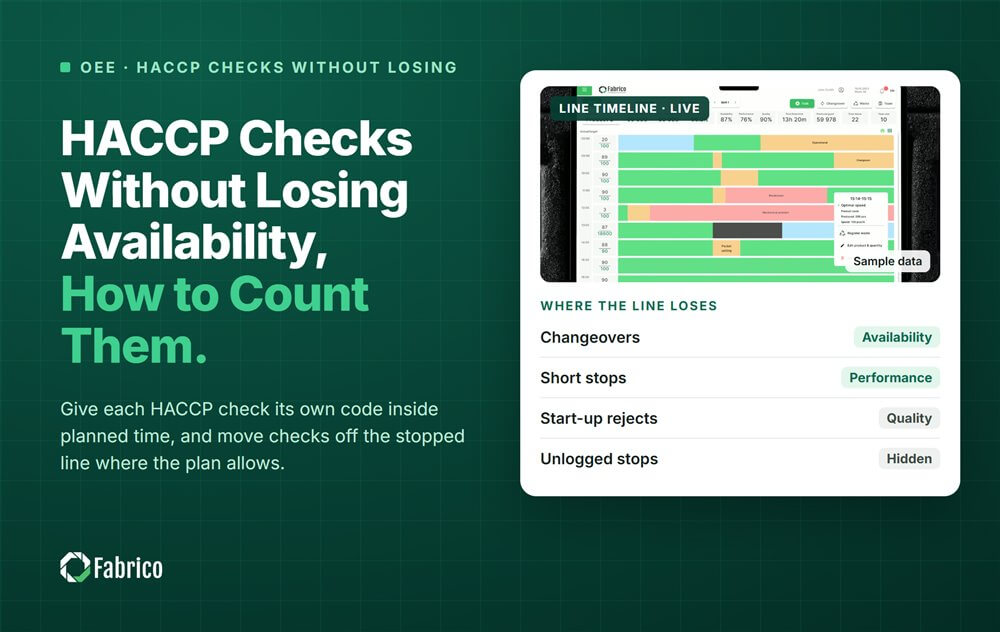
HACCP Checks Without Losing Availability: How to Count Them

Key takeaways
- A check that stops the line is a loss in OEE. Give it its own reason code so it stays visible.
- Your HACCP plan decides how each check is done. OEE only measures what it costs.
- Some checks can run on samples taken from a running line, where the plan allows it.
- Never skip or shorten a check to raise OEE.
- Price check minutes in money, so the method gets attention, not the check.
HACCP checks protect the food, and some of them stop the line. You can keep those minutes small without touching food safety. Count each check under its own code, see what it costs, and move work off the stopped line where your plan allows.
Fabrico, OEE and light MES software with AI cameras, logs each stop automatically and lets the operator mark it as a check in one tap. It makes no HACCP claim of its own: your plan and your records stay where they are.
What does a HACCP check look like in OEE terms?
HACCP rests on seven principles: hazard analysis, critical control points (CCPs), critical limits, monitoring, corrective actions, verification and record keeping. A critical limit is the maximum or minimum value a parameter must be held to at a CCP.
The checks on a line come from principles 4 and 6, monitoring and verification. In OEE terms, each check is one of three things:
- A check while running: the line keeps going. No Availability loss.
- A check on a stopped line: an Availability loss, with its own reason code.
- Units taken as samples: made but not sold, so they count in total count, not good count.
Do HACCP checks count as planned downtime in OEE?
OEE starts from planned production time: the shift minus planned stops such as breaks. A check that stops the line happens inside that time, so most plants count it as an Availability loss. They give it its own reason code, so it never hides under "Other".
Some plants define a fixed check slot as planned instead. That can work, if the rule is written down and the minutes are reported next to OEE. What does not work is moving checks in and out of planned time to make a week look better.
Christoph Roser calls shrinking the time basis one of the three common ways OEE gets fudged.
Our guide to planned vs unplanned downtime explains the split in more detail.
Which checks can run without stopping the line?
That is your HACCP team's call, not the OEE team's. Ask them one question per check: does this need a stopped line, or can it be done on product taken from a running line?
- Checks on samples from the outfeed often need no stop at all.
- Checks at start-up and after a changeover usually belong to the restart, so time them as part of it.
- Checks that wait for a person are a staffing problem: the waiting is the loss, not the check.
Moving work outside the stop is the same idea as SMED, which turns internal work into external work. Our SMED guide shows the method.
Worked example: checks on one shift
Sample line (illustrative numbers, not a customer). A line runs a 480 minute shift at 150 units a minute. The margin is USD 0.10 a unit, so a lost minute costs USD 15 (about EUR 13.80).
| Check | Today | After review with the HACCP team |
|---|---|---|
| Hourly CCP check | 8 stops x 3 minutes = 24 | Done on samples from the running line = 0 |
| Start-up check | 10 minutes | 10 minutes |
| Label check at each changeover | 2 x 4 = 8 minutes | 8 minutes |
| Total stopped minutes | 42 | 18 |
The checks themselves did not change. Only the hourly check moved off the stopped line. That saves 24 minutes a shift, or 24 / 480 = 5 points of Availability.
In money: 24 x USD 15 = USD 360 a shift. On two shifts a day for 250 days, that is USD 180,000 a year (about EUR 165,600). That output was lost while people checked a stopped line.
How do you log checks so they stay visible?
- One reason code per check type, such as CCP check, start-up check and label check.
- Times from the machine signal, not from the clock on the wall.
- The operator confirms the code when the stop ends, in one tap.
- Results go in the HACCP record. The OEE system holds the minutes, not the measured values.
- Review check minutes each week. Rising minutes point to the method or the staffing.
Our HACCP guide for food manufacturing covers the plan itself, and OEE vs Availability explains the factor these checks affect.
Which mistakes cost Availability or food safety?
- Skipping a check when the shift is behind plan. Never.
- Booking checks as "Other", so nobody can see what they cost.
- Timing checks by hand, so short ones vanish and long ones get rounded.
- Waiting for one technician to walk to every line, which turns a 3 minute check into a 12 minute stop.
Where does Fabrico fit?
Fabrico is a computer vision enabled Manufacturing Performance Platform. OEE and light MES come first, and checks are one more reason on the stop log.
- Automatic downtime logging, so each check stop is timed by the machine.
- The operator confirms the reason in one tap, so checks never land in "Other".
- Every loss priced in money, so check minutes have a cost.
- OEE live by line and shift, with checks kept inside the calculation.
It is the OEE layer of a light MES. You start on one line, with a baseline and a decision date agreed in advance. There is no free plan and there are no tiers: each plant gets a quote.
Frequently asked questions
Do HACCP checks count against OEE?
A check that stops the line costs Availability, because no product is made in those minutes. A check done on samples from a running line costs no Availability, but the sampled units count in total count, not good count. Give each kind of check its own code.
Should CCP monitoring stop the line?
That depends on the CCP and on your HACCP plan, so ask your HACCP team. Some checks need a stopped line; others can be done on product taken from the running line. OEE should measure the result, never decide it.
Can you reduce the time HACCP checks take?
Yes, around the check itself. Prepare tools and forms before the stop, put a trained person near the line, and move checks to running samples where the plan allows. The check itself stays as the plan says. Skipping or shortening it is never an option.
Where should HACCP check results be recorded?
In your HACCP records, kept the way your food safety system requires. The OEE system holds when the line stopped for a check and for how long. The two can sit side by side, but OEE data does not replace the HACCP record.
What happens to OEE when a check fails?
A failed check starts a corrective action, and the line may stop until it is done. Log that stop under its own food safety reason, apart from routine checks. Any product put on hold counts in total count, and it only counts as good once it is released.
See your check minutes per shift
Bring one week of shift reports. We will show how many minutes your checks take and what they cost.
Latest from our blog


Real Fabrico tiles, sample data.