


 Login
 Blog
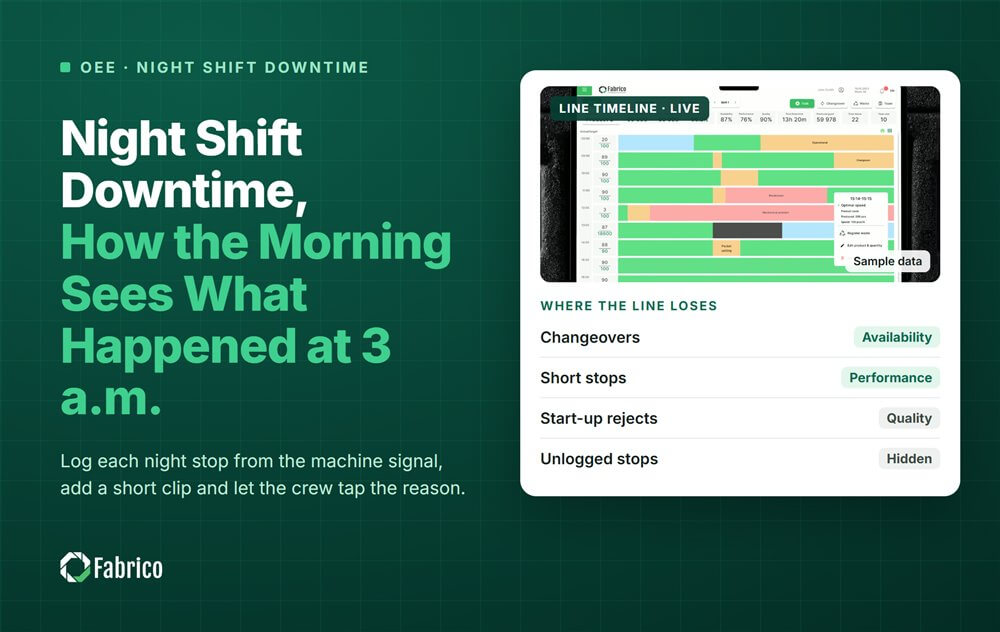
Night Shift Downtime: How the Morning Sees What Happened at 3 a.m.

Key takeaways
- Nights run with a small crew and no managers, so stops get written down late, from memory, often as "other".
- Automatic stop logging puts each stop on the record, a clip shows what happened, and one tap gives the reason.
- The night crew gets fewer calls and support that arrives with the clip. The record is about the process, never the people.
- On a sample line, the hand log showed 60 minutes of stops for one night. The line recorded 108.
Night shift downtime is hard to see because the people meant to log it are busy clearing it. Stops reach the sheet late, shortened or as "other", so the morning gets a number with no story. When the line logs each stop itself, the morning sees the night as it ran.
Fabrico is OEE (overall equipment effectiveness) and light MES (manufacturing execution system) software, with AI cameras as an add-on. It logs stops from the machine signal, attaches a short clip where a camera watches, and lets the operator confirm the reason in one tap.
Why is night shift downtime so hard to see?
Because a shift lead and a few operators may run the whole line, with no supervisor or technician in the building. Each stop is cleared by the same person meant to log it.
- Clearing comes first. The crew restarts the line, and the note waits, often until the end of the shift.
- Short stops are too short to write down. A fallen bottle cleared in a minute rarely reaches the sheet.
- Memory edits the log. Written at 05:45, long stops shrink, short ones vanish, and the rest becomes "other".
None of this is a crew problem. Knowing how to log a stop is not the same as logging it at 3:40 a.m. with gloves on.
What goes wrong in the morning meeting?
The morning sees the night's OEE, but not the stops behind it, so the meeting fills the gap with guesses.
- The loss lands in the wrong place. Unlogged stops still cost output, so they show up as slow running.
- The talk turns to people. The crew gets the questions, not the machine.
- The only witness is asleep. Someone phones the night lead, or the question waits a day.
Many plant managers know the story: the night stopped logging after a few weeks, and the numbers became fiction. A good daily OEE meeting needs a true record of the night first.
How does the morning see what happened at 3 a.m.?
With three pieces that do not depend on anyone's memory.
- Automatic stop logging. The machine signal marks when each stop starts and ends, so it is on the record even when nobody writes it down.
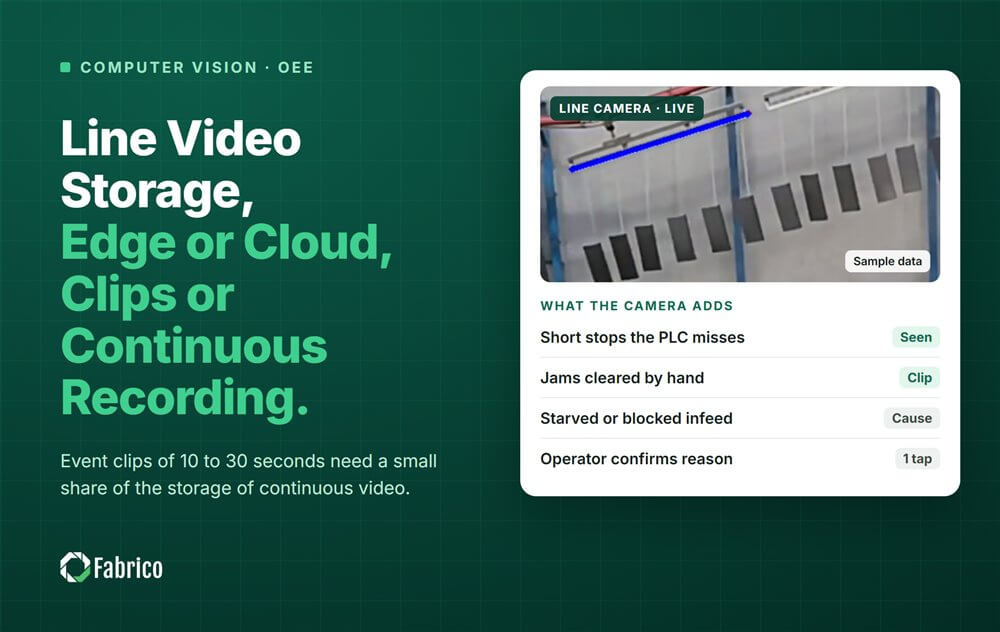
- A clip per stop. Where a camera watches the station, Fabrico attaches a 10 to 30 second clip with lead-in to each camera event.
- A one-tap reason. The screen at the line suggests a reason, and the operator accepts it or picks another. The camera suggests; the person decides.
At 06:30 the morning has the night's stops in time order, with minutes, reasons and clips. Keep the reason list short and in the crew's words. Our guide to operator friendly reason codes shows how. If "other" is above a few percent of stops, the list is missing a category.
What does the night crew get out of it?
Automatic logging takes work off the night, not onto it.
- Fewer calls. Nobody phones the night lead at 7:00 to ask what happened at 3:00.
- No report from memory. One tap per stop replaces the sheet.
- Support that arrives with the clip. When a stop is a breakdown, a work order goes to the right technician with its cost, and the clip shows what the machine did.
- Proof on their side. A clip of bottles tipping at the infeed shows a machine problem, not a slow crew.
Worked example: how does a sample night look by hand and as recorded?
Sample line (illustrative numbers, not a customer): a bottling line with the filler rated at 300 bottles a minute. The night shift has 450 planned minutes. A shift lead and three operators run it, and a technician is on call from home. Cameras watch the filler infeed and the capper; the labeller has a machine signal only.
The night lead's sheet, written at 05:45, has three entries: capper breakdown 25 minutes, labeller problems 20, other 15. Total: 60 minutes. The line recorded this:
| Recorded cause (reason tapped) | Stops | Minutes | Clip |
|---|---|---|---|
| Capper fault: 23 minutes waiting for the on-call technician, 15 minutes repair | 1 | 38 | Yes |
| Fallen bottles at the filler infeed | 26 | 26 | Yes |
| Label web break at the reel splice | 3 | 21 | No |
| Cap chute jams | 34 | 17 | Yes |
| No reason tapped, at the labeller | 4 | 6 | No |
| Total | 68 | 108 | 61 clips |
The filler counter gives the same output either way: 97,200 bottles, of which 96,228 were good.
| The night | Logged by hand | Recorded by the line |
|---|---|---|
| Downtime | 60 minutes | 108 minutes |
| In "other" or with no reason | 15 minutes (25%) | 6 minutes (5.6%) |
| When the reasons were written | 05:45, from memory | At the line, a median of 2 minutes after each stop |
| Availability | 86.7% | 76.0% |
| Performance | 83.1% | 94.7% |
| OEE | 71.3% | 71.3% |
- Recorded: run time = 450 minus 108 = 342 minutes. Availability = 342 / 450 = 76.0%.
- Ideal time for 97,200 bottles = 97,200 / 300 = 324 minutes. Performance = 324 / 342 = 94.7%.
- Quality = 96,228 / 97,200 = 99.0%. OEE = 0.760 x 0.947 x 0.990 = 71.3%. Check: 96,228 / 300 = 320.8 minutes, and 320.8 / 450 = 71.3%.
- By hand: run time = 450 minus 60 = 390 minutes. Availability = 390 / 450 = 86.7%. Performance = 324 / 390 = 83.1%. OEE = 71.3% again.
- The hand log missed 108 minus 60 = 48 minutes. That is 48 x 300 = 14,400 bottles a night.
- At a contribution of $0.04 a bottle (or €0.04 in a euro plant): $576 a night. Over 250 nights a year: $144,000, or €144,000.
The OEE is the same, because the counter decides it. What changed is where the loss sits. By hand, 48 minutes hide inside "slow running", with no names. Recorded, every minute has a name: 60 short stops at two stations worth 43 minutes, and a 23 minute wait for the technician.
The clips show the rest: bottles tip where the infeed guide narrows, and caps jam at the bend in the chute. The day shift adjusts both without calling anyone. The $576 is cash only if the line is sold out or the lost bottles cost overtime.
How do you keep it about the process, not the night crew?
Say the rule before the first camera goes up: we look at the machine, the material and the method.
- Point cameras at the process: the infeed, the capper chute, the splice.
- Report OEE by line and shift, never by named operator or as a league table of crews.
- Treat missing reasons as a training or staffing gap, not a crew failure.
- Agree it with the works council first in Germany, and with the CSE staff committee in France.
Deming's eighth point is short: drive out fear. A crew that fears the record stops feeding it. Our guide to production line cameras without surveillance shows how to hold that line.
How do you start on the night shift?
- Write the reason codes with the night crew, in their words.
- Train on the line, on every shift. Nights get skipped in training, and nights matter most here.
- Show the night its own record at handover. Our guide to OEE at shift handover covers those ten minutes.
- Check reason coverage by shift each week: coded downtime minutes divided by total downtime minutes.
Then compare nights and days fairly with our shift comparison script with video evidence.
Where Fabrico fits
Fabrico is a computer vision enabled Manufacturing Performance Platform. OEE and light MES come first; cameras are an add-on.
- Automatic downtime logging, so night stops exist even when the crew is busy clearing them.
- A camera clip as evidence for a stop, and the operator confirms the reason in one tap.
- Losses ranked by money and OEE live by line and shift.
- A work order to the right technician, with its cost, when a stop is a breakdown.
You start with a pilot on one line. Devices are connected in about a month, and the full rollout takes 3 to 4 months. There is no free plan and there are no tiers: each plant gets a quote. See the computer vision OEE and MES page.
Frequently asked questions
Why is night shift downtime often underreported?
Because the crew that clears the stops also has to log them, with no supervisor on site. Short stops are too short to write down. The sheet is often filled in from memory at the end of the shift, when long stops shrink and short ones disappear into "other".
Will automatic logging make the night shift's OEE look worse?
Often not. OEE follows the good count, so it can stay the same. What changes is where the loss sits. Stops that were hidden as slow running become named stops, so Availability falls and Performance rises. The crew is no longer told it "ran slow".
Does the camera watch the night crew?
It should not. Point it at the process and keep faces out of the frame. Report OEE by line and shift, never by named operator. In Germany, a works agreement is needed before the first camera goes up, even for a camera that records nothing.
What if the night crew does not tap a reason?
The stop stays on the record with its time, its minutes and, where a camera watches, its clip. The line lead can watch the clip and code it at handover. If many night stops go uncoded, look for the cause: too many codes, a screen out of reach, or too few people.
See your night shift's stops in a demo
Bring one line and last night's downtime sheet. We will show what the line itself would have recorded, and what each stop cost.
Latest from our blog


Real Fabrico tiles, sample data.