

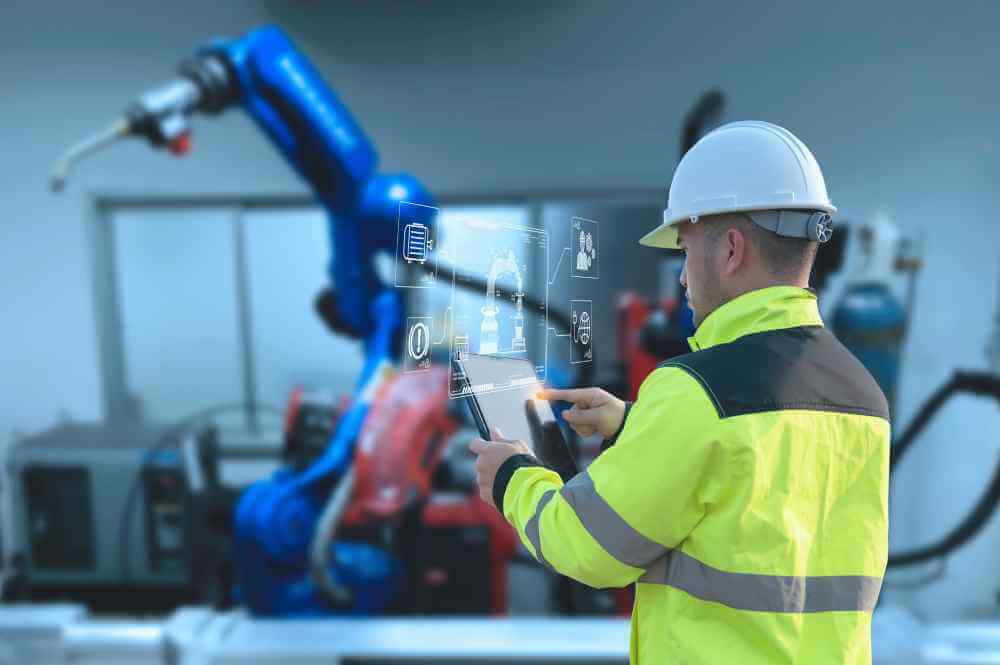

Implementing OEE software with an AI maintenance assistant is the fastest way to bridge the manufacturing skills gap and reclaim revenue lost to diagnostic latency.
In high-speed production, the bottleneck is no longer just the machine; it is the time Tom (the technician) spends searching for manuals or "guessing" the root cause of an error code.
To achieve world-class results in 2026, you must move beyond passive alerts and implement a unified System of Action that puts an intelligent troubleshooting advisor in every technician's pocket.
See OEE & CMMS live in 15 minutes.
Book a demoAI Assistants turn "Tribal Knowledge" into a digital asset. Uploading manuals and repair history creates a "Factory Brain" that answers technical questions in seconds.
Diagnostic time is the primary MTTR bottleneck. AI assistants eliminate the "Information Hunt," allowing technicians to focus on the Value Fulcrum.
Integration with OEE is non-negotiable. An assistant is only effective if it natively understands the live performance drift and previous failure modes of the asset.
An AI Maintenance Assistant is a generative AI tool natively integrated into a manufacturing platform that analyzes uploaded machine manuals, historical maintenance logs, and real-time OEE performance data to provide technicians with instant, step-by-step troubleshooting guidance and reset procedures via a mobile interface.
For Mike (the Tactical Manager), this is the end of the "Post-Breakdown Scramble."
Instead of Tom walking back to the office to find a binder, he asks the Fabrico Assistant (Roadmap), "How do I reset the E-04 error code on the filler?" and receives the exact SOP instantly.
Fabrico eliminates this friction by ensuring the AI has access to the Unified Data Intelligence layer, capturing 100% of the machine's technical and operational truth.
Fabrico is the only platform designed to natively merge Native OEE pulses with a Field-Ready CMMS and a generative AI troubleshooting advisor.
Why it wins for high-speed lines:
Fabrico treats AI as an active teammate rather than a search bar. Because it is a System of Action, the Fabrico Assistant (Roadmap) doesn't just read manuals; it cross-references real-time performance drops with historical "Bad Actor" patterns.
When a machine slows down by 5%, the system triggers a prioritized Work Order and provides the technician with the specific troubleshooting steps derived from that asset's "Digital Medical Record." This ensures maintenance effort is always applied to reclaim the Hidden Factory revenue.
Tractian is a robust reliability platform known for its AI-powered vibration and health monitoring sensors.
The Trade-off:
While Tractian excels at predicting that a machine will fail based on technical signals, its "Assistant" functionality often is less focused on the deep production context (OEE) found in a unified system. For Paula (the Strategic Leader), this means her maintenance team has good sensors but still faces a data silo between "technical health" and "production throughput."
Augury is a leader in Machine Health as a Service, using advanced acoustics and vibration AI to identify mechanical failures before they occur.
The Trade-off:
Augury provides world-class "Early Warning" signals, but it is primarily a "System of Intelligence" rather than a "System of Action." It is less focused on the native, field-ready maintenance execution engine required to manage spare parts, daily CILs, and interactive production scheduling.
Guidewheel uses "Clip-on" sensors to monitor machine electricity consumption and derive OEE insights for any asset regardless of age.
The Trade-off:
Guidewheel is excellent for rapid "Brownfield" digitalization and general OEE awareness. However, its AI capabilities are focused on data extraction rather than acting as a technical assistant for repair execution.
Mike would still need a separate CMMS to provide technicians with the troubleshooting steps Guidewheel identifies.
UpKeep is a mobile-first CMMS that has recently introduced AI modules to help automate the creation of work orders and summaries.
The Trade-off:
UpKeep is designed for broad facility management and general asset care. It is less focused on the native, high-frequency PLC integration and Advanced Visual RCA (Computer Vision) required for precision reliability in high-speed Food & Beverage or Plastics lines.
Its AI assistant is a valuable administrative tool but is less focused on the engineering depth required to fix complex machinery on the fly.
| Feature | Fabrico (System of Action) | Tractian | Augury | Guidewheel | UpKeep |
| Source Data | Manuals + OEE + History | Sensor Signals | Acoustics / Vib | Electricity Pulse | User Input |
| Response Trigger | Automated (OEE Pulse) | Threshold Alert | Anomaly Detection | Dashboard | Manual Request |
| Visual Proof | Advanced (Zoom-In) | None | None | None | Photo-Only |
| Maintenance Link | Native CMMS | Siled / API | None | None | Native CMMS |
| Troubleshooting | Step-by-Step SOPs | Technical Alerts | Health Report | Data Trends | Admin Tasks |
| Implementation | 3-4 Months | 4-6 Months | 6-12 Months | 1-2 Months | 1-2 Months |
For Paula (the Strategic Leader), the business case for an AI-enabled System of Action is built on the reduction of MTTR (Mean Time to Repair) and the protection of Residual Asset Value.
By providing Tom with instant technical knowledge, you reclaim the 30% of the day technicians waste searching for information. This efficiency directly reduces the Maintenance Cost per Unit and ensures that your technical budget is spent on outcomes, not research.
As you gather 12 months of clean data via the assistant, you are preparing the facility for the future of autonomous optimizations.
Stop searching for manuals. Start engineering uptime with a System of Action.
Want OEE captured straight from your machines, no manual logs?
See it live













 Login
Login
 Blog
Blog