Key Takeaways:
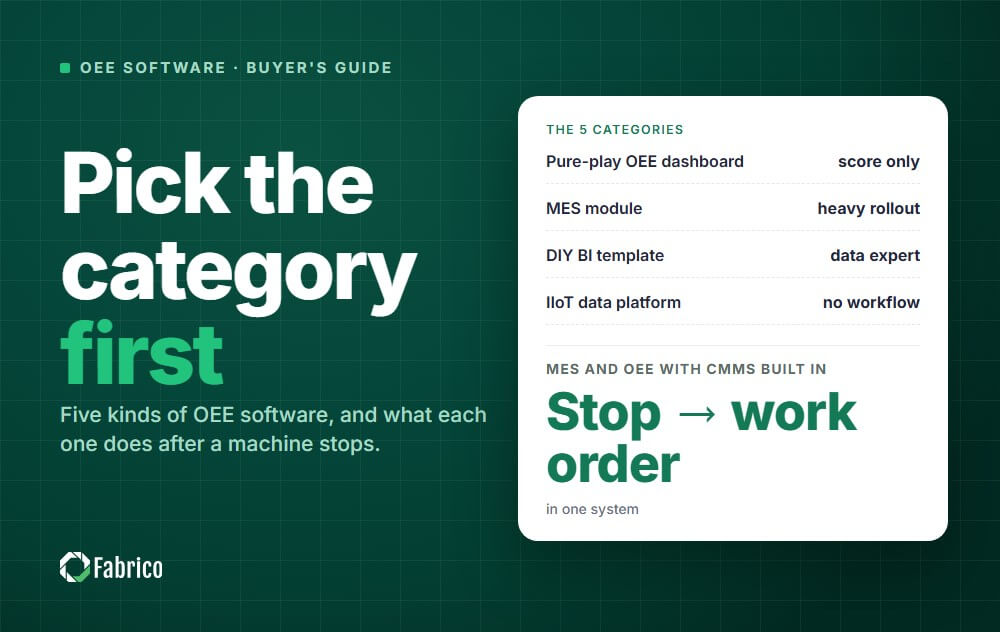
Selecting the best OEE software for metal casting and foundries requires a platform built to handle extreme industrial consequences.
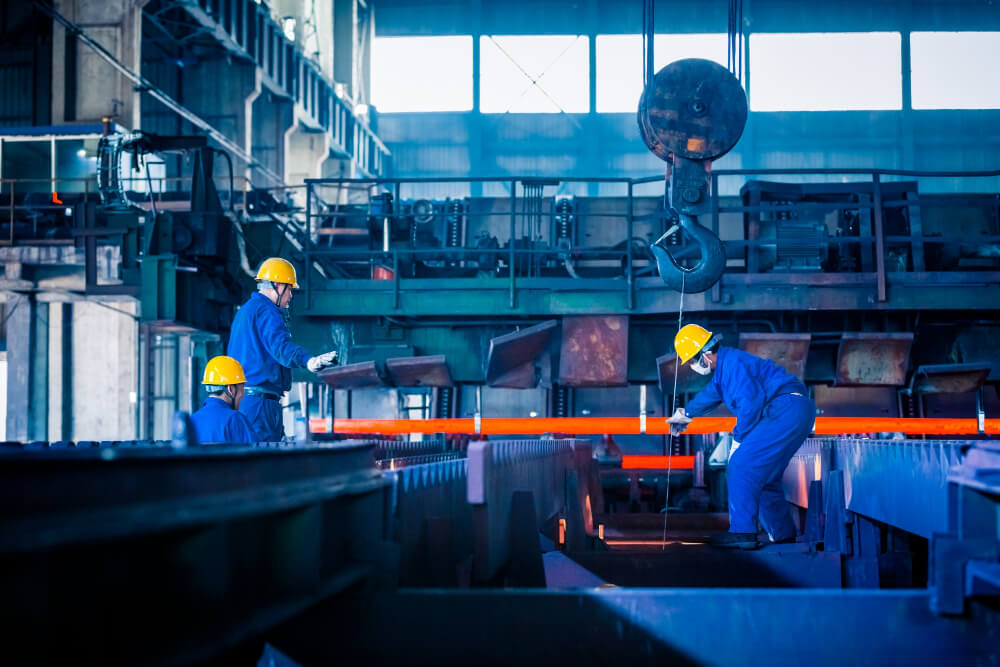
In a foundry environment, unexpected downtime does not just delay production, it actively destroys machinery if molten materials are allowed to cool and solidify.
Standalone OEE scoreboards simply report that a machine has stopped, offering absolutely no digital workflows to execute the emergency repair.
Generic facility maintenance apps lack direct machine connectivity, forcing mechanics to rely on manual work requests while the equipment drops in temperature.
Fabrico is a cloud-based MES and OEE platform for manufacturers, with maintenance management (CMMS) built in. It bridges this gap by combining machine data, Computer Vision and mobile work orders.
By logging machine cycle data so technicians can open condition-directed work orders, Fabrico prevents catastrophic thermal events before they occur.
Whichever OEE platform you shortlist, the decisive question is data quality. Sensors and manual logs miss the short stops, micro-stops, and idle time that quietly erode availability.
Looking beyond foundries? See our comparison of the best OEE software for the wider market.
Fabrico records every stop with its cause and duration straight from the machine, uses AI computer vision to name the cause from the line camera, and keeps the maintenance work order in the same system.
See our guide to the meaning of OEE and how to calculate OEE, or book a Fabrico demo to see it on your line.
Why is equipment reliability so critical in a metal casting foundry?
Metal casting and die-casting facilities operate at incredibly high temperatures, relying on a continuous, uninterrupted flow of molten materials.
If a high-pressure die-casting machine jams or a furnace conveyor suddenly stops, the liquid metal inside the system will rapidly begin to cool and solidify.
When metal solidifies inside the internal mechanisms of a machine, the resulting damage requires weeks of manual chiseling, complete component replacement, and millions of dollars in lost yield.
Because of this extreme risk, foundries cannot afford to wait for a human operator to notice a minor performance degradation and manually type out a work order.
World-class foundries require a digital ecosystem that actively predicts wear and automates maintenance execution before a catastrophic thermal event occurs.
Fabrico is a cloud-based MES and OEE platform for manufacturers, with real-time production monitoring, OEE by line and shift, and maintenance management (CMMS) built in, which fits the reliability demands of a modern foundry.
Unlike standalone applications, Fabrico connects natively to your machine PLCs and IoT gateways to continuously track the exact cycle counts and temperature profiles of your die-casting machines.
To solve the diagnostic blind spot on the factory floor, Fabrico utilizes its proprietary "Inefficiencies Zoom-In" module, deploying overhead computer vision cameras.
When a molding line experiences a micro-stop, the system automatically captures a short video clip of the exact moment of failure.
Furthermore, Fabrico natively houses a field-ready mobile CMMS, with production planning on its roadmap.
When a machine deviates from its engineered baseline, Fabrico logs the deviation, and the right technician opens a condition-directed work order, ensuring rapid intervention.
eMaint is an established, enterprise-grade CMMS that is highly respected in heavy industrial environments for its deep asset management capabilities.
Its core advantage is extreme customizability, allowing reliability engineers to build highly specific dashboards for complex foundry equipment and integrate with proprietary vibration sensors.
For massive steel mills that require strict tracking of financial depreciation and global spare parts, eMaint is a viable legacy choice.
The primary weakness of eMaint is its aging software architecture and its dated desktop user interface.
Because the interface is not exceptionally technician-friendly, frontline adoption rates often struggle, leading to delayed data entry and incomplete shift reports.
Additionally, tracking real-time OEE requires expensive custom integrations, meaning it often functions as a disconnected system of record rather than a platform that acts on the data.
MachineMetrics is a powerful machine data platform engineered specifically for discrete manufacturing and precision machining environments.
Its primary advantage is its ability to plug directly into the controls of modern CNC equipment to pull highly granular diagnostic data regarding spindle loads and feed rates.
While it is an elite tool for the post-casting machining department, it is generally poorly optimized for the harsh, continuous flow of the actual pouring and molding lines.
the main focus difference of MachineMetrics is its complete lighter emphasis on a native, field-ready maintenance execution engine.
It is not positioned to manage complex MRO spare parts inventory, meaning it is not positioned to track the refractory materials or custom die molds required for daily operations.
To actually fix the foundry machines that MachineMetrics monitors, plant managers are forced to purchase and integrate a completely separate maintenance software platform.
MaintainX is a massively successful cloud-based CMMS that revolutionized the reliability industry by bringing a simple mobile interface to maintenance technicians.
Its primary strength is extreme user-friendliness, ensuring high adoption rates for digitizing paper work orders and tracking basic facility repairs.
For tracking forklift maintenance or general facility HVAC units, MaintainX provides a massive upgrade over paper clipboards.
However, the main focus difference of MaintainX is its complete lighter emphasis on native integration with the daily production schedule and OEE metrics.
It relies entirely on calendar dates or manual human work requests to trigger preventive maintenance, which is far too slow for a volatile foundry environment.
When a MaintainX technician arrives to assist with a heavy die swap, they have absolutely no visibility into the broader production constraints of the melting schedule.
Evocon is a globally adopted OEE tracking system known for its extreme simplicity and highly visual factory scoreboards.
Its primary strength is a hardware-agnostic approach, allowing foundries to quickly bolt simple optical sensors onto legacy conveyors to track cycle times.
For foundries taking their very first step away from paper-based production logs, Evocon is a highly accessible introductory tool.
the main focus difference of Evocon is that it operates strictly as a passive monitoring device.
It relies heavily on machine operators manually selecting downtime reasons from a touch screen, which introduces massive subjective bias and completely hides the true mechanical root cause.
Additionally, Evocon is less focused on a native CMMS, forcing your reliability engineers to use a completely separate software tool to execute the actual mechanical repairs.
| Feature Capability | Legacy CMMS (eMaint) | Standalone IIoT (MachineMetrics) | Fabrico (MES and OEE Platform) |
| Native PLC & Cycle Tracking | Requires API Customization | Excellent (CNC Focus) | Yes (Direct Machine Integration) |
| Visual Root Cause Analysis | No (Blind Diagnostics) | No (Blind Diagnostics) | Yes (Inefficiencies Zoom-In) |
| Field-Ready Mobile CMMS | Poor (Clunky UX) | No | Excellent (Mobile Work Orders) |
| Interactive Production Scheduling | No (Blind to Orders) | No | On the roadmap |
| Usage-Based Maintenance Triggers | Calendar-Based Default | Yes (Analytics Only) | Yes (Run Hours and Cycle Counts) |
| MRO Inventory Optimization | Advanced | No | Advanced (ERP Synchronized via Mobile) |
| Pencil Whipping Prevention | Poor (Allows Remote Closing) | No | Excellent (QR Code Opens Each Machine's Checklists) |
In a foundry, scheduling preventive maintenance based on the calendar is a massive financial liability.
If a high-pressure die-casting machine runs triple shifts to meet an automotive order, a 30-day calendar inspection will arrive two weeks too late.
The Fabrico Framework eliminates this risk by replacing calendar-based PMs with automated usage triggers driven by real-time OEE data.
Fabrico continuously monitors the exact cycle counts and run hours of your equipment through direct PLC connections.
When a critical hydraulic pump reaches its engineered lifecycle limit, Fabrico generates a preventive work order on the technician's mobile device and notifies the team if the necessary spare part falls below its minimum stock.
This usage-based maintenance helps replace components before they fail, protecting your molten materials from solidifying.
When a molding line suffers a micro-stop, the extreme heat and smoke often obscure the physical cause of the jam.
Generic software systems force reliability engineers to blindly guess the root cause based on vague operator descriptions written after the shift ends.
Fabrico completely eliminates this diagnostic guesswork through its proprietary "Inefficiencies Zoom-In" module, utilizing overhead computer vision cameras.
When a micro-stop occurs on a conveyor or molding station, the system automatically captures a short video clip of the exact moment of failure.
Instead of arguing with the operator, the maintenance team simply watches the video replay attached directly to the CMMS work order.
This visual root cause analysis (RCA) provides undeniable proof of the mechanical failure, allowing engineers to permanently optimize the equipment.
Changing out heavy metal dies and molds is one of the most time-consuming and dangerous processes in a foundry.
If your maintenance software does not communicate with your production planners, these heavy changeovers will inevitably overrun their scheduled timeframes.
Fabrico reduces this friction by showing planners live OEE, downtime and the maintenance calendar in one platform, so the schedule can be built around real machine status.
Production planning itself is on our roadmap, so planners group similar casting runs in their ERP or planning software to minimize the frequency of heavy die swaps.
When it is time for the changeover, mechanics scan a QR code to unlock Digital SOPs, ensuring the heavy tooling is secured perfectly and safely on the first attempt.
Artificial intelligence cannot optimize your foundry if it is fed fragmented, pencil-whipped data from disconnected legacy applications.
Because Fabrico synchronizes exact machine cycle speeds, QR-code validated repair logs, and video evidence of micro-stops, it builds a connected dataset for industrial AI.
Currently on the roadmap and under development is the Fabrico Agent, an automated optimization engine that will autonomously refine production schedules based on predictive wear trends of your die-casting machines.
Also in development is the Fabrico Assistant, a generative AI tool that will read complex OEM manuals to instantly answer troubleshooting queries directly on the technician's mobile device.
By upgrading to a unified platform today, your foundry secures the clean data infrastructure required to deploy these self-optimizing capabilities tomorrow.
If your only objective is to log repair costs after a machine has already failed, a generic CMMS will happily record your massive financial losses.
However, if you are a strategic financial leader tasked with maximizing EBITDA and protecting your facility from catastrophic thermal breakdowns, you must eliminate your data silos.
For metal casting facilities that want proactive control over their operation, Fabrico is a cloud-based MES and OEE platform that tracks every stop with its cause and duration straight from the machine.
By unifying real-time machine data, Computer Vision, and a mobile-first CMMS, Fabrico forces your execution to match your physical reality.
Stop treating your production data and your maintenance execution as completely separate departments.
Bring them into one platform, so your foundry team can see why a line stopped and fix it in the same system.
Turn downtime into a number your team can actually act on.
Request a demo









 Login
Login
 Blog
Blog