


 Login
 Blog
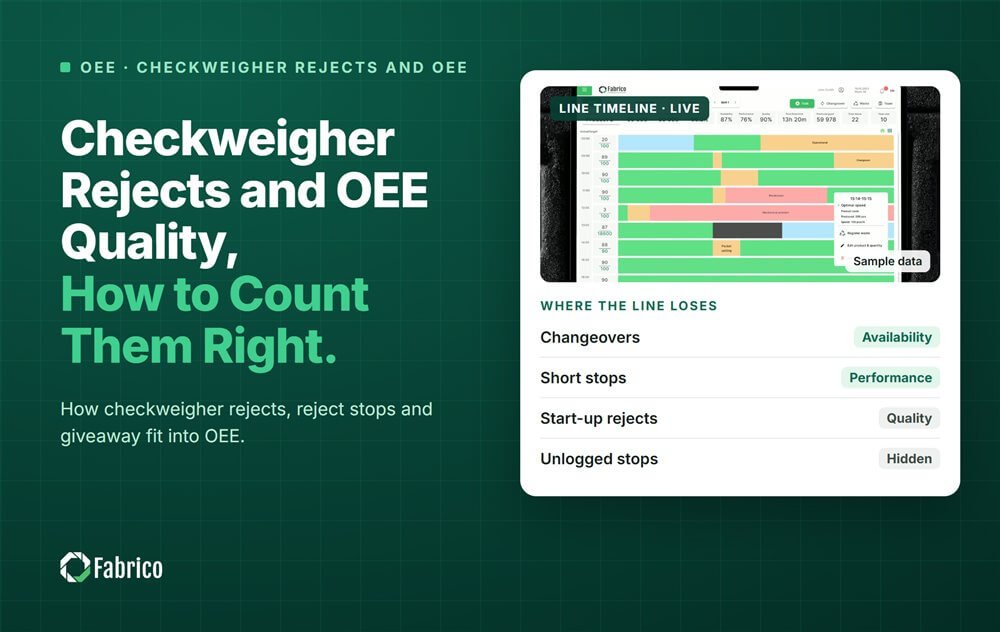
Checkweigher Rejects and OEE Quality: How to Count Them Right

Key takeaways
- Underweight and overweight rejects reduce Quality.
- Reject bin full and repeated reject stops reduce Availability.
- Write down your rule for rechecked packs, so Quality is counted the same way on every shift.
- Giveaway is invisible to OEE because overfilled packs are good packs.
- Price giveaway separately: grams over target x packs x product cost.
A checkweigher reject counts against OEE Quality: the pack was made, but it is not good. A reject stop, when the checkweigher stops the line because the reject bin is full or too many packs failed in a row, counts against Availability. Overfill, or giveaway, passes the checkweigher as good and does not show in OEE at all, even though it costs money every shift.
Fabrico, an OEE and light MES platform, logs stops automatically and shows OEE live by line and shift, rejects included, so checkweigher rejects and reject stops sit next to each other. This guide shows where each checkweigher event belongs in OEE, how to code the stops, and how to put a price on the giveaway that OEE misses.
Where does the checkweigher sit in OEE?
Quality in OEE is good count divided by total count. The checkweigher is often the place where "good" is decided for weight: every pack outside the limits is pushed off the line.
- Underweight rejects: packs below the allowed weight. Always a Quality loss.
- Overweight rejects: packs above an upper limit, where the line has one. Also a Quality loss.
- Rechecked packs: some plants reweigh rejects and return the good ones. Decide whether they count as good or as rework, write the rule down, and keep it.
The checkweigher is not always the last word on quality. Metal detectors, vision checks and seal checks reject packs too. Keep each reject source separate so you know which one is growing. For the formulas, see our guide to how to calculate OEE, and for scrap in general, scrap rate.
What counts as a reject, a stop and a loss?
| Checkweigher event | OEE factor | Note |
|---|---|---|
| Underweight reject | Quality | Count it as a reject, by product |
| Overweight reject | Quality | Only where an upper limit is set |
| Reject bin full, line stops | Availability | A routine problem: emptying, not the machine |
| Too many rejects in a row, line stops | Availability | Usually a filler or doser problem upstream |
| Checkweigher fault | Availability | A machine stop on the checkweigher itself |
| Calibration or test weights | Planned, if scheduled | Measure it and keep it in its own code |
| Giveaway (packs over target, still good) | None | Money lost, invisible to OEE |
Why does giveaway not show in OEE?
Giveaway is product packed above the declared weight. It is legal and often intentional: in Europe, the e-mark average quantity rules cover packs up to 10 kg filled on average weight, and plants set the filler or doser target above the declared weight to stay safely within them. The packs are good, so OEE counts them as good.
But every gram above what you need is product given away for free. On a line that packs millions of kilograms a year, even a small overfill adds up to a large yearly sum, and it never appears in an OEE report. Track it next to OEE, not inside it. The worked shift below puts a number on it.
How should checkweigher stops be coded?
- Reject bin full: a routine stop. The fix is an emptying routine or a bigger bin, not maintenance.
- Consecutive reject stop: the checkweigher stopped the line after repeated rejects. The note should say underweight or overweight, because the cause is usually the filler or doser upstream.
- Checkweigher fault: a fault on the machine itself.
- Calibration: scheduled checks with test weights, coded as planned if they are planned.
- Starved or blocked: charged to the machine that stopped first.
Most of these stops are short, which is why they rarely reach a paper log. Our guide to micro stops explains why short stops add up.
What does one shift at the checkweigher look like?
Sample line (illustrative numbers, not a customer): a snack bagging line making 150 g bags, 46,000 bags weighed in one shift. Product costs $6.00 a kg, or €6.00 in a euro plant.
| Event | Count or minutes | Where it goes |
|---|---|---|
| Bags weighed | 46,000 | Total count |
| Underweight rejects | 600 | Quality |
| Overweight rejects | 140 | Quality |
| Good bags | 45,260 | Good count |
| Reject bin full, 3 stops of 4 minutes | 12 minutes | Availability |
| Consecutive underweight stops, 5 of 2 minutes | 10 minutes | Availability |
| Average weight of good bags | 153 g (3 g over target) | Giveaway, outside OEE |
- Quality at the checkweigher: 45,260 / 46,000 = 98.4%.
- Reject stops: 12 + 10 = 22 minutes of Availability loss, 12 of them only because the bin was not emptied in time.
- Giveaway: 45,260 bags x 3 g = 135.8 kg of free product, x $6.00 = about $815 a shift. Over 750 shifts a year: about $611,000, or €611,000.
- The OEE report shows a good Quality figure. The biggest money loss at this machine is not in it.
How do you reduce rejects and giveaway?
- Set the fill target against measured variation, not against habit. The less your fill weight varies, the closer to the declared weight you can safely run.
- Fix the variation at the filler or doser, because that is where both underweight rejects and giveaway start. Our guide to VFFS machine OEE covers the bagger side.
- Use the checkweigher's trend, where your equipment supports it, to adjust the filler before packs go out of limits.
- Empty the reject bin on a routine, or size it for the shift.
- Calibrate on a schedule and code it as planned.
- Report giveaway in money next to OEE on the weekly board.
Where Fabrico fits
Fabrico is a computer vision enabled Manufacturing Performance Platform. OEE and light MES come first, with computer vision on stops.
- Automatic downtime logging, including short reject stops at the checkweigher.
- OEE live by line and shift, with rejects next to stops.
- The operator confirms the reason in one tap, so bin full and consecutive rejects get different codes.
- Every loss priced in money and ranked, stops and rejects together.
- One view across plants for the same product on different lines.
You start with a pilot on one line, with a baseline and a decision date agreed in advance. There is no free plan and there are no tiers: each plant gets a quote. See how stops are captured on our computer vision OEE page.
Frequently asked questions
Do checkweigher rejects count in OEE?
Yes. Rejected packs reduce the Quality factor: good count divided by total count.
Is a checkweigher reject stop Availability or Quality?
The rejected packs are Quality. The minutes the line stood still because of the reject stop are Availability.
Does giveaway count in OEE?
No. Overfilled packs pass as good, so OEE does not see them. Track giveaway in money next to OEE.
How do I calculate giveaway cost?
Multiply the average grams over target by the number of good packs and by the product cost per gram or kilogram.
Should rechecked packs count as good?
That is a plant rule. Decide it, write it down, and use it on every shift and every line so Quality is comparable.
See your checkweigher's losses in a demo
Bring one line and a week of rejects and stops. We will show where they land in OEE and what they cost.
Latest from our blog


Real Fabrico tiles, sample data.