

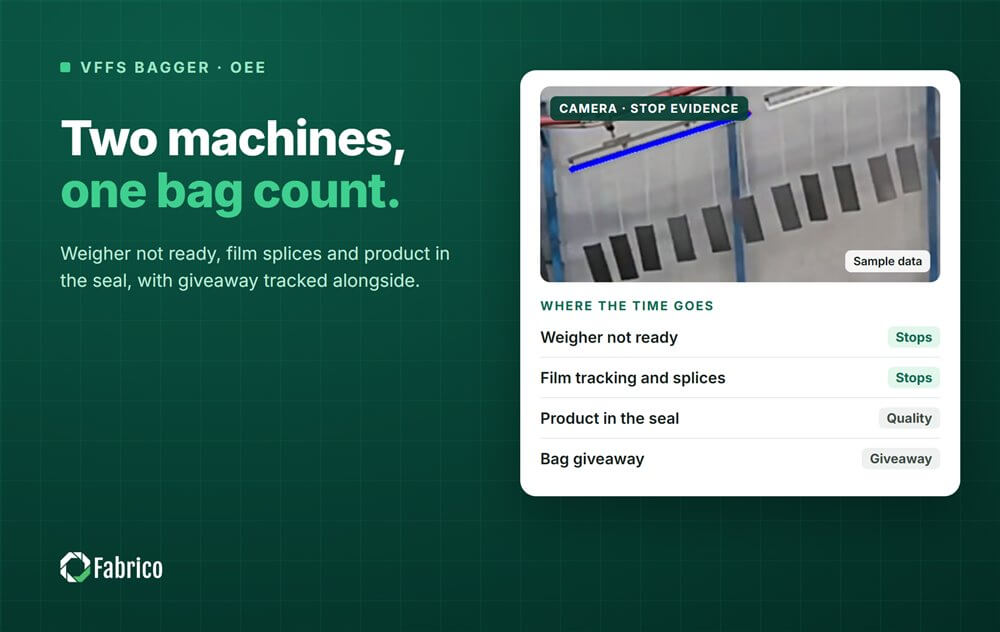

The bagger on the snack line waits. The jaws are open, the film is threaded, and the multihead weigher above it has not released a dose for a few seconds because the product feed is running thin. On the PLC the VFFS is running. On the OEE report the lost seconds appear as a lower Performance figure, with no cause attached.
A vertical form fill seal (VFFS) bagger and the weigher on top of it make one bag together. This guide covers how to measure OEE for the pair, the bag cycle and rated speed, film tracking, product in the seal, changeovers of bag length and film, and how giveaway links to the numbers.
On most snack, frozen and confectionery lines the VFFS sits under a multihead weigher. The weigher combines product from several heads to hit the target weight and releases a dose down the forming tube. The VFFS pulls film over the forming collar and tube, makes the back seal, and closes and cuts the bag with the cross jaws as the dose falls.
The two machines handshake on each bag: the bagger waits for the weigher's dose, and the weigher waits for the bagger to be ready. So the bag is the unit. OEE for the pair is measured at the bag: bags made, good bags, and the time the pair was planned to make them. Each stop is then charged to the machine that caused it: weigher, bagger, product feed or downstream.

| Area | Typical stops and losses | Charge to |
|---|---|---|
| Product feed to the weigher | Low product, bridging in the feed, seasoning drum or conveyor stop | Upstream product handling |
| Weigher | Bucket or door fault, heads not filling, doses out of range | Weigher |
| Film unwind | Reel end, splice failure, film break | Bagger |
| Film tracking | Film walking on the tube, print mark lost | Bagger |
| Jaws and seals | Product in the seal, jaw temperature, knife fault | Bagger |
| Downstream | Checkweigher, metal detector or case packer backed up | Downstream (blocked) |
| Changeover | Bag length, film, forming set, product | Availability, minutes over standard |
Weigher not ready deserves its own code. A few seconds of waiting per bag never looks like a stop, yet over a shift it can be one of the pair's biggest losses. Our guide to micro stops on packing lines shows how short waits add up.
A VFFS makes one bag per cycle, and the cycle has to fit the dose falling down the tube, the jaws closing, the seal dwell and the cut. Bag length, product and film decide how fast that can go, and the weigher decides how fast doses come. So the rated speed is the bags a minute the pair can make for that product and bag size, from the nameplate or the maximum demonstrated rate, whichever is lower for the pair.
Do not use the weigher's top speed or the bagger's top speed on its own, and do not use a good shift's average. If Performance ever reads above one, the rate is wrong. Our guide to OEE calculation covers the formula step by step.
Film stops on a VFFS are like those on any film machine: reel ends, splice failures and film breaks, each with its own code. Film tracking is more specific: the film can walk on the forming tube, and printed film needs the print mark read so the jaws seal between images.
Product in the seal is the VFFS quality problem. Product that falls late, fines and dust, or pieces that bounce up into the seal area get caught in the cross seal, and the bag leaks. On nitrogen-flushed snack bags a leaking bag loses its gas, so it is a reject even if it looks closed. Leakers that rise with one product or after a product change point to dose timing and product behaviour rather than the jaws.
A VFFS changeover comes in levels. A bag length change is often a setting on the bagger and a target change on the weigher. A film change means a new reel, threading and registration. A bag width change usually means a new forming set, collar and tube. A product change may need the weigher cleaned, and an allergen change needs a validated clean.
Measure each one from the last good bag to the first good bag at rated speed, set a standard per type and code the minutes over it. Keep the film path drawn on the machine and the settings stored per product, so the first bags after a change are good bags. Our guide to changeover time covers how to measure and cut it.
Giveaway is product packed above the declared weight. A bag with, for example, 152 grams in a 150 gram pack passes the checkweigher, so OEE counts it as a good bag, yet each gram over is product given away.
The weigher and the checkweigher already measure it. Track average fill against declared weight per product and shift, and price it next to OEE. Targets depend on measured fill variation and the legal rules of the market, so lowering giveaway is a weigher and process decision, not a setting to cut blindly. Our guide to giveaway and overfill as a quality loss covers the method.
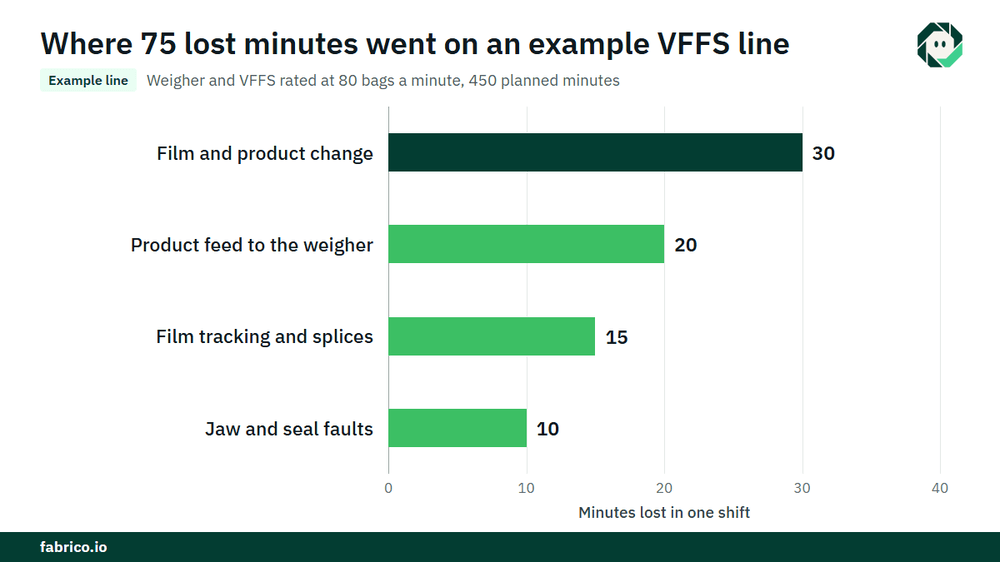
Sample line (illustrative numbers, not a customer): a weigher and VFFS rated at 80 bags a minute for a 150 gram snack bag, with 450 minutes of planned production time.
The OEE figure for this shift does not move by a single point because of giveaway. The money does, which is why it belongs on the same report.
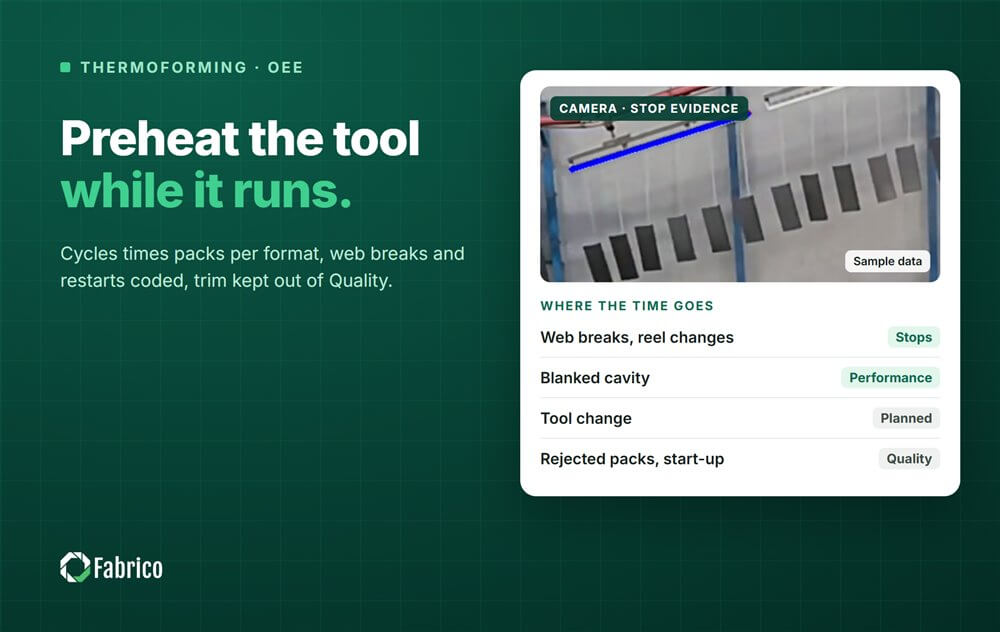
The bagger PLC knows its faults, its film sensors and its counts; the weigher knows its heads and its doses. Neither sees product bridging in the feed or a bag with product caught in the seal. Where a camera watches the weigher feed or the jaws, the clip shows what happened before the stop and the operator confirms the reason in one tap.
Fabrico is a computer vision enabled Manufacturing Performance Platform. OEE and light MES come first: automatic downtime logging for the weigher and bagger, so weigher not ready and film stops are counted, and OEE live by line and shift.
You start on one line, with a baseline and a decision date agreed in advance. There is no free plan and there are no tiers: each plant gets a quote. See how a stop gets its evidence on our computer vision for OEE page.
Measure at the bag. Availability is run time over planned production time, Performance is bags made over what the weigher and bagger could make at their rated speed for that product, and Quality is good bags over bags made.
Yes. The pair makes one bag together, so measure OEE for both at the bag, then charge each stop to the weigher, the bagger, the product feed or downstream.
Most often product caught in the cross seal: late falling product, fines, dust or pieces that bounce up. Jaw temperature, seal dwell and film quality are the other usual suspects.
Not in standard OEE, because an overweight bag is a good bag. Track it in grams per bag and price it next to OEE, so the line sees both.
It depends on bag size, product, film and the weigher. Use the rated speed the pair can reach for each product, from the nameplate or the maximum demonstrated rate, and hold it under change control.
Bring one line and its current downtime log. We will show its weigher waits, film stops and giveaway, priced in money.


 Login
 Blog