

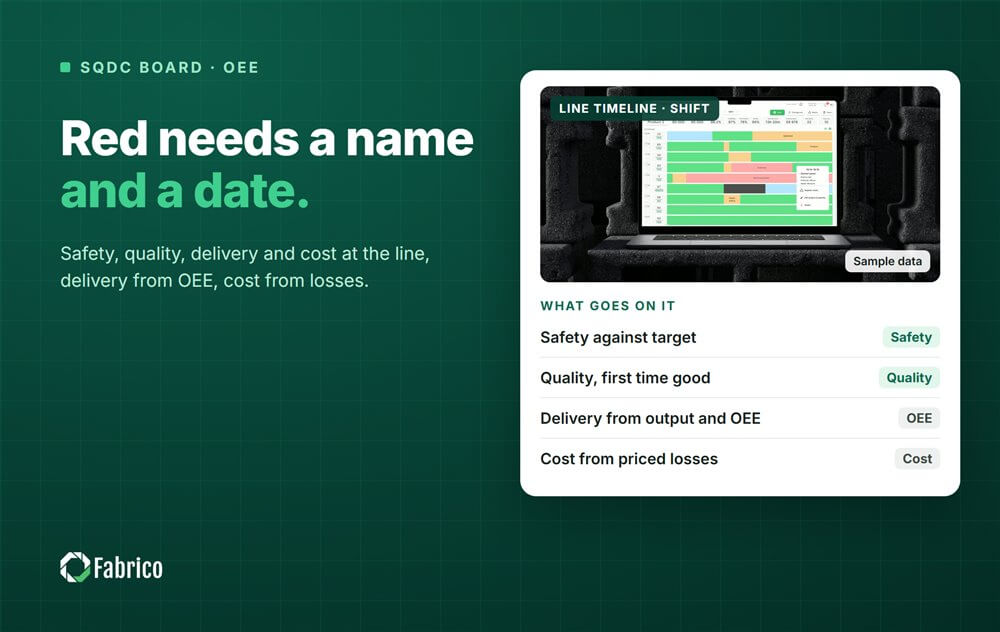

It is 07:30 at line 5. The team leader and four operators stand at the board. Safety is green. Quality is red, with a label complaint from a customer. Delivery says the line missed plan, and the cost row holds an OEE figure nobody in the group can turn into a task. Eight minutes later the meeting ends, and nobody owns the miss.
An SQDC board is meant to do the opposite: put the few numbers that matter where the work happens, every morning, and turn each red mark into an action. The board itself is simple. Feeding the delivery and cost rows with numbers people trust is the hard part.
This guide covers what goes on each row, how OEE and downtime feed delivery and cost, a worked day on the board, how to run the tier 1 meeting and the mistakes that turn the board into wallpaper.
SQDC stands for safety, quality, delivery and cost. It is a visual management board at the line, used in lean daily management for the tier 1 meeting: operators and the team leader, a few minutes at the start of the shift, reviewing yesterday and deciding what to do today. Problems the line cannot solve go up to tier 2, the supervisors and support functions, usually shortly after.
Plants add letters to fit their priorities: SQCDP adds people, SQDCM adds morale. The principle stays the same: a few rows, in a fixed order, with safety first. Our guide to the daily OEE meeting covers how the tier 1, tier 2 and tier 3 meetings connect.

| Row | Typical measures | Where the number comes from | Typical action |
|---|---|---|---|
| Safety | Incidents, near misses reported, open safety actions | The plant's own safety reporting | Fix the hazard, close the action |
| Quality | Internal rejects, startup rejects, holds, customer complaints, first pass yield | Reject counters, QC records, complaint log | Containment, check settings, root cause |
| Delivery | Good output against plan by shift, OEE, gap in units and minutes | Line counts and the OEE system | Attack the top downtime reason behind the gap |
| Cost | Losses priced in money: downtime, slow running, scrap, overtime | Lost minutes times the agreed value per minute, scrap at material cost | Pick the most expensive loss for an action |
Each row needs a target, yesterday's result, a colour and room for one or two actions. A small trend for the last few days helps the team see whether a red is a one-off or a pattern.
Safety comes first on the board and first in the meeting, on purpose. It shows that the plant puts people before output. Most boards use a simple calendar of the month, coloured by day, plus a list of reported near misses and the actions on them.
This row belongs to the plant's own safety process and its people. It is fed by the plant's safety reporting, not by production software, and nothing in this article changes that. What matters for the meeting is that every reported hazard gets an owner, and that reporting a near miss is thanked, never punished.
Quality on the board covers what the line made wrong yesterday and what came back from customers. Count internal rejects and startup rejects after changeovers separately: the first point to the process, the second to the changeover. First pass yield is good parts made right the first time divided by total parts, with rework counted as not good.
A customer complaint goes on the board the day it arrives, with containment as the first action. The detail of the root cause lives elsewhere, but the board shows that someone owns it.
The delivery row answers one question: did the line make what was planned? Show good output against plan by shift, the gap in units and the same gap in minutes at ideal rate. Then show the reason behind the gap, taken from the downtime record, so the discussion starts from a fact.
OEE belongs here as the explanation, not as the headline. A line that misses plan with Availability down points to stops. A line that misses with Performance down points to micro stops and slow running. If the line runs an hour by hour production board, the delivery row is its daily summary.
A cost row that shows a budget variance from finance a month late does nothing at a tier 1 meeting. What the team can act on is yesterday's losses priced in money: lost minutes times the agreed value of a minute, plus scrap at material cost. The value of a minute is agreed once with the controller, usually the contribution margin at the constraint when the plant can sell what it makes.
Priced losses turn the cost row into a ranking. The team sees which loss cost most yesterday, which is not always the longest one. Our guide to the value of one OEE point shows how to agree the numbers.
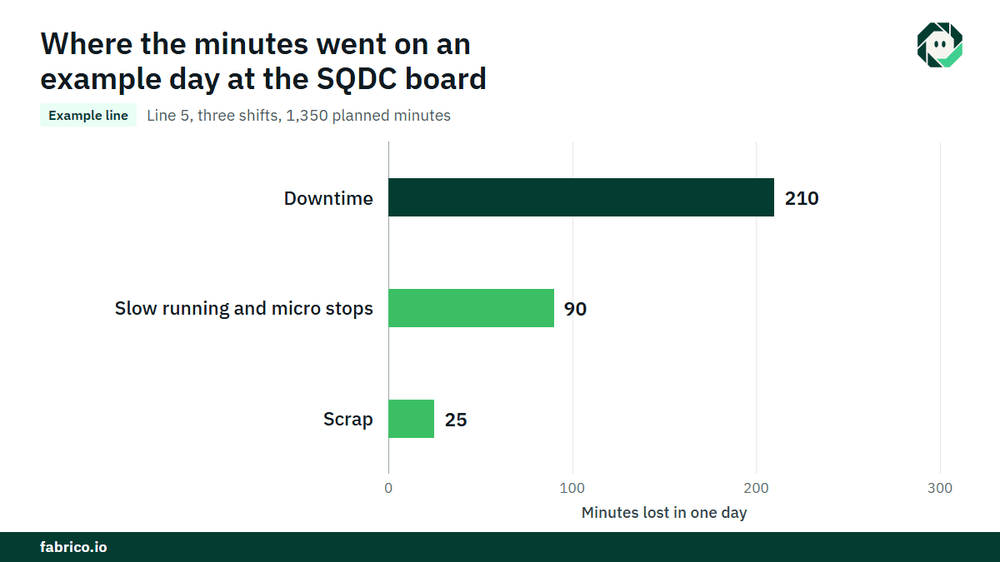
Sample line (illustrative numbers, not a customer): line 5 runs three shifts with 450 planned minutes each, 1,350 minutes a day. The ideal rate is 60 units a minute and the plan is set at a planned OEE of 80%: 1,350 x 60 x 0.80 = 64,800 good units. Each unit carries $0.25 of contribution, €0.25 in a euro plant, so a lost minute is worth 60 x $0.25 = $15 (€15). Material in a scrapped unit costs $0.20 (€0.20).
The delivery row shows 61,500 against a plan of 64,800, a gap of 3,300 units, which is 55 minutes at ideal rate, with filler jams named as the top reason. The cost row shows the day's losses: downtime 210 x $15 = $3,150, slow running 90 x $15 = $1,350, and scrap 25 x $15 = $375 plus 1,500 x $0.20 = $300 of material, $675 in all. The day cost $5,175 (€5,175), and the filler jams alone were 120 x $15 = $1,800 (€1,800). That is the action for today.
Keep it standing, at a fixed time, at the board, and short, about ten minutes. The order never changes: safety, quality, delivery, cost, then open actions.
The team leader runs the meeting, but the operators should do most of the talking about their line. The questions are about the process, never about who was on shift.
A paper board is hard to ignore and easy to write on. Its weakness is the numbers: someone has to collect output, stops and rejects before the meeting, often from several places, and the cost row is rarely filled at all.
The practical answer is both. Fill the delivery and cost rows from line data automatically, on a screen at the board or a printout, and keep the discussion, the actions and the colours on the board itself. The screen supplies the facts. The board holds the decisions. For problems that cannot wait until the next morning, a digital andon with escalation and response times covers the hours in between.
Fabrico is a computer vision enabled Manufacturing Performance Platform. On an SQDC board it feeds the delivery and cost rows: OEE and light MES first, with OEE live by line and shift and automatic downtime logging that names the stops behind a missed plan.
The operator confirms the reason in one tap, and where a camera watches the station, a camera clip is kept as evidence for a stop, so the team at the board can look at the jam instead of arguing about it. Losses are priced in money and ranked by money, which is exactly what the cost row needs. When an action is a repair, a work order goes to the right technician with its cost. Groups get one view across plants, and you can start on one line.
The safety row stays the plant's own: Fabrico is not a safety system and does not feed that row. There is no free plan and there are no tiers: each plant gets a quote.
Safety, quality, delivery and cost. Some plants add P for people or M for morale, as SQCDP or SQDCM.
For each row, a target, yesterday's result, a colour, a short trend and the open actions with owners and dates. Keep it to one or two measures per row.
About ten minutes, standing at the board at the start of the shift. Anything that needs longer is escalated to tier 2 or handled after the meeting.
Good output against plan by shift, with the gap in units and in minutes, and the top downtime reason behind it. OEE explains whether the gap came from stops, speed or rejects.
Yesterday's losses priced in money: lost minutes times the agreed value per minute, plus scrap at material cost, with the most expensive loss highlighted for action.
Bring a photo of your current board to a demo. We will show the same line with delivery and cost filled from machine data, priced in money.


 Login
 Blog