

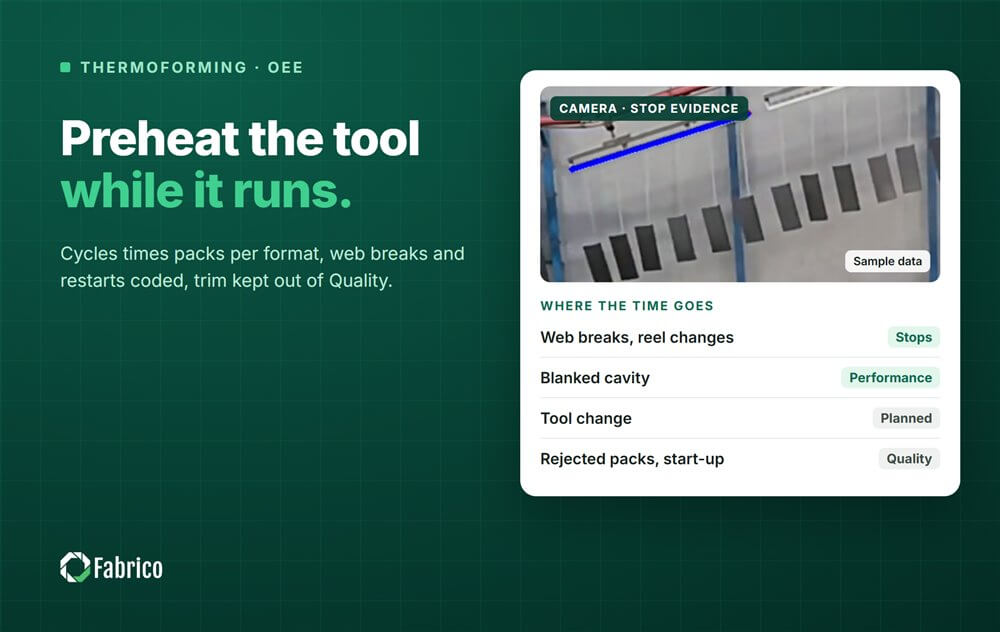

The bottom web broke at the forming station for the second time this shift. Threading it back took twelve minutes, and the first forty cycles after the restart went to scrap because the forming had not settled. The OEE report shows twelve minutes of downtime. The scrap bin shows the rest, and nobody adds the two together.
Thermoforming lines run a web through heat, form, fill, seal and cut in one machine, so a fault in one station stops them all. Losses come as web breaks, tool changes, short jams at the outfeed and packs that are formed, sealed or cut wrong. This guide covers the two kinds of thermoformer, where the time goes, the ideal rate, typical stops, web breaks, tool changes, trim scrap and quality, data sources and a worked shift.
A form fill seal thermoformer makes the pack and fills it in one machine. It forms cups or trays from a bottom web, fills them with product such as yogurt, desserts, sliced meat or cheese, seals a top web over them, and cuts the packs apart. Packs for fresh meat and cheese often get an evacuation and gas flush before sealing.
A packaging thermoformer makes empty cups, trays or lids from sheet or roll stock for another line to fill. It heats, forms, trims and stacks. The OEE logic is the same for both: one ideal rate per format, the same three factors, and the same question of where trim belongs. Our guide to OEE in plastics manufacturing covers the wider family.

Follow the web. It comes off the reel through a splice point and is gripped at its edges by the chain that indexes it through the machine. The heating station softens it, with contact plates or radiant heaters. The forming station shapes it in a die with compressed air or vacuum, sometimes with a plug assist. On a form fill seal machine, the product is dosed or loaded, the top web comes in, kept in register by a print mark sensor, and the sealing station closes the packs. Cutting separates them with punches or knives, the trim skeleton is wound up or shredded, and the packs leave on the outfeed.
Time is lost at the reel, at the heaters, in forming, at the seal, at the cutter and at the outfeed, where packs that do not transfer cleanly jam the stacker or the conveyor.
Each cycle makes a block of packs: a tool with 4 across and 3 rows makes 12 per cycle. The ideal rate is rated cycles per minute times packs per cycle. The cycle rate depends on the format: a deeper draw needs more heating and forming time, and a heavier web or lid film needs more sealing time. Take the OEM rating for that format, or the best speed the machine holds for a full hour on it.
If a cavity is blanked off because of a damaged insert, keep the ideal at the full count. The machine runs, but makes fewer packs each cycle, so the loss shows in Performance and needs its own code. Lowering the ideal to the working cavities hides a broken tool.
| Station | Typical stop or loss | Usual cause | OEE factor |
|---|---|---|---|
| Bottom web unwind | Reel end, splice fault | Reel change, splice not taken | Availability |
| Web transport | Web break, web out of the chain | Thin spots, tension, chain grippers | Availability, then start-up scrap |
| Heating | Heater fault, uneven forming | Failed heater zone, wrong profile | Availability, Quality |
| Forming | Thin corners, incomplete forming | Temperature, air or vacuum, plug set-up | Quality |
| Sealing | Leakers, seal off register | Product on the flange, top web registration, seal temperature | Quality, Availability |
| Cutting | Miscut, packs joined, fine plastic strands | Blunt punch or knife, set-up | Quality, Performance |
| Outfeed and stacking | Jam, packs fall | Transfer timing, miscut packs, downstream stop | Performance, Availability when blocked |
Set a stop cutoff and keep it. Long stops go to Availability with a reason, short ones to Performance. Outfeed jams are usually short and frequent, which makes them easy to underestimate.
A web break means stopping, cutting out the damaged web, threading the new end through the chain and the stations, and restarting. The minutes are visible; the scrap after the restart often is not, because the heating and forming need cycles to settle. Code web breaks by where they happened, forming, chain or sealing, since each points to a different cause.
Reel changes on machines without an automatic splice stop the line. Give them their own code, and check that the next reel is at the unwind before the old one runs out. A top web that drifts out of register gives misprinted or off-centre lids, which are Quality losses even when the machine never stops.
A format change on a thermoformer can mean the forming tool, the sealing tool and the cutting tool, each heavy enough to need a lift or a trolley, plus the recipe, the web and the lid film. Count it from the last good pack of the old format to the first good pack of the new one at rated speed.
The SMED method fits well: separate the steps that need the machine stopped from those that can be done while it runs. Preheating the next sealing tool off the machine, staging tools on trolleys at the right height, and quick clamps are the usual moves. Our guide to SMED explains the method, and our guide to start-up and shutdown losses covers the scrap after the change.
OEE counts packs, so trim needs care. The skeleton left after cutting is designed into the format: it would exist on a perfect day. It is a material yield figure, priced in money on its own, and not part of OEE Quality. Reducing it is a tool design question.
The OEE Quality loss is the packs that were made and are not good: thin or incomplete forming, leakers, seals off register, miscut packs, wrong weights on filled packs, and the packs scrapped while the machine settles after a stop or a tool change. That last group is start-up loss, one of the six big losses, and it is often the biggest. Count it by cycle after each restart. Our guide to the OEE Quality factor explains what counts as good.
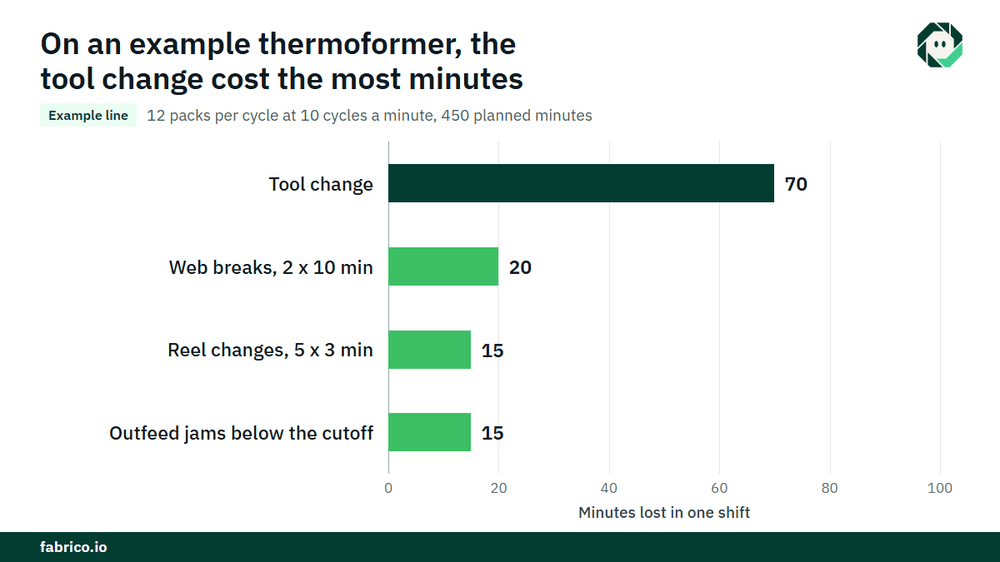
Sample line (illustrative numbers, not a customer): a form fill seal thermoformer with 12 packs per cycle, rated at 10 cycles a minute, so the ideal rate is 120 packs a minute. The shift has 450 minutes of planned production time, so 54,000 packs are possible. Stops above the 2-minute cutoff: a tool change of 70 minutes, two web breaks of 10 minutes (20) and five reel changes of 3 minutes (15), 105 minutes in all. Run time is 345 minutes, so Availability = 345 / 450 = 76.7%.
At 120 a minute, 345 minutes should give 41,400 packs. The counter shows 39,600, so Performance = 39,600 / 41,400 = 95.7%. The 1,800 missing packs are 150 cycles, or 15 minutes at full rate: thirty outfeed jams of about 30 seconds each.
The first 40 cycles after the tool change were scrapped, 40 x 12 = 480 packs, and seal and forming rejects add 312, so 792 packs are not good. The good count is 38,808 and Quality = 38,808 / 39,600 = 98.0%. OEE = 0.767 x 0.957 x 0.980 = 71.9%. Check: 38,808 good packs out of 54,000 possible is 71.9%.
Price it at a contribution of $0.15 a pack, €0.15 in a euro plant. The tool change cost 70 x 120 = 8,400 packs, $1,260 (€1,260). The web breaks cost 20 x 120 = 2,400 packs, $360 (€360). The start-up scrap is 480 packs, $72 (€72) of contribution plus the web, lid and product inside them. The designed trim is priced separately as material.
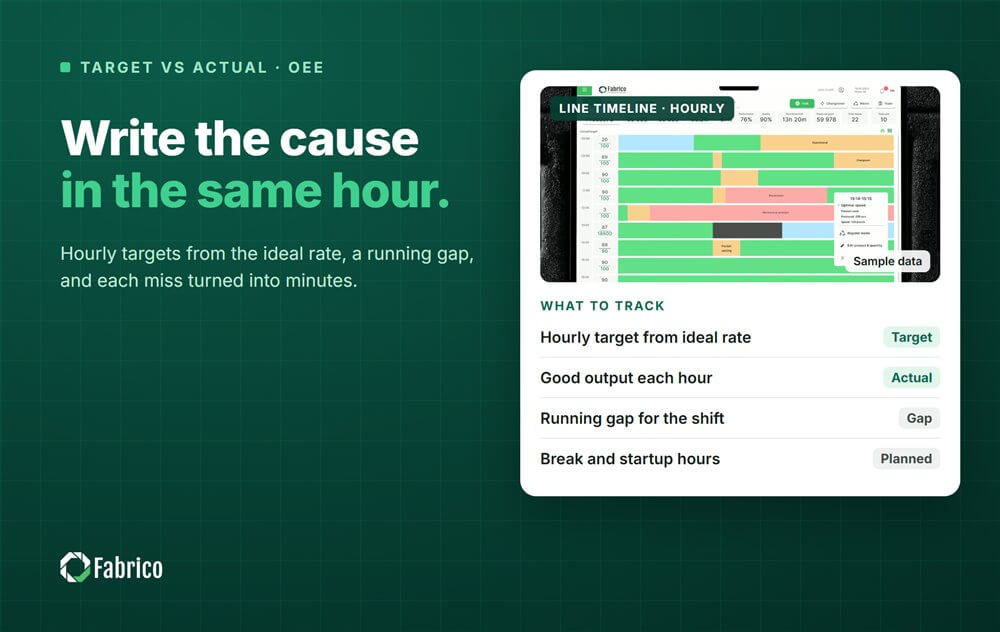
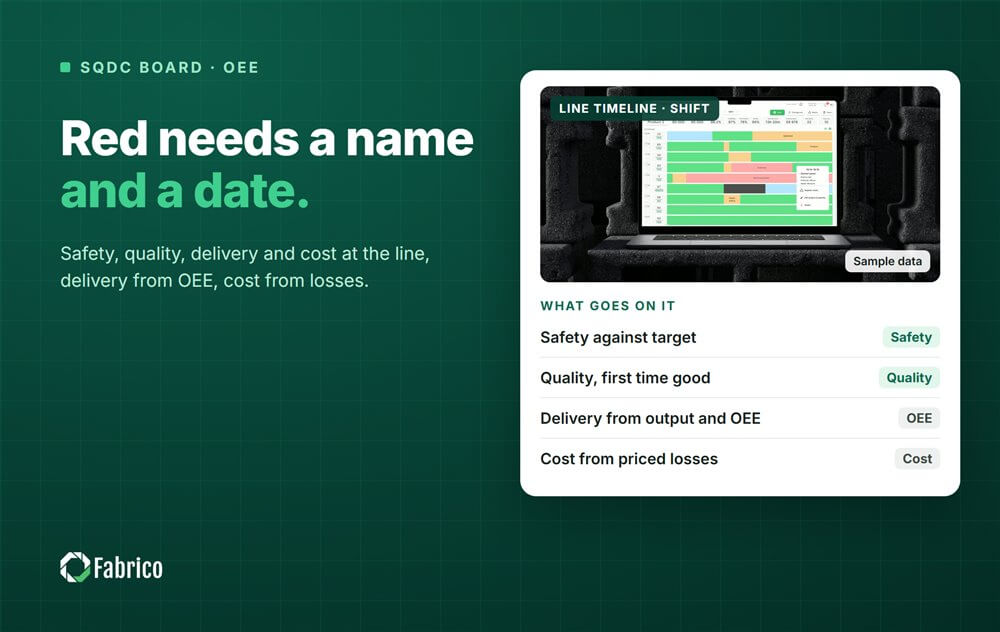
Fabrico is a computer vision enabled Manufacturing Performance Platform. On a thermoforming line it starts with OEE and light MES: automatic downtime logging from the machine signal and OEE live by line and shift, so web breaks, reel changes and tool changes are recorded without a paper log.
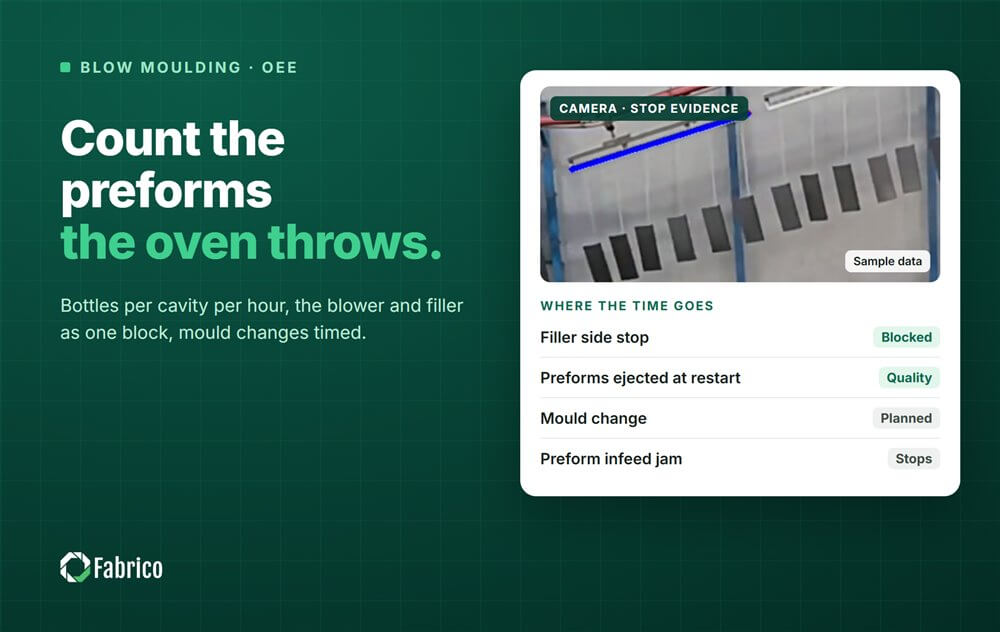
The operator confirms the reason in one tap, so a web break at the chain and a web break at the forming station get different codes. Where a camera watches the cutter or the outfeed, a camera clip is kept as evidence for a stop. The camera suggests the reason, the operator decides.
Losses are priced in money and ranked by money, so a tool change, a web break and the outfeed jams can be compared in one currency. A breakdown becomes a work order to the right technician with its cost. One view across plants compares the same machine type across sites, and you start on one line with a decision date agreed in advance.
There is no free plan and there are no tiers: each plant gets a quote.
Set the ideal rate as rated cycles per minute times packs per cycle for the format. Availability is run time over planned production time, Performance is packs made over run time times the ideal rate, and Quality is good packs over packs made.
The designed skeleton does not: it exists on a perfect day, so track it as material yield in money. Rejected packs and the packs scrapped after a restart or a tool change do count against Quality.
Usually thin spots or defects in the web, wrong tension, worn chain grippers or a splice that did not hold. Coding each break by where it happened shows which cause is yours.
Preheat the next sealing tool off the machine, stage all tools on trolleys at the right height, use quick clamps, and write down the settings for each format. Then measure to the first good pack at rated speed.
Bring one shift of machine data with a tool change. We will show where the web breaks, jams and start-up scrap sit, and what each costs.



 Login
 Blog