

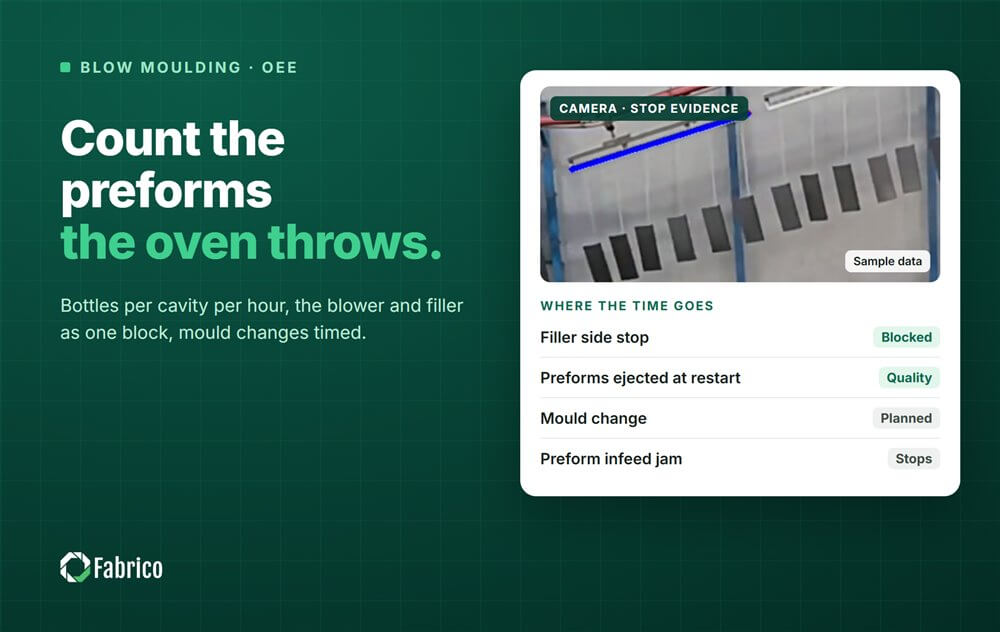

The filler stops for forty seconds to clear a fallen cap. On a stand-alone blower, the air conveyor would absorb it. On this blower-filler block, the blower stops too, and when it restarts the preforms that were waiting in the oven go to the scrap bin. One cap, two losses, and the block's OEE takes both.
Stretch blow moulding looks simple from the outside: preforms in, bottles out. The losses hide in the details, in the infeed rail, the oven profile, the moulds and the link to the filler. This guide covers where the time goes, how to set the ideal rate, the stand-alone versus block question, the typical stops, mould changes, rejects, data sources and a worked shift.
Preforms are tipped into a hopper, lifted by an elevator and lined up by a roller sorter onto the infeed rail. A star wheel loads them onto spindles that carry them through the oven, where infrared lamps heat them to a profile while they rotate. A transfer arm places each hot preform into a mould on the blow wheel, a stretch rod pushes it down, and pre-blow and high-pressure air form the bottle. The bottle leaves on an air conveyor to the filler, or straight into the filler on a block.
Time is lost at each step: preform jams on the rail, an oven lamp that fails, a transfer that drops a preform, a bottle that bursts in the mould, high-pressure air that cannot keep up, and on a block, each stop on the filler side.

The ideal rate is the rated output per cavity times the number of cavities. A machine with 12 cavities rated at 2,000 bottles per hour each has an ideal of 24,000 bottles an hour, or 400 a minute. Read it from the OEM's rating for that bottle format, because a larger or heavier bottle runs slower than a small water bottle.
Do not take a good day's speed as the ideal. If the machine runs below its rating on a format because the oven cannot heat that preform fast enough, that is a speed loss to know about, not a new ideal. Our guide to OEE in plastics manufacturing covers the same rule for other moulding processes.
A stand-alone blower feeds an air conveyor that holds bottles between it and the filler. A short filler stop fills the conveyor and the blower keeps running. A long one blocks the blower, which is lost time on the blower's record but caused by the filler. Code it as blocked, and our guide to starvation and blocking shows how to charge it to the machine that caused it.
A block removes the conveyor. The blower and filler run in step, so a stop on either side stops both. Measuring them as two machines makes little sense: they cannot run apart. Measure the block as one unit, with one ideal rate, and give each stop a code that says which side caused it, blower or filler. Then the loss Pareto still shows whether the problem is the oven or the capper.
The block has a second cost. On many blocks, the preforms sitting in the oven when the machine stops are ejected on restart, because their heat profile is no longer right. Every short stop on the filler side then costs a load of preforms as well as the time.
| Station | Typical stop or loss | Usual cause | OEE factor |
|---|---|---|---|
| Preform feed | Rail jam, sorter blocked | Deformed neck, wrong preform, dust or chips in the rail | Availability, or Performance if short |
| Oven | Lamp failure, heating fault | Lamp or module failure, ventilation, profile drift | Availability, then Quality |
| Transfer and blow wheel | Preform dropped, gripper fault | Worn grippers, timing | Availability or Performance |
| Moulds and blowing | Bottle burst, blow fault | High-pressure air, valve wear, preform defect | Availability, Quality |
| Bottle exit and inspection | Bottles rejected | Thin base, off-centre gate, poor wall distribution | Quality |
| Filler side of a block | Block stops | Filler or capper fault, bottles down | Availability for the block |
Set one stop cutoff for the machine. Stops above it are downtime in Availability with a reason. Shorter stops are booked in Performance. On a block, the short filler stops are often the biggest Performance loss on the blower, and they never show up as blower faults.
A format change swaps the mould shells and base moulds, and sometimes the stretch rods and the neck parts if the neck finish changes. The oven profile and blow recipe for the new bottle are loaded, and the machine runs until the first good bottle at rated output. On a block, the filler's format parts change too, so the block's changeover is the longer of the two plus whatever cannot run in parallel.
Split the steps into those that need the machine stopped and those that can be done while it runs: moulds staged and checked, tools at the machine, the recipe ready. Count the change from the last good bottle of the old format to the first good bottle of the new one, and set a standard per format. Our guide on how to reduce changeover time covers the method.
Quality on a blow moulder has two parts. The first is bottles rejected at inspection: thin or uneven walls, a weak base, a gate that is off centre, white streaks or haze from a preform heated wrong. Each one counts against the OEE Quality factor.
The second is preforms ejected on restart or at the oven exit. Agree before you start whether your counter includes them. If the count starts at bottles out, the ejected preforms vanish from OEE, and the scrap bin is the only record. Counting every preform that entered the oven makes them a start-up loss that the Quality figure shows. Our guide to cutting start-up and shutdown losses covers how to track them.
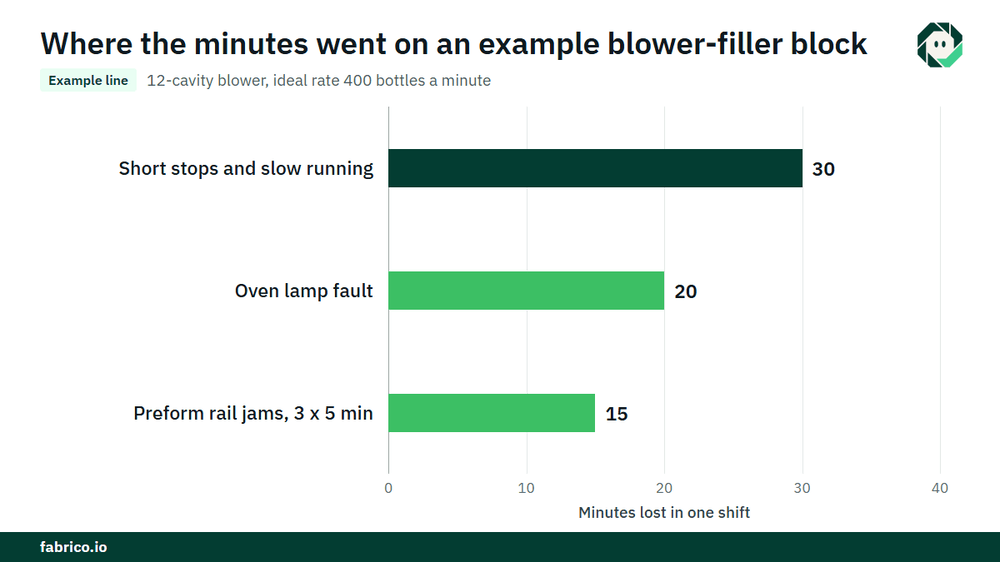
Sample line (illustrative numbers, not a customer): a 12-cavity blower in a block, rated at 2,000 bottles per hour per cavity, so the ideal rate is 400 bottles a minute. The shift has 450 minutes of planned production time. Stops above the 2-minute cutoff: three preform rail jams of 5 minutes (15) and one oven lamp fault (20), 35 minutes in all. Run time is 415 minutes, so Availability = 415 / 450 = 92.2%.
At 400 a minute, 415 minutes should give 166,000. The counter, which counts every preform that entered the oven, shows 154,000, so Performance = 154,000 / 166,000 = 92.8%. The 12,000 missing are 30 minutes at full rate: 25 filler-side stops of about a minute each (10,000) and slow running after restarts (2,000).
The shift had 29 restarts, each ejecting 60 preforms: 1,740 in all. Inspection rejected 1,340 bottles. That is 3,080 not good, so the good count is 150,920 and Quality = 150,920 / 154,000 = 98.0%. OEE = 0.9222 x 0.9277 x 0.9800 = 83.8%. Check: 150,920 good bottles out of 450 x 400 = 180,000 possible is 83.8%.
Price the filler-side stops. They cost 10,000 bottles of time at a contribution of $0.02 a bottle, $200 (€200 at €0.02), plus 25 x 60 = 1,500 ejected preforms at $0.03 each, $45 (€45). That is $245 a shift, €245 in a euro plant. Over 700 shifts a year it is $171,500, or €171,500, from stops that never appear as blower faults.
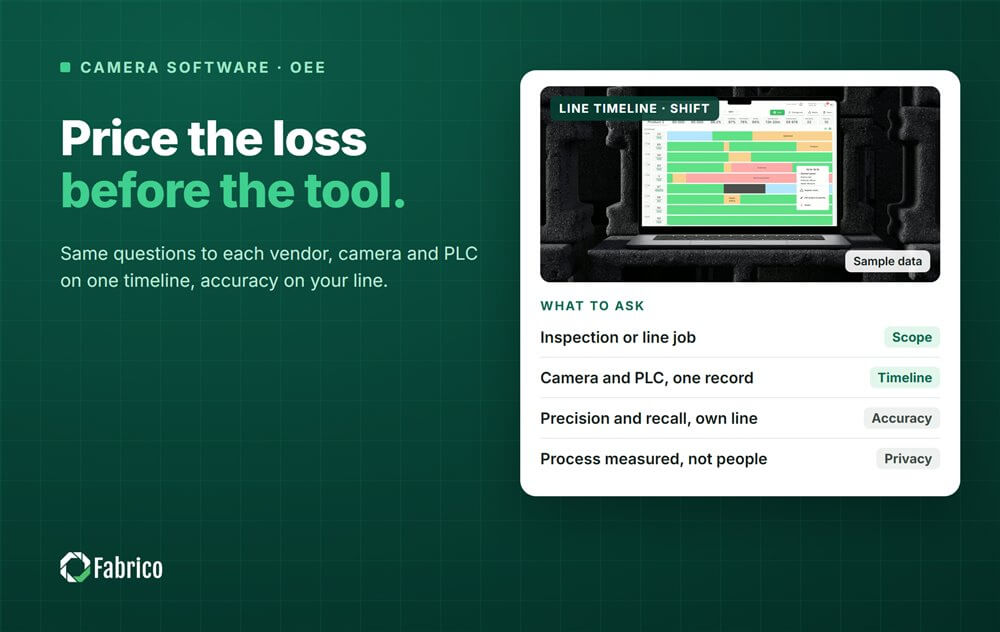
Fabrico is a computer vision enabled Manufacturing Performance Platform. On a blow moulding line it starts with OEE and light MES: automatic downtime logging from the machine signal, and OEE live by line and shift, so the short filler-side stops on a block are recorded with the long ones.
The operator confirms the reason in one tap, so each stop says which side of the block caused it. Where a camera watches the preform infeed, a camera clip is kept as evidence for a stop. The camera suggests the reason, the operator decides.
Losses are priced in money and ranked by money, so a preform jam and a capper fault can be compared in the same currency. A breakdown becomes a work order to the right technician with its cost. One view across plants compares blowers across sites, and you start on one line with a decision date agreed in advance.
There is no free plan and there are no tiers: each plant gets a quote.
Set the ideal rate as rated bottles per hour per cavity times the cavities, for that format. Availability is run time over planned production time, Performance is total count over run time times the ideal rate, and Quality is good bottles over the total count.
One. The two machines cannot run apart, so measure the block as a unit and code each stop with the side that caused it. The Pareto still shows whether the blower or the filler costs more.
They should. Count every preform that entered the oven, so preforms ejected on restart show up as a Quality loss instead of vanishing into the scrap bin.
Mostly the oven profile: preforms too cold or too hot give poor wall distribution, white streaks or haze. Preform defects, worn moulds and high-pressure air problems come next.
Bring one shift of data from your blower or block. We will show where the stops, the ejected preforms and the rejects sit, and what each costs.


 Login
 Blog