


 Login
 Blog

Cosmetics Manufacturing Software: What to Buy First, by Plant Size

In short: cosmetics manufacturing software is a small stack, not one product: an ERP for formulas and lots, and a light MES with OEE for the filling lines. The right first buy depends on where your plant hurts.
- Automated filling and cartoning lines lose hours to changeovers and stops: add a light MES with OEE next to the ERP.
- Formulas, batch records, lot tracing, expiry dates or stock are the pain: buy a cosmetics ERP or MRP first.
- Regulatory files and GMP documents are the pain: add a formulation or quality system.
- Fabrico is the light MES with OEE. It is not an ERP, it keeps no formulas or batch records, and we make no GMP claim about it.
Search for cosmetics manufacturing software and you mostly get ERP pages. That is fair: in our view most cosmetics makers need formulas, batches and lots under control first.
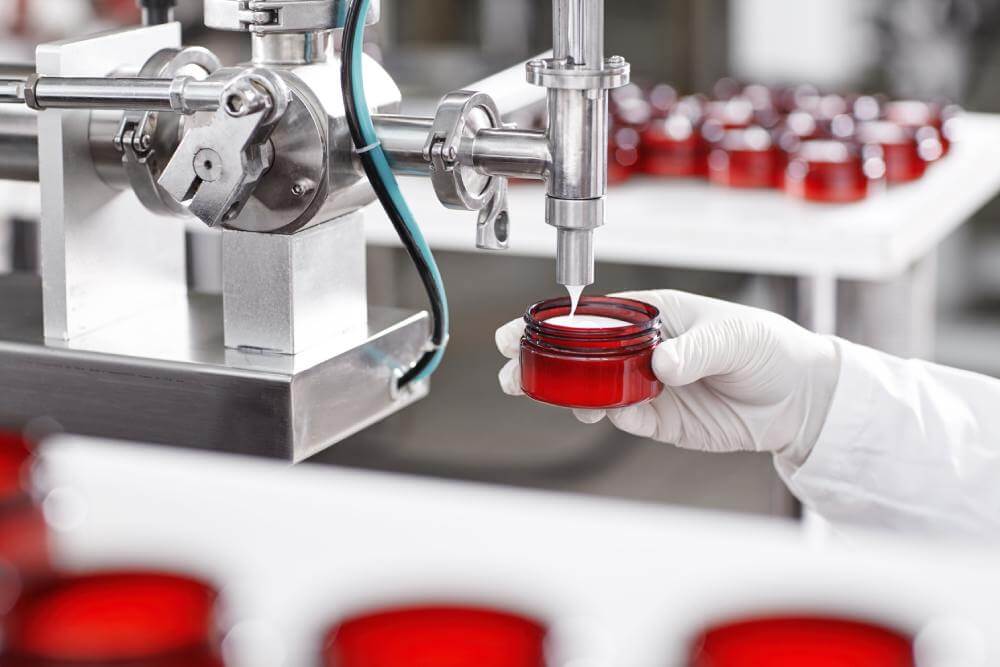
But a plant with filling, capping, labelling and cartoning lines has a second problem that an ERP does not see: where the line hours go.
We sell Fabrico, a light MES with OEE, so we have a side here. This page still says plainly when to buy something else first.
The map: what a cosmetics plant runs
Here are the kinds of software you will meet, what each one does, and the problem that tells you it is time.
| Software | What it does | You need it when |
|---|---|---|
| ERP or MRP with formulas | Formulas, batches, lot numbers, expiry dates, stock, purchasing, costs, orders | You cannot say which raw material lot went into which finished lot, or stock is a guess |
| Formulation and regulatory tool | Formula versions, ingredient checks, product files, label and artwork data | Launches wait on documents, or the same formula lives in five spreadsheets |
| Quality and GMP documents | Procedures, training, audits, complaints, corrective actions | An audit or a customer asks for proof and it takes days to collect |
| MES | Tracks orders on the shop floor: what ran, on which line, how it went | The ERP knows the plan but not what happened on the shift |
| OEE and production monitoring | Stops, speed and rejects per line, from the machines | Lines look busy, output is short, and nobody can say why |
| Planning and scheduling | Order sequence per line, with changeovers in mind | The schedule lives in one person's head or one spreadsheet |
| Warehouse | Locations, picking, scanning, pallets | Pickers lose time looking, or the wrong lot ships |
The names overlap: many ERPs include planning and a warehouse module, and an MES often includes OEE.
ERP and MRP: formulas, batches and lots
This is what most people mean by cosmetic manufacturing software, and in our view it is where most plants should start.
Software Connect's roundup of the category shows it. Its feature list includes "Formula Management" and "Lot Traceability and Recall Management", and its picks are mostly ERP, MRP or formulation products.
Here is how some suppliers describe their own products, read on 10 November 2026.
| Product | In its own words |
|---|---|
| BatchMaster ERP | "end-to-end lot traceability across raw materials, production batches, and finished goods" |
| Aptean Personal Care and Cosmetics ERP | "handles formulas, stability testing and label claims" |
| Katana | "Track lots, serial numbers, and expiry dates from supplier to customer." |
| Stocksmith (formerly Craftybase) | "Batches carry lot numbers in both directions" |
| Cosmetri Product Manager | "formulation, compliance checks, testing, packaging & cost, clean handoff to production" |
This is a sample of what each site says, not a ranking and not a test.
Fabrico does none of this.
Quality and GMP documents
Good manufacturing practice (GMP) is written into cosmetics law, so here is what the rules say and where to read them.
- EU: Article 8 of Regulation (EC) No 1223/2009 says "The manufacture of cosmetic products shall comply with good manufacturing practice".
- ISO 22716: the European Commission lists EN ISO 22716:2007, the guidelines on cosmetics GMP, as the harmonised standard for cosmetic products.
- US: under MoCRA, the FDA says "Manufacturers and processors must register their facilities with FDA and renew their registration every two years."
- US GMP: the same FDA page says MoCRA requires the agency to set GMP rules for cosmetics facilities, and that it "exempts certain small businesses from GMP, registration, and product listing requirements."
For software, that mostly means records. The FDA's older GMP self-inspection checklist asks whether records of each batch document the "Kinds, lots and quantities of material used."
That is a job for an ERP batch record plus a document system. One example is Cosmetri GMP, which its maker describes as "ISO 22716 workflows: internal audits, CAPA/SCAR, EDMS with SOP templates, complaints & recalls".
MES, OEE and production monitoring on the lines
An ERP tells you a batch was filled. It does not tell you that the line stood still for 40 minutes while someone looked for the right pump heads.
That is the job of an MES with OEE. OEE (overall equipment effectiveness) is availability x performance x quality, and our OEE calculation guide covers the full method.
Cosmetics lines run many products and pack sizes in short runs, so the losses look like this.
| Loss | What it looks like | OEE factor |
|---|---|---|
| Product change | Empty the hopper, clean and sanitise the filler, first-off check | Availability |
| Format change | New bottle or tube size, pump or cap, label, carton | Availability |
| Faults and jams | Cap feed, pump sorter, labeller, cartoner | Availability, or Performance if very short |
| Slow running | Speed cut for a thick or foaming product, plus very short stops | Performance |
| Rejects | Wrong fill weight, crooked label, missing code, leaking cap | Quality |
Very short stops rarely reach a paper log. Our guide to micro-stops shows how to count them.
Set the rated speed per product and pack size. One speed for a thin toner and a thick cream makes the performance number meaningless.
This page stays at map level. For the detail, see MES for cosmetics manufacturing, and for named tools see our comparison of OEE software for cosmetics and personal care.
Worked example: one filling line, four short runs
Example data, not a customer: a line fills and cartons 200 ml bottles. It runs four products in one shift, all in the same bottle, at a rated speed of 60 bottles a minute.
Planned time is 450 minutes: an 8 hour shift less a 30 minute break.
| Item (example data) | Value |
|---|---|
| 3 product changes, 30 minutes each | 90 minutes |
| Faults, jams and waiting for cartons | 40 minutes |
| Run time | 450 - 130 = 320 minutes |
| Bottles filled | 16,320 |
| Rejects | 320 |
| Good bottles | 16,000 |
- Availability (example): 320 / 450 = 71.1%.
- Performance (example): 16,320 / (320 x 60 = 19,200) = 85.0%.
- Quality (example): 16,000 / 16,320 = 98.0%.
- OEE (example): 0.7111 x 0.8500 x 0.9804 = 59.3%. Check: 16,000 good bottles / 60 a minute = 266.7 minutes, and 266.7 / 450 = 59.3%.
What this shift tells you
Changeovers took 90 minutes, a fifth of planned time and more than twice the faults and jams. That is the first thing to work on.
Still example data: say the team cuts each change from 30 to 20 minutes and all else stays the same. Run time becomes 350 minutes, so at the same 51 bottles a minute (85% of 60) the line fills 17,850 bottles, and 17,500 are good.
That is 1,500 more good bottles in the shift, and OEE goes from 59.3% to 64.8%.
The ERP saw four batches filled and all lots recorded. Nothing looked wrong there.
Planning, warehouse and maintenance
Planning and scheduling: with many short runs, sequence matters, because similar products and the same pack size together mean fewer and shorter changes. Fabrico does not do production planning or scheduling today.
Warehouse: if the ERP's stock module cannot keep up with locations and scanning, a warehouse system is the next step.
Maintenance: a maintenance system keeps work orders and machine history, and Fabrico includes a maintenance module as a complement. If that is your open question, we have a separate page on CMMS for cosmetics plants.
What to buy first, by plant size
Small brand, batches made by hand
You mix in pots or small vessels and fill by hand or with a bench filler. Your risks are lot numbers, formula costs and stock, so start with an inventory and batch tool built for small makers.
You do not need an MES or OEE software yet.
Growing brand or small contract filler
You have mixing vessels, semi-automatic fillers and more products every quarter. Buy an ERP or MRP with formulas, lots and expiry dates, and get your GMP documents out of shared folders.
Plant with automated filling and cartoning lines
You most likely have an ERP already. Your next gap is the line: changeovers, short stops and speed, on lines that cost real money per hour.
This is where a light MES with OEE earns its place.
Private label and contract manufacturers
You run other people's formulas and packs, so you change over more than a brand's own plant does. You need lot tracing per customer in the ERP, and you need real run rates per product.
If you quote a job at one speed and the line runs at another, only measured line data will show it.
How to choose: a short checklist
- Name the pain in one line. "We cannot trace a lot" and "line 3 is always behind" lead to different software.
- Check what you already own. Many ERPs have planning, quality or warehouse modules nobody switched on.
- Ask where the data comes from. For line software: a machine signal, or a person typing after the shift?
- Ask what it does not do. A good supplier can name the edge of the product without help.
- Decide which system owns each number. Lots live in the ERP, stops live in the line system, and two reports should never disagree.
Where Fabrico fits, and where it stops
Fabrico is a cloud-based light MES with OEE. In a cosmetics plant it belongs on filling, capping, labelling and cartoning lines with many short runs and changeovers.
- Stops: they come from the machine signal, through a PLC or a Fabrico IoT device. The operator adds the reason on a tablet or phone.
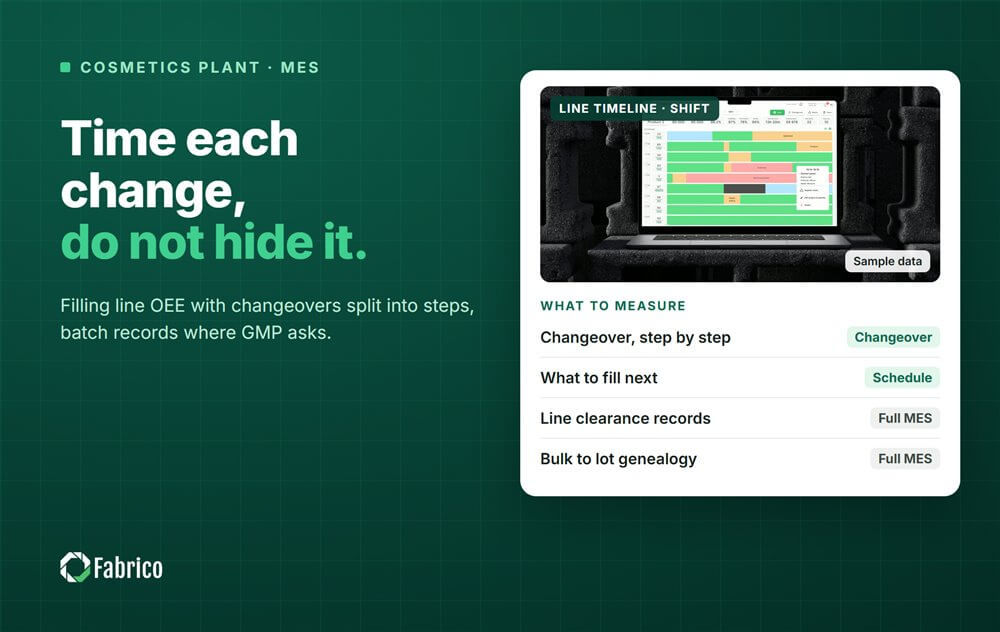
- OEE: availability, performance and quality per line and shift. A changeover shows up as a stop with its reason, so you can see its time.
- Parts: AI cameras (an add-on) count parts. You can open the camera video for that minute.
- Camera video: in the standard setup it is streamed, not stored in Fabrico. If cameras fit your line, ask us to show them in the demo.
What Fabrico does not do: it is not an ERP, so it has no formulas, recipes, batch records, lot genealogy, inventory or warehouse, and no lab or quality management system. Production planning and scheduling are not part of Fabrico today.
What we do not claim: we make no GMP, ISO 22716 or FDA claim about Fabrico.
Ficosota (also a Fabrico investor) raised OEE from 53.1% to 59.6% on 16 lines, June to September 2026, with monthly good output up 23.2%. That is one company, not a benchmark for your plant.
Want to see it on lines like yours? Book a demo or Contact us.
Who should buy something else
- Your pain is formulas. Versions, costs and ingredient lists need a formulation tool or a cosmetics ERP.
- Your pain is batch records or lot tracing. A recall would take days of paper today, and that is an ERP job.
- Your pain is regulatory documents. Product files, registrations and GMP procedures need a regulatory or quality system.
- Your pain is stock. You run out of caps or find expired bulk, and that is ERP and warehouse.
In all of these, Fabrico is the wrong first buy.
What people ask next
Is cosmetic manufacturing software the same as a cosmetics ERP?
Mostly, in how the term is used: the products sold under that name are largely ERP, MRP and formulation tools. A plant with automated lines usually adds line software next to the ERP, because the two answer different questions.
Does software make a plant ISO 22716 or MoCRA compliant?
No: software keeps records and documents in order, and your quality lead decides what the rules ask of your site. Start from the sources linked in the GMP section above, not from a supplier's page, ours included.
Do I need an MES if I already have an ERP?
Only if the shop floor is your open question. If the ERP shows the batch was made but not how the shift went, read MES for cosmetics manufacturing next.
What software does a private label cosmetics manufacturer need?
An ERP with lot tracing per customer first, then line data once you run automated lines. Short runs for many customers make changeover time and real run rates the numbers to watch.
Filling lines losing hours you cannot name? Book a demo or Contact us.
Related articles

Latest from our blog



Real Fabrico tiles, sample data.