


 Login
 Blog
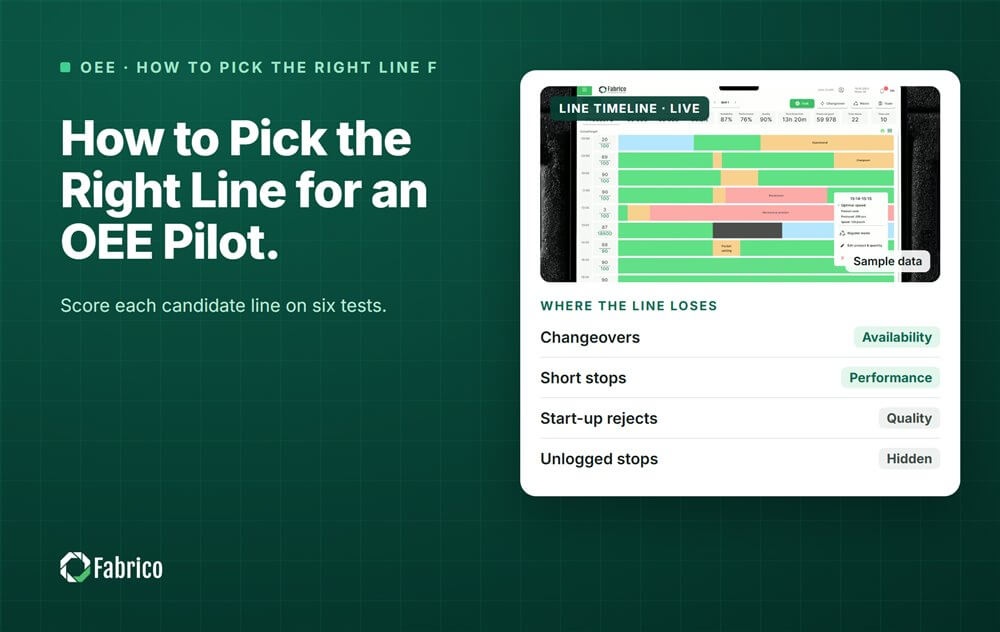
How to Pick the Right Line for an OEE Pilot

Key takeaways
- Pick the line with losses big enough to see, data you can get and a team that wants it.
- The bottleneck is often the best start, because its lost minutes cost the whole line.
- Pick a line that looks like your other lines, so the result can scale.
- Avoid a line that is due for a rebuild, a move or a big product launch.
- Score each candidate on the same six tests and write the reason down.
Pick the line where the losses are big enough to see. Its machines should give you data, through a PLC, an IoT device or a camera. The line team should want to try it. It should look like your other lines and not be due for a rebuild. The bottleneck is often the best start.
Line 1 is the newest and cleanest, so it looks like the obvious choice. But it already runs well, and its stops are short. Meanwhile, the night shift on line 3 keeps losing output to jams nobody writes down.
This guide is for plant managers and CI (continuous improvement) leads choosing where to start. It comes from Fabrico, a vendor of OEE and light MES software with computer vision on stops. The six tests below work with any vendor.
Should the OEE pilot be on the bottleneck?
Usually, yes. A lost minute on the bottleneck is a lost minute for the whole line, so the losses you find there are worth the most.
Goldratt's Theory of Constraints, from The Goal (1984), starts with finding the constraint, because it sets the pace for everything else. Our guide to finding the real constraint on linked packaging lines shows how to check which machine it is.
- Pick the bottleneck when you can get its data and its team is on board.
- Pick the line that feeds it when the bottleneck itself is about to change.
- Check first. The machine everyone blames is not always the constraint. A bottleneck analysis settles it.
What data can you get from the line?
Enough to log each stop without a person typing it. List each machine and how it would connect.
- PLC (programmable logic controller): the run, stop and count signals, where the controller allows it.
- A small IoT device: reads a run signal or a sensor on a machine whose PLC is closed.
- A camera: watches an old machine with no usable signal, so a clip shows what happened.
- Manual entry: the last resort, for a hand-packing table.
Old machines are no reason to skip a line. Our guide to OEE on legacy machines covers the options.
Why does the line team matter more than the machines?
Because people confirm the stop reasons and act on the losses. A line team that wants the pilot makes the data good. One that was told to do it makes the data say "other".
- A line lead who asked for it, and will run the shift routine with the screen.
- Both shifts on board, not only the day shift.
- A maintenance contact who will help with signals.
- In Germany, a works council that has seen the plan before any camera goes up.
How big should the losses be?
Big enough that a fix shows in the numbers. Check the paper log or the shift reports before you choose.
- Frequent short stops, jams and misfeeds.
- Long or uneven changeovers.
- Speed loss: a line that runs below its rated speed.
- Rejects at the checkweigher or at the end of the line.
A line with hidden capacity is a good start. Our guide on hidden capacity explains how to spot it.
Which lines should you avoid?
Any line where the result would not mean much, or would not carry over.
- A line due for a rebuild or a move. The baseline disappears with it.
- A one-off line that nothing else in the plant looks like.
- A line in the middle of a big product launch. Most stops are start-up issues.
- The best-run line. There is little to find.
A worked example: scoring 4 candidate lines
Sample line (illustrative numbers, not a customer): four bagging lines in a snack plant. The team scored each line from 1 to 5 on six tests. Weights total 100 points. "No rebuild due" is also a gate: a score of 1 rules the line out.
| Test | Weight (points) | Line 1 | Line 2 | Line 3 | Line 4 |
|---|---|---|---|---|---|
| Bottleneck or feeds it | 25 | 2 | 4 | 5 | 3 |
| Data you can get | 20 | 5 | 3 | 4 | 2 |
| Team wants it | 20 | 3 | 4 | 4 | 3 |
| Losses big enough | 15 | 2 | 4 | 5 | 4 |
| Like other lines | 10 | 2 | 5 | 4 | 1 |
| No rebuild due (gate) | 10 | 5 | 5 | 1 | 4 |
| Weighted score | 100 | 3.10 | 4.00 | 4.10 | 2.85 |
- Multiply each score by its weight, add, then divide by 100.
- Line 1: 50 + 100 + 60 + 30 + 20 + 50 = 310, and 310 / 100 = 3.10.
- Line 2: 100 + 60 + 80 + 60 + 50 + 50 = 400, and 400 / 100 = 4.00.
- Line 3: 125 + 80 + 80 + 75 + 40 + 10 = 410, and 410 / 100 = 4.10.
- Line 4: 75 + 40 + 60 + 60 + 10 + 40 = 285, and 285 / 100 = 2.85.
Line 3 has the highest total, but its bagger is due for a rebuild, so the gate rules it out. Line 2 at 4.00 is the pick: it feeds line 3's packer, its team asked for it, and its machines match lines 1 and 3. Line 1 scored well on data but has little to find.
Mistakes plants make with pilot line choice
- Picking the newest, best-run line, so there is little to find.
- Picking the worst line, with problems no software fixes alone.
- Ignoring the night shift team.
- Choosing a one-off line that nothing else looks like.
- Starting on a line due for a rebuild.
Where Fabrico fits
Fabrico is a computer vision enabled Manufacturing Performance Platform. OEE and light MES come first, so the line you pick is the line where losses get a price.
- A pilot on one line: one line, one baseline, one decision.
- Automatic downtime logging: each machine connects through its PLC, a Fabrico IoT device or an AI camera.
- OEE live by line and shift: the pilot line's number, shift by shift.
- Losses ranked by money: the first fixes are the ones worth the most.
You start on one line, with a baseline and a decision date agreed in advance. Devices are connected in about one month, and the full rollout takes 3 to 4 months. There is no free plan and there are no tiers: each plant gets a quote.
See how stops are captured on the computer vision OEE page.
Frequently asked questions
Should an OEE pilot be on the bottleneck?
Often, yes, because a minute lost on the bottleneck is a minute lost for the whole line. Choose it when you can get its data and its team wants the pilot. If the bottleneck is about to be rebuilt, start on the line or machine that feeds it.
Can you run an OEE pilot on an old line with no PLC?
Yes. A small IoT device can read a run signal or a sensor, and a camera can watch a machine with no usable signal. Old machines often have the biggest unlogged losses, so they can be a good place to start.
Should the pilot line be the best or the worst line?
Neither. The best line has little to find, and the worst may have problems that no software fixes alone. Pick a line with clear losses, data you can get, a willing team and machines like the rest of the plant.
How many lines should an OEE pilot cover?
One. A pilot on one line gives a clean baseline, one team to support and a clear answer. Spreading it over several lines gives several half-finished tests. Once the first line passes, the next lines follow with the same definitions.
Who should choose the pilot line?
The plant manager decides, after the production manager, the CI lead and maintenance have scored the candidates. IT checks that the network can reach the line. The line lead of the chosen line should say yes before the choice is final.
Bring your candidate lines to a demo
Bring your shortlist of lines and one stop log from each. We will show how each would connect and where its losses would show first.
Latest from our blog


Real Fabrico tiles, sample data.