


 Login
 Blog
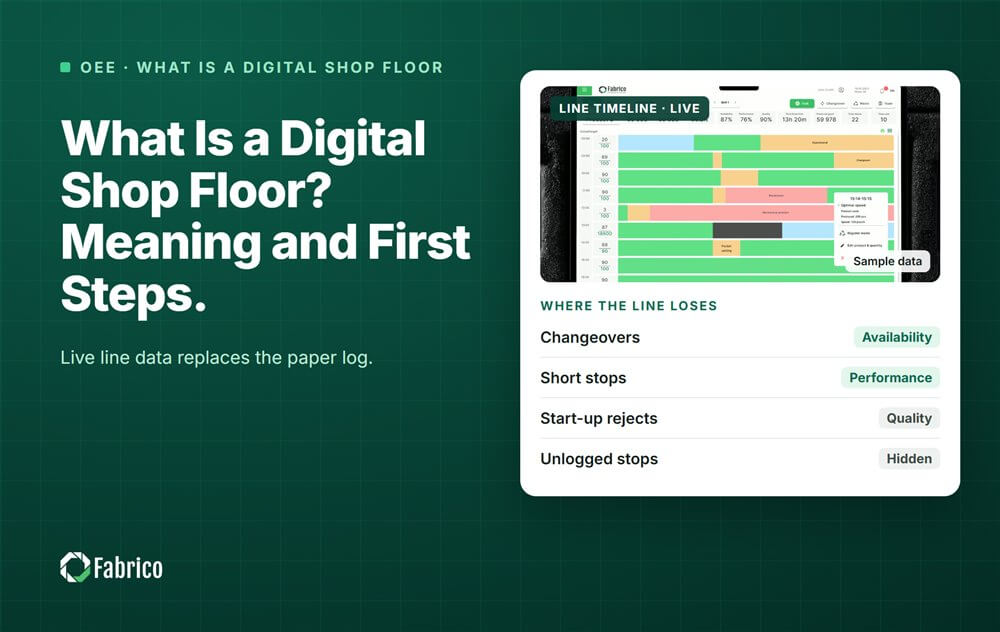
What Is a Digital Shop Floor? Meaning and First Steps

Key takeaways
- Stops and counts come straight from the machines; the stop reason comes from the operator, in one tap.
- The core is machine data, stop reasons and live overall equipment effectiveness (OEE) by line and shift. Checklists, handovers and shift reports follow.
- It is not a robot factory, and not a full manufacturing execution system (MES) project on day one.
- 54.4% of small and medium manufacturers still run production on pen and paper or spreadsheets, says IoT Analytics.
By the numbers
- Only 8% of the world's roughly 5 million factories use a commercial MES; many more rely on homegrown tools, ERP add ons, spreadsheets or paper. (IoT Analytics, 2025)
- In 2018 only about 30% of manufacturers had rolled out their digital manufacturing solutions company wide, the 'pilot purgatory' McKinsey described. (McKinsey & Company, 2018)
- 29% of large US manufacturers use AI or machine learning at facility or network level, and another 23% are piloting it. (Deloitte, 2025)
A digital shop floor is a factory floor where the line's data is captured as it happens, not copied from paper at shift end. Machines report their stops and counts by themselves. Operators add what a machine cannot know, such as the stop reason, on a screen at the line.
Fabrico is OEE and light MES software that logs stops automatically, prices each loss in money and shows OEE live by line and shift. This guide stays vendor neutral: what a digital shop floor includes, what it is not, and how to start on one line.
What does a digital shop floor include?
Most definitions share five building blocks.
- Machine data collection. Each machine reports whether it runs or stands, and how many units it made. The signal comes from the PLC (programmable logic controller), a small sensor or a camera. Our guide to OEE data collection methods compares the options.
- Stop reasons. The machine knows that it stopped, not why. The operator picks the reason from a short list, in seconds.
- Live OEE by line and shift. Availability, Performance and Quality update during the shift, not after it.
- Digital checklists and handovers. Checks and handover notes move from a clipboard to a tablet.
- Shift reports. The report builds itself from the data. Nobody retypes a sheet at night.
The first three are the core. They answer the question a plant manager asks on Monday: where did the time go?
A digital shop floor is also the data layer under shop floor control, the daily work of steering orders, people and machines.
What is a digital shop floor not?
The term gets stretched in sales talk. It does not mean three things.
- Not a robot factory. People still run the line. What changes is how the line's data is captured, not who does the work.
- Not a full MES project on day one. A full MES can also plan orders, track lots and hold quality records. Those can come later, line by line, where a product or a customer needs them.
- Not a way to watch people. Cameras, where used, watch the machine and the process, not the person. A camera can suggest a likely stop reason, the operator confirms it in one tap, and the clip stays as evidence.
The natural starting scope is a light MES: the part of an MES that watches the machines, logs the stops and shows OEE. Our guide to what a light MES covers lists what it includes and leaves out.
What does paper miss? A worked example
Sample line (illustrative numbers, not a customer): a snack bagging line with 450 minutes of planned time a shift. Its ideal speed is 80 bags a minute. Each bag carries a contribution margin of $0.15, or €0.15 in a euro plant: the selling price minus the variable cost of one bag.
On paper, the operator wrote down 4 stops, 38 minutes in total. The machine signal for the same shift shows 27 stops and 64 minutes. The 23 extra stops were short ones of a minute or two, 26 minutes together. Nobody writes those down.
| Measure | Paper sheet | Digital shop floor |
|---|---|---|
| Stops recorded | 4 | 27 |
| Short stops under 5 minutes | 0 | 23 |
| Downtime | 38 minutes | 64 minutes |
| Run time (450 minus downtime) | 412 minutes | 386 minutes |
| Availability (run time / 450) | 91.6% | 85.8% |
| Stop reasons coded | At shift end, from memory | During the shift, one tap each |
Method note: Sample line, illustrative numbers, not a customer. Every result above comes from the inputs listed and the formula shown with it, so you can repeat the calculation with your own line's numbers.
- Hidden time: 64 minus 38 = 26 minutes a shift.
- Lost bags: 26 x 80 = 2,080 bags.
- Lost margin: 2,080 x $0.15 = $312 a shift, or €312 in the euro version.
- Over 500 shifts a year (2 shifts, 250 days): $156,000 a year, or €156,000.
The paper sheet was right about the long stops. It was blind to the short ones, which cost 5.8 points of Availability.
How do you start a digital shop floor on one line?
Six steps keep the scope tight.
- Pick one line with a known problem, where losses hurt and the team wants to fix them.
- Connect the machines. Read state and count from the PLC, a sensor or a camera. Begin with the bottleneck, the slowest machine on the line.
- Agree a short list of stop reasons, one screen long, in the operators' own words.
- Write down the baseline: the current OEE and the top losses, before anything changes.
- Review the top three losses at each shift start and give each one an owner.
- Set a decision date. Agree in advance which result moves you to the next line.
IT will ask where the data lives. Our guide to edge vs cloud for shop floor data covers the trade offs.
Which software do you need for a digital shop floor?
Search for shop floor software and you get many tool types. Sort them by the job they do.
- OEE and downtime software collects machine data, stop reasons and live OEE.
- Paperless form and checklist tools replace clipboards. Our guide to paperless manufacturing software compares them.
- Light MES joins the OEE core with shift reports and work orders, and grows line by line.
- Full MES adds order planning, lot tracking and quality records. It suits regulated or complex plants.
- Live status screens show what runs now. Our article on real time shop floor visibility gives six tests for any "real time" claim.
The main rival is often paper, not another tool. Whatever you test, ask three questions.
- Does it capture stops without anyone typing?
- Can an operator add a reason in seconds?
- Does the supervisor see the loss during the shift?
Where does Fabrico fit?
Fabrico is a computer vision enabled Manufacturing Performance Platform. OEE and light MES come first.
- Automatic downtime logging from the machine signal, short stops included.
- The operator confirms the reason in one tap. A camera on the machine can suggest a likely reason, and the clip stays as evidence.
- OEE live by line and shift, plus one view across plants.
- Every loss priced in money and ranked by money.
A machine connects through its PLC, a Fabrico IoT device or an AI camera, so the machine itself needs no PLC. Devices are connected in about one month, and a full rollout takes 3 to 4 months. Named result: ABB, 20% less downtime.
You start with a pilot on one line, with a baseline and a decision date agreed in advance. There is no free plan and there are no tiers: each plant gets a quote.
Proof from a named plant: Ficosota raised factory-wide OEE from 53.1% to 59.6%, with good output up 23.2% a month from June to September 2026. Read the Ficosota case.
Toyota describes the andon in plain words: when equipment stops, it "lights up to notify workers of the abnormality." (Toyota, Toyota Production System)
Frequently asked questions
What is digital shop floor management?
It means running the line from live data instead of paper. The supervisor sees stops, reasons and OEE during the shift, and the team reviews the top losses at each shift start. Decisions happen at the line, while the loss can still be fixed.
Does a digital shop floor need new machines?
No. Older machines can share their running state and count through their PLC, a small add-on sensor, or a camera pointed at the machine. Start with the signals the line already has, and add a device where a machine has none.
Is a digital shop floor the same as an MES?
Not quite. A digital shop floor is the result: line data captured live. An MES is one kind of software that delivers it. A light MES covers the core, while a full MES adds order planning, lot tracking and quality records.
Will operators accept screens at the line?
They do when the screen saves them work. Keep each entry to one tap from a short list, and never ask them to retype what the machine knows. Show results by line and shift, not by person, so the data defends the operator.
Latest from our blog


Real Fabrico tiles, sample data.