


 Login
 Blog
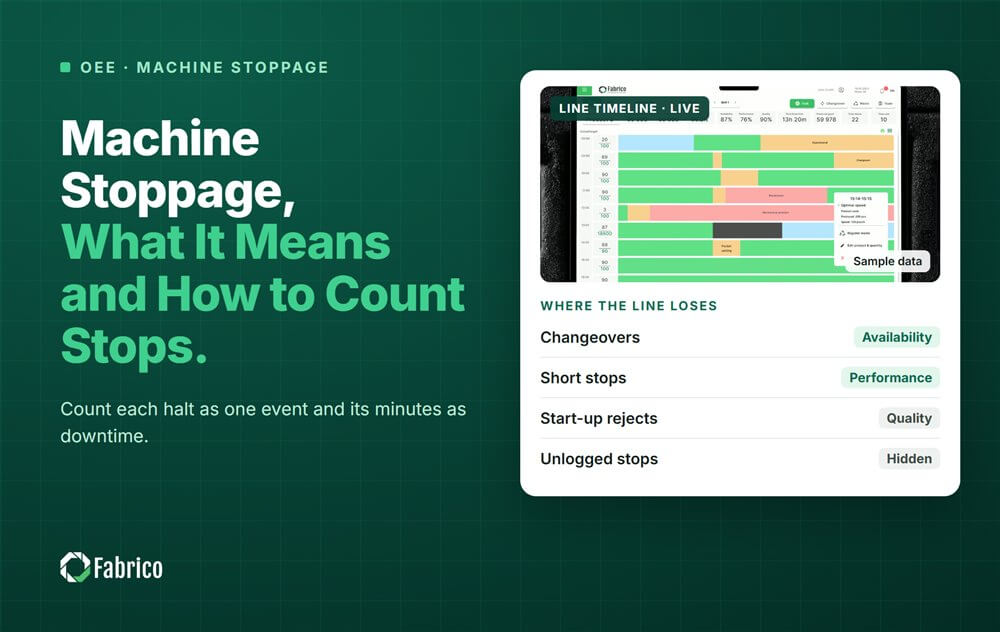
Machine Stoppage: What It Means and How to Count Stops

Key takeaways
- Track two numbers per line and shift: the number of stops and the stop minutes.
- The main kinds are breakdowns, minor stops, changeovers, starved or blocked time, and planned stops.
- Your plant sets a cutoff for short stops. Stops under it are counted and timed, with no reason asked.
- The cutoff moves a stop between availability and performance. OEE (overall equipment effectiveness) stays the same.
- Where a machine gives no clear signal, a camera clip and a one-tap reason fill the gap.
By the numbers
- Getting production running again after an unplanned stop takes 81 minutes on average, up from 49 minutes five years earlier. (Siemens, 2024)
- 69% of industrial plants have an unplanned outage on critical equipment at least once a month. (ABB, 2023)
- 8% of industrial plants have an unplanned outage on critical equipment every single day. (ABB, 2023)
A machine stoppage is an event: a machine or a line stops making product while it is planned to run. Each stoppage has a start, an end and, ideally, a reason. Downtime is the total time of those events.
Ten stops of 3 minutes and one stop of 30 minutes give the same downtime, but they are very different problems. Fabrico is a computer vision enabled Manufacturing Performance Platform. Its OEE and light MES (manufacturing execution system) software logs stops automatically and shows the count and the minutes by line and shift.
How is a machine stoppage different from downtime?
A stoppage is a count. Downtime is a length of time. They point to different fixes.
- Stoppage: one event, with a start time, an end time and a reason.
- Downtime: the sum of all stop minutes in a shift, a day or a week.
- Average stop length: downtime divided by the number of stops.
Many short stops point to jams, misfeeds or settings. A few long stops point to breakdowns, missing material or a wait for a technician. Our guides to unplanned downtime and equipment downtime cover the long ones.
The Siemens True Cost of Downtime 2024 report puts an average large plant at 25 unplanned downtime incidents a month, 27 hours in total. In FMCG (fast-moving consumer goods), a lost hour costs about $36,000.
What types of machine stoppages are there?
Most plants sort stops into six kinds. First ask: was the stop booked before the shift? If not, it is an unplanned production stoppage and a real loss.
| Kind of stop | What happens | How it counts |
|---|---|---|
| Breakdown | The machine fails and needs a repair | Availability loss, with a reason |
| Minor stop (short stop) | A jam or misfeed the operator clears alone | Performance loss, counted without a reason |
| Changeover | The line stops to switch product, format or tooling | Availability loss; many plants plan the standard time and count the overrun |
| Starved | The machine is fine, but nothing arrives at its infeed | A stop here, charged to the upstream machine that stopped first |
| Blocked | The machine is fine, but its outfeed is full | A stop here, charged to the downstream machine that stopped first |
| Planned stop | A break, planned maintenance or a cleaning booked before the shift | Not a loss; it comes out of planned production time |
This matches Nakajima's six big losses. A minor stop is typically a minute or two, well under five minutes. Our guide to micro stops shows how fast they add up.
When the case packer jams, product backs up and the labeler before it is blocked. The stop shows at the labeler; charge it to the case packer.
How do you count machine stoppages?
Use the same five rules on every line:
- Log a start and an end for each stop, from the machine signal where you have one. Paper logs lose most short stops.
- Set a minimum stop length: the shortest pause that counts as a stop. Shorter pauses count as slow running. Never set it below the product's cycle time.
- Set a reason cutoff. Stops under it are minor stops, counted and timed with no reason asked. Longer stops need a reason from the operator.
- Report the count and the minutes per line and shift, plus the average stop length.
- Check reason coverage: the share of stop minutes that carries a reason. The rest piles up as unclassified downtime.
No standard sets the cutoff; two or five minutes are common plant habits. The cutoff decides whether a stop lands in availability or performance. OEE stays the same; the diagnosis changes, so keep the cutoff fixed. Our micro stops guide for OEE shows how short stops hide inside performance.
How do you count stops in one shift? A worked example
Sample line (illustrative numbers, not a customer): a biscuit packing line where the flow wrapper is the bottleneck. Planned production time is 450 minutes. The minimum stop length is 10 seconds and the reason cutoff is 2 minutes. The wrapper makes 120 packs a minute at a contribution margin of $0.05 a pack, or €0.05 in a euro plant.
| Kind of stop | Stops | Minutes | Reason asked? |
|---|---|---|---|
| Breakdown: sealing jaw heater | 1 | 38 | Yes |
| Changeover to a new flavor | 1 | 25 | Yes |
| Starved: no biscuits from the oven | 3 | 21 | Yes |
| Film splice | 2 | 6 | Yes |
| Minor stops under 2 minutes | 42 | 35 | No |
| Total | 49 | 125 |
Method note: Sample line, illustrative numbers, not a customer. Every result above comes from the inputs listed and the formula shown with it, so you can repeat the calculation with your own line's numbers.
- Stops: 1 + 1 + 3 + 2 + 42 = 49 stops.
- Downtime: 38 + 25 + 21 + 6 + 35 = 125 minutes.
- The 7 longer stops average 90 / 7 = 12.9 minutes. The 42 minor stops average 35 x 60 / 42 = 50 seconds.
- Minor stops are 42 / 49 = 86% of the stops but 35 / 125 = 28% of the minutes.
- One stopped minute at the bottleneck costs 120 x $0.05 = $6. The shift's stops cost 125 x $6 = $750. The minor stops alone cost 35 x $6 = $210.
- Availability = (450 minus 90) / 450 = 80.0%.
Now move the cutoff to 5 minutes. The 2 film splices become minor stops. Availability rises to (450 minus 84) / 450 = 81.3%, performance absorbs the 6 minutes, and OEE does not move.
A paper log would likely show the 7 long stops and miss the 42 short ones, worth $210 a shift.
How do cameras help when the machine signal is weak?
Many older machines have no signal you can read, or a run signal that says "stopped" and nothing more. There, short stops and their reasons go missing first.
A camera on the process fills that gap:
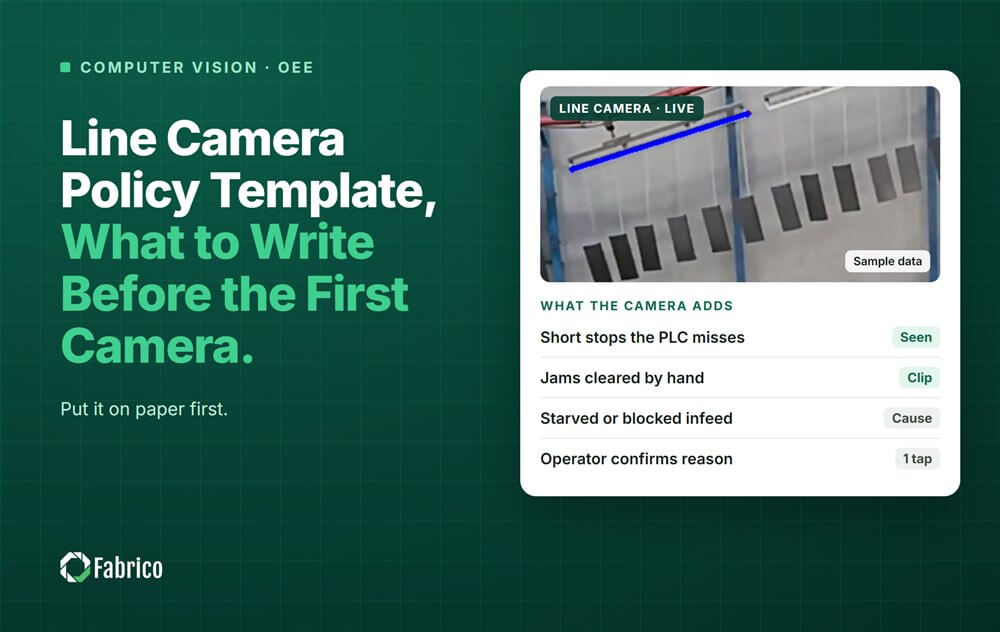
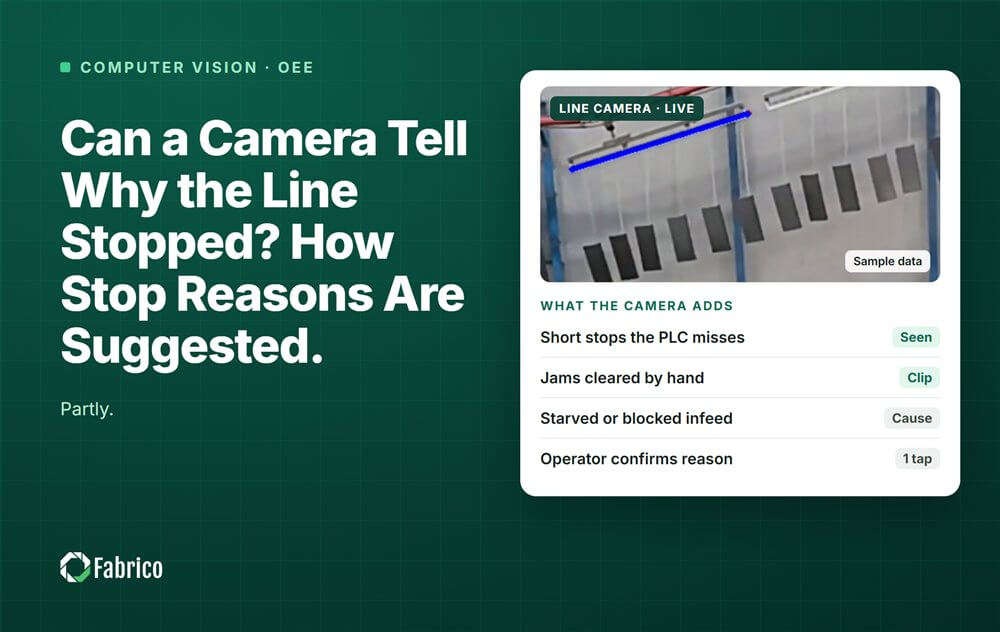
- It sees product stop moving and saves a short clip of the stop.
- It may suggest a likely reason, and the operator confirms it in one tap.
- The clip stays with the stop as evidence, so the talk is about the machine, not the crew.
- It watches the process, not the person, and does not rank operators.
Video also shows what a run signal cannot: a conveyor running empty is starved, not broken.
In Fabrico, a machine connects through its PLC (programmable logic controller), a Fabrico device or a camera, and the machine itself needs no PLC. There is no free plan and there are no tiers: each plant gets a quote. See how a stop gets its clip and reason on the computer vision OEE page.
Proof from a named plant: ABB reports 20% less downtime with Fabrico. Read the ABB case.
Toyota describes the andon in plain words: when equipment stops, it "lights up to notify workers of the abnormality." (Toyota, Toyota Production System)
Frequently asked questions
What is a machine stoppage in manufacturing?
A machine stoppage is one event in which a machine or a line stops producing while it is planned to run. It has a start time, an end time and a reason. Plants count stoppages per shift and add up their minutes as downtime.
What is the difference between a stoppage and downtime?
A stoppage is a single event, counted one by one. Downtime is the total time of those events in a shift or a week. Two lines can share the same downtime with very different stop counts, and each pattern needs a different fix.
What is a minor stoppage?
A minor stoppage, or short stop, is a brief halt the operator clears alone, typically a minute or two. Each plant sets its own cutoff for it. Minor stops are counted and timed but usually get no reason, and in OEE they are a performance loss.
What is an unplanned production stoppage?
It is any stop in planned production time that was not booked as a planned type before the shift. A break or a standard changeover is planned. Breakdowns, jams, missing material and changeover overruns are not. Each unplanned stop is a real loss.
How short can a stop be and still count?
That depends on your plant's minimum stop length. Pauses shorter than it count as slow running. Set it no lower than the product's cycle time, or normal cycles will look like lost speed. Many plants use 1.5 to 2 times the ideal cycle time.
Latest from our blog



Real Fabrico tiles, sample data.