


 Login
 Blog
OEE for Nuts and Dried Fruit Packing: Allergens, Sticky Product, Many Packs

In short: OEE for nuts and dried fruit packing is measured at the pack: good packs past the checkweigher, each product against its own ideal rate, over the time you planned to run.
- Availability: allergen cleans and format changes are the big blocks of lost time. Keep them inside planned time.
- Performance: sticky fruit bridges in the weigher, so the bagger cycles with nothing to fill.
- Quality: dust, oil or fruit in the seal, plus metal detector and checkweigher rejects.
- Giveaway is a cost next to OEE, and on nuts it is an expensive one.
Peanuts in the morning, almonds after lunch, sticky dates tomorrow, in 40 g snack packs and 1 kg bags. Each switch changes the clean, the speed and the reject pattern.
This page shows how to measure OEE on that line, and what to ask of software that has to keep up. We sell Fabrico, so test what we say here like any other vendor's claims.
The line in order, and where to count
Product arrives from roasting, seasoning and cooling (nuts) or from conditioning (dried fruit). It is sorted, lifted to a multihead weigher, dropped into a vertical bagger or a pouch filler, then checked and packed in cases.
Take the total count from the bagger or pouch filler: one cycle, one pack. Take the good count from the checkweigher, after the metal detector has kicked out what it does not like.
The gap between the two is your reject count.
With metallised film the metal detector sits in the weigher throat, before the bag is made. What it rejects there is loose product, so log it as waste by weight, not as packs.
Where a nut and dried fruit line loses time, speed and product
| Station | Typical loss | OEE part |
|---|---|---|
| Roasting, cooling, conditioning | Batch not ready or not cool enough, so the weigher waits | Availability (starved) |
| Sorting and picking belt | Shell, stones, stems and discoloured pieces taken out. Slow running when raw material is poor | Quality, performance |
| Elevator and weigher infeed | Sticky fruit bridges in the funnel. Nuts break at drops and make dust | Performance, quality |
| Multihead weigher | Product sticks in buckets, no valid combination, missed drops, wipe-downs mid-run, giveaway | Performance, availability (giveaway is cost) |
| Vertical bagger | Reel change, film tracking, long pieces hanging in the tube, product in the seal | Availability, quality |
| Pouch or doypack filler | Pouch not picked or not opened, zipper faults, empty magazine | Performance, availability |
| Metal detector | False rejects, common on moist or salted product, and real finds | Quality |
| Checkweigher | Underweight packs, empty packs after a missed drop | Quality |
| Case packer | Case misfeeds, small pouches that will not stack, backs up the bagger | Availability (blocked) |
Seal faults deserve their own reason. Nut dust, salt and oil sit in the seal area, and a sticky raisin holds the jaws open.
The result is a leaking pack, or a gas-flushed pack that lost its gas.
Most of these faults are cleared in under a minute, so nobody writes them down. They are micro-stops, and on this line they often cost more than the breakdowns.
Keep starved and blocked apart from the line's own faults. A weigher waiting for a roast to cool is not a weigher problem.
Allergen cleans and changeovers: the biggest block of time
On this line a product change is often an allergen change. EU labelling law lists peanuts and tree nuts as two separate allergens, so peanut to almond is not a simple flavour change (Regulation 1169/2011, Annex II).
The same list names sulphur dioxide and sulphites above 10 mg/kg. So a switch from sulphured apricots to a product sold without sulphites can also call for a clean, depending on your own allergen plan.
These are dry cleans: strip the weigher buckets and chutes, vacuum, brush, wipe, check, rebuild. They are slow and manual, and the steps are fixed by your food safety team, not by OEE.
For OEE, four rules keep them honest:
- Keep the clean inside planned time. It is an availability loss, even when it is on the schedule. This is the same rule we use for the allergen changeover matrix.
- Time it from last good pack to first good pack at full speed. The strip-down is only part of it. The rebuild, the checks and the slow restart belong to it too.
- Split the reason by type. At least three: format or film change, product change with the same allergens, allergen clean.
- Do not cut the clean to win points. Look for time in the waiting around it: tools, spare buckets, the sign-off, the next film already on the shaft.
Take out of planned time only what was never meant for production: no orders, breaks with the line down, a planned deep clean on a day off.
Sticky product: bridging in the weigher
Dates, prunes, raisins, figs and soft apricots smear sugar on every surface they touch. They hang in the infeed funnel, clump on the feeder pans and stick in the buckets.
The weigher then finds no valid combination and skips a drop. The bagger keeps cycling, so the line looks like it is running.
That is why this loss hides. There is no stop to log, only fewer packs per minute than the ideal rate, and a few empty packs at the checkweigher.
Three things make it visible:
- An honest ideal rate for the sticky product, so performance shows the gap.
- A short-stop threshold low enough to catch the 15 seconds an operator spends poking a bridge loose.
- A reason for the mid-run wipe-down. If the line stops every hour to clean buckets, that is a stop caused by the product, and it should have its own code.
Many pack formats: one ideal rate per product and pack
A line that packs 40 g of peanuts and 1 kg of dates does not have one ideal rate. Small packs of free-flowing nuts run fast, and large packs of sticky fruit run slow, even on a perfect day.
So set the ideal rate per product and pack format, in packs per minute. Use the best rate the line has held on that combination with good quality, not the nameplate of the bagger.
With one rate for the whole line, a shift of large packs always looks bad and a shift of snack packs always looks good. Nobody learns anything from that.
If performance reads over 100%, the rate is too low.
Worked example: two products in one shift
These are example numbers, round on purpose. They describe no real plant.
One 480 minute shift. The line packs salted cashews in 150 g bags, does an allergen clean, then packs dried apricots in 250 g bags.
| Example data | Cashews 150 g | Apricots 250 g |
|---|---|---|
| Ideal rate | 60 packs a minute | 40 packs a minute |
| Run time | 200 min | 200 min |
| Packs made | 10,800 of 12,000 possible | 6,000 of 8,000 possible |
| Good packs | 10,620 | 5,820 |
| Good packs in ideal minutes | 10,620 / 60 = 177 | 5,820 / 40 = 145.5 |
The other 80 minutes are stops: 50 for the allergen clean and changeover, and 30 for other stops, of which 20 were bucket wipe-downs on the apricots.
With two rates you cannot add packs. Turn each product's packs into minutes at its own ideal rate, then add the minutes.
- Availability: 400 of 480 minutes = 83.3%
- Performance: packs made are worth 180 + 150 = 330 ideal minutes, in 400 minutes of running = 82.5%
- Quality: good packs are worth 177 + 145.5 = 322.5 ideal minutes, of 330 = 97.7%
- OEE: 400/480 x 330/400 x 322.5/330 = 67.2%
Multiply the three rounded percentages and you get 67.1%, so keep the unrounded figures. Now check it the short way: good packs times ideal cycle time is 322.5 minutes.
322.5 of 480 planned minutes is 67.2%. The two agree.
Now read it by product. The cashews ran at 90% of their rate and the apricots at 75%, and the apricots own 50 of the 70 minutes lost to slow running.
That is the bridging, in a number you can act on. With one rate of 60 for the whole shift, the apricots would read 50%, and two thirds of that gap would be a wrong rate, not a real loss.
For the method itself, see our page on OEE calculation.
Giveaway on nuts: a cost next to OEE
A 150 g bag filled to 153 g is a good pack. It passes the checkweigher and it ships, so OEE quality is right to count it as good.
But 3 g over on the 10,620 good cashew packs in the example is about 32 kg given away in one run. Price that at what you pay for cashews.
Piece size makes it worse here. One date or one Brazil nut weighs several grams, so on a small pack the weigher has few combinations close to the target.
Track giveaway next to OEE, in grams per pack and kg per run, per product.
Do not push it into the quality figure. Our page on giveaway and overfill explains why.
What to check in OEE software for this line
Run these checks in a demo with every vendor, including us. Bring one real shift with two products and an allergen clean between them.
- Ideal rate per product and pack. Can each combination have its own rate, and does the rate switch when the product changes mid-shift? Check the shift OEE by hand, as above.
- Changeover types. Can a changeover carry a type, and can you compare the real time of allergen cleans against format changes over a month?
- Slow running without a stop. The bagger cycles while the weigher skips drops. Ask how that shows up, and how a reason gets attached to it.
- Short stops. Ask where a 15 second stop to clear a bridge goes, and who sets the threshold.
- Rejects by cause. Can metal detector and checkweigher rejects come in by signal, and stay apart in the report?
- Starved and blocked. Ask how a weigher waiting for the roaster, or a bagger held by the case packer, is kept out of its own fault list.
- Counting without a usable signal. On an older pouch filler or a hand packing table for gift boxes, what are the options: a sensor, a camera, a manual entry?
For a wider list of products to run these checks on, see our review of OEE software.
Where Fabrico fits
Fabrico is a cloud-based OEE and light MES platform. Here is what it does, and what it does not.
- Stops: they come from the machine signal, through the PLC or a Fabrico IoT device. The operator adds the stop reason on a tablet or phone.
- OEE and downtime: availability, performance and quality by line and by shift, on the web, iOS and Android.
- Micro-stops: detected from the machine signal, so short stops at the weigher and bagger are not left to memory.
- Losses in money: losses can be shown in money, not only in minutes.
- Your data: REST API and webhooks, and any list exports to Excel or CSV.
- Camera: the AI camera is an add-on that counts parts. It is worth a look where a pouch filler or a hand packing table has no usable count signal. You can open the video of a stop. In the standard setup video is streamed, not stored.
- Not in Fabrico today: production planning and scheduling. The order of products that keeps allergen cleans low stays with your planning tool.
A stop reason can also be set up to open a maintenance task, for example on a repeat seal jaw fault.
What people ask next
Does an allergen clean count against OEE on a nut line?
Yes, as an availability loss, if the line was planned to run that shift. Take it out of planned time and it disappears from the figure, and so does the reason to work on the time around it.
How do we set the ideal rate with so many pack sizes?
Set one ideal rate per product and pack format, in packs per minute. Use the best rate the line has held on that combination with good quality, and start with the combinations that fill most of your hours.
Is weigher bridging a stop or a speed loss?
Both, depending on how it ends: skipped drops while the bagger cycles are a performance loss. A stop to clear the bridge or wipe the buckets is a short stop with its own reason.
Is giveaway part of OEE quality?
No, an overfilled pack is a good pack, so it counts as good in OEE. Track giveaway as a cost next to OEE, in grams per pack and kg per run.
Want to run these checks on your own packing line data? Book a demo or Contact us.
Related articles



Latest from our blog





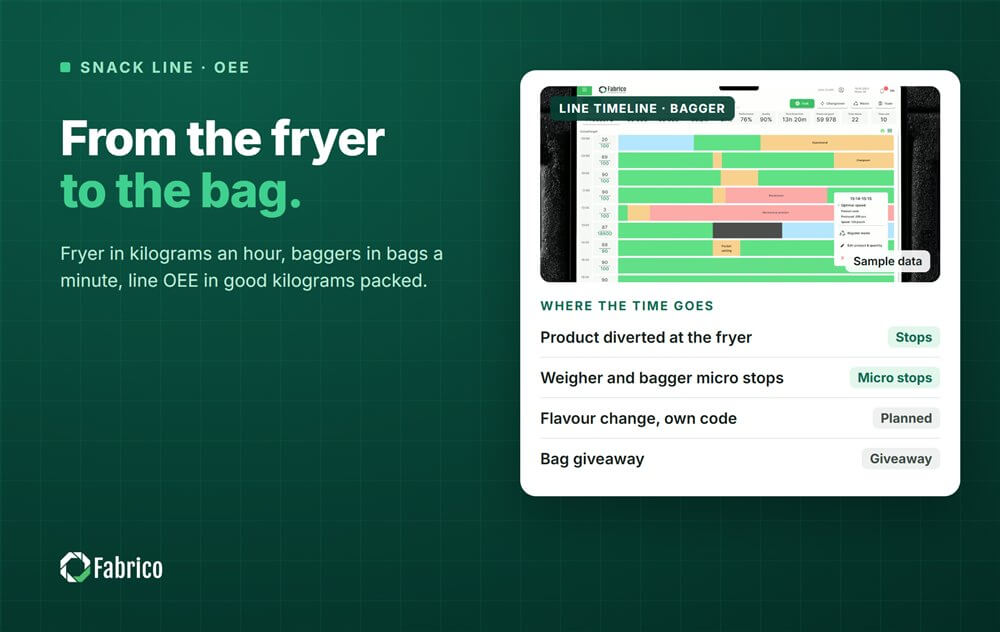
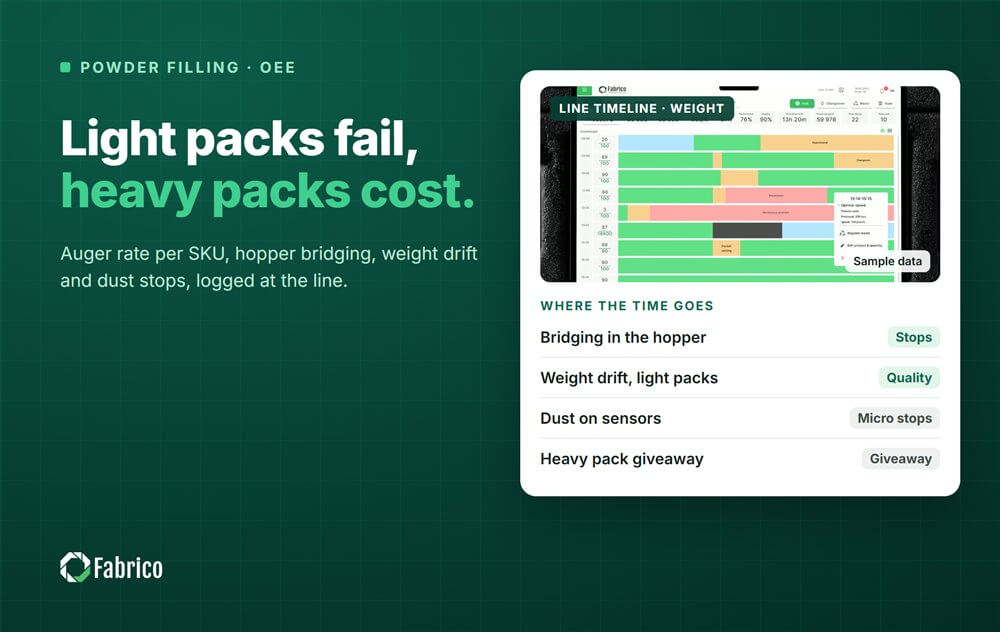
Real Fabrico tiles, sample data.