







 Login
 Blog
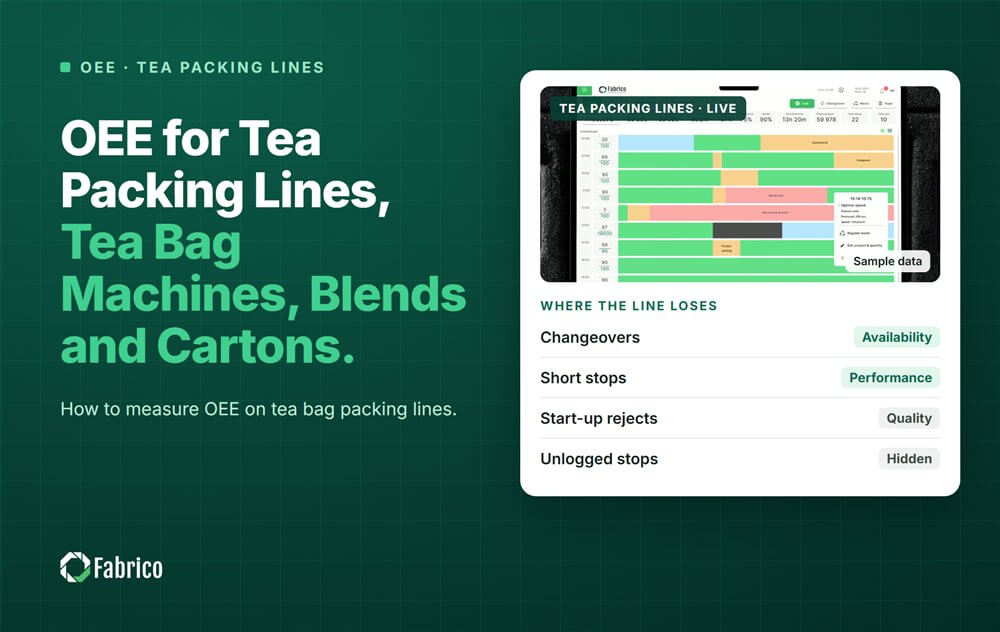
OEE for Tea Packing Lines: Tea Bag Machines, Blends and Cartons

Key takeaways
- Count tea bag lines in bags at the bag machine, then convert to cartons for money.
- Blend changes with dust cleaning are usually the largest single loss. Plan the blend order for the day.
- String, tag and staple feeds cause most short stops. Each is quick, together they are a large loss.
- Tea dust affects sensors and sealing. Expect more stops on fine blends and code them by blend.
- Bag weight giveaway sits outside OEE, but on premium blends it can cost more than a stop. Weigh it.
To measure OEE on a tea packing line, take the tea bag machine as the pace, count bags against its rated speed for each bag type, and charge cartoner stops and blend supply delays to their own causes. Then weigh bags, because small overfills on every bag add up to real money.
Fabrico, a computer vision enabled OEE and light MES platform, logs bag machine and cartoner stops automatically and asks the operator to confirm the reason in one tap. This guide is for plant managers and production leads at tea plants packing string and tag bags, pyramid bags, enveloped bags and loose tea.
What does a tea packing line look like?
- Blend supply. Blended tea from silos or bins feeds the machine hopper.
- Tea bag machine. Doses tea by volume onto filter paper, forms the bag and adds string and tag. Pyramid machines use mesh and ultrasonic sealing instead.
- Envelope unit. On some lines, each bag is wrapped in its own paper or foil envelope.
- Cartoner. Counts bags into cartons of 20, 40, 80 or more and closes them.
- Overwrapper and case packer. Film around each carton, then cases and pallets.
Loose tea and larger pouches usually run on auger fillers or VFFS machines, which have their own loss pattern.
Where does a tea packing line lose time?
| Area | Typical stops | OEE factor |
|---|---|---|
| Blend supply | Hopper empty, blend not released, bridging in the hopper | Availability, charged to supply |
| Filter paper | Reel change, paper break, splice faults | Availability or short stops |
| String, tag and staple | Tag misfeed, string break, staple wire out or jammed | Short stops, Quality |
| Dosing | Weight drift as blend density changes, dust in the dosing unit | Quality, giveaway |
| Cartoner and overwrapper | Carton feed jams, wrong bag count, film faults | Blocked time for the bag machine |
| Whole line | Blend change with dust clean, carton format change | Availability |
Why do tea bag machines stop so often?
A tea bag machine joins paper, tea, string, tag and often a staple on every bag, at high speed. Any one of those feeds can stop the machine for a few seconds. Most stops are cleared by the operator in under a minute, so they rarely reach a paper log.
- Tag and string feeds are the most common short stops on string and tag machines.
- Dust from fine blends settles on sensors and in the dosing unit. Stops often rise on fine blends and fall on leafy ones, so code stops by blend.
- Reel changes on filter paper, string and tag reels are planned in a sense, but they still cost run time. Count them, and check whether a larger reel or a splice table saves minutes.
Our guide to micro stops explains how to set a cutoff for short stops and keep them in the data.
A worked shift on a tea bag line
Sample line (illustrative numbers, not a customer): a string and tag tea bag machine rated at 300 bags a minute, feeding an inline cartoner that packs 20 bags a carton. Planned production time is 450 minutes.
| Event | Minutes | Bags not made (x 300) |
|---|---|---|
| Blend changes with dust clean, 2 x 20 minutes | 40 | 12,000 |
| Tag and string short stops, 30 x 0.5 minutes | 15 | 4,500 |
| Filter paper reel changes, 6 x 2 minutes | 12 | 3,600 |
| Blocked by cartoner jams, 10 x 1 minute | 10 | 3,000 |
| Starved, waiting for blend from the silo | 8 | 2,400 |
| Running | 365 |
- Availability = 365 / 450 = 81.1%.
- Performance: 100,800 bags against an ideal of 365 x 300 = 109,500, so 92.1%.
- Quality: 1,200 weight rejects, 400 torn bags and 600 bags with a missing tag, 2,200 in total. Good bags = 98,600, so 98,600 / 100,800 = 97.8%.
- OEE = 0.811 x 0.921 x 0.978 = 73.0%. Check: 98,600 / 300 = 328.7 minutes of ideal output, and 328.7 / 450 = 73.0%.
The good bags fill 4,930 cartons. At a sample contribution of $0.60 a carton (or €0.60 in a euro plant), the blend changes cost 600 cartons, or $360 a shift. Over 750 shifts a year, that is $270,000. The speed loss of 8,700 bags is $261 a shift, and the tag and string stops $135.
How much does tea bag giveaway cost?
Tea is dosed by volume, and blend density changes from lot to lot. To stay above the declared weight, many lines run a little heavy. That overfill is not in OEE, because a heavy bag still counts as good.
On the sample line above (illustrative numbers, not a customer), the bags averaged 0.1 g over a 2.0 g target. On 98,600 good bags that is 9.9 kg of tea a shift. At a sample blend cost of $20 a kg, that is about $197 a shift, or about $148,000 over 750 shifts. Set that against the cost of tighter dosing checks for each blend lot.
How do you shorten blend changes?
- Plan the order. Run similar blends next to each other, and put strongly flavoured or scented teas last before a full clean.
- Prepare outside the stop. Next blend staged and released, cartons and tags for the next SKU at the machine.
- Standard cleaning steps. Write down which parts must be cleaned for each type of change, so crews do not clean too little or too much.
- Measure to the first good bag at rated speed. Then code the minutes over the standard.
Our changeover checklist helps turn those steps into one routine.
What mistakes do tea plants make with OEE?
- Counting cartons only, so bag machine stops and rejects blur together.
- Charging cartoner jams and blend supply delays to the bag machine crew.
- Filtering out short stops, so tag and string feeds never reach the Pareto.
- Leaving giveaway out of the loss report because heavy bags count as good.
- One ideal rate for every bag type, whether string and tag, envelope or pyramid.
For the cartoner itself, see our cartoner OEE guide. Coffee lines share many of these losses; see coffee capsule line OEE.
Where does Fabrico fit on a tea line?
Fabrico is a computer vision enabled Manufacturing Performance Platform. OEE and light MES come first: automatic downtime logging that keeps own stops, starved and blocked time apart, and OEE live by line and shift.
- The operator confirms the reason in one tap, so a tag misfeed and a string break get different codes.
- A camera clip as evidence for a stop, where a camera watches the tag station or the cartoner infeed.
- Losses priced in money and ranked, so blend changes and short stops show their real cost.
- One view across plants for tea lines on different sites.
- A work order with its cost to the right technician when a stop is a breakdown.
You start on one line, with a baseline and a decision date agreed in advance. There is no free plan and there are no tiers: each plant gets a quote. See how computer vision OEE logs and codes stops.
Frequently asked questions
How do you calculate OEE on a tea bag machine?
Availability is run time over planned production time, Performance is bags made over the ideal at rated speed for that bag type, and Quality is good bags over bags made. Multiply the three.
Should reel changes count as downtime?
Yes. They are part of running the machine, but they still cost run time. Count them as their own code, so you can see whether larger reels or faster splicing would help.
Is bag weight giveaway part of OEE?
No. A heavy bag still counts as good. Track giveaway next to OEE in grams and in money.
What is a good OEE for a tea packing line?
There is no standard. Lines with many blends and carton formats score lower than lines with long runs. Compare each line with its own trend first.
See your tea line's losses in a demo
Bring one line and its stop log. We will show blend changes, short stops and cartoner blocks, and what each one costs.
Related articles








Real Fabrico tiles, sample data.