


 Login
 Blog
Sachet and Stick Pack Machine OEE: Lanes, Seals, Dosing and Counts

Key takeaways
- A multi-lane machine has one ideal rate: cycles per minute times all lanes. Keep it fixed when a lane is closed.
- A closed lane on a running machine is a Performance loss on that machine. Give it its own reason code so it does not hide in slow running.
- Reel changes, film breaks, dosing blockages and jaw cleans are the usual Availability losses. A stop cutoff decides what lands in Performance instead.
- Leaking seals, light sticks and miscounts are the Quality losses. Count rejects by lane to find the lane that makes them.
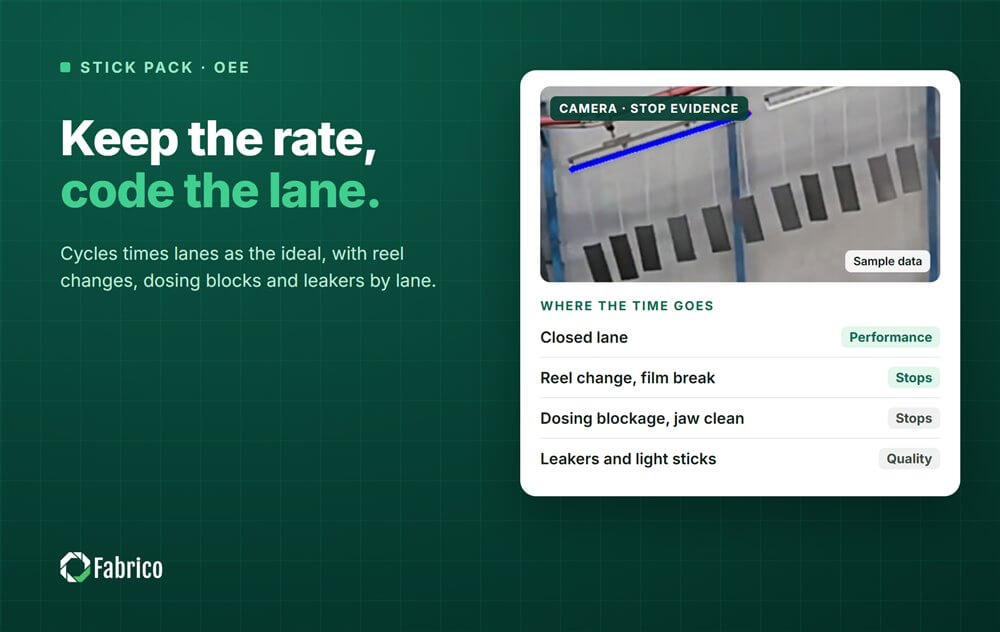
- The PLC says stopped. A camera over the forming and sealing area keeps a clip of the film, the jaws and the product at that moment.
Lane 7 on the stick pack machine has been closed since the ten o'clock reel change. Its slitting knife started tearing the film, the operator shut the lane to keep the other nine running, and the line display has shown green ever since. The shift report shows a decent OEE and no stop. Nine lanes out of ten is a tenth of the output gone, and nobody logged a thing.
Sachet and stick pack machines are hard to measure because they are several small machines inside one frame. One film reel feeds every lane and one set of cross seal jaws closes them all, but each lane has its own forming tube, its own longitudinal seal and its own dosing unit. A loss can hit the whole machine or a single lane, and the two need different handling.
Below: the ideal rate, the closed lane, stops by station, quality losses, data sources and one worked shift.
Where the time goes on a multi-lane machine
Walk the machine in flow order. The film comes off the reel through a dancer and a splice table, past the print mark sensor that keeps the cut in register. On a stick pack machine the web is slit into narrow strips, one per lane. Each strip is wrapped round its forming tube, sealed lengthwise, filled by the lane's dosing unit, then closed and cut by the cross seal jaws. Four-side seal sachets work the same way, with the lanes divided by vertical seals. Dosing is an auger for powders, volumetric cups for granules, a pump or piston for liquids.
The time goes to a short list: reel changes and splices, film breaks and tracking faults, seal faults, dosing blockages, jaw cleaning, and the cartoner blocking the outfeed.

The ideal rate: cycles times lanes
The ideal rate of a multi-lane machine is the rated cycles per minute times the number of lanes it was built with. A 10-lane machine at 50 cycles a minute has an ideal of 500 sticks a minute, whether one lane is closed or not.
Set the cycle rate per format, not once for the machine. Stick length, fill weight and film all change the speed the jaws can seal at. Take the OEM rating for that format, or the best speed the machine holds for a full hour on it. If Performance ever reads above its maximum, the ideal is too low. Our guide to setting the ideal cycle time covers the governance.
Never lower the ideal to the lanes that happen to be running, or a closed lane disappears from OEE.
A closed lane: Availability or Performance?
There are two consistent ways to book it.
- Machine view. The machine is running, so the time is run time. The missing sticks show up as a Performance loss, because the count falls short of cycles times all lanes.
- Lane view. Treat each lane as its own machine. The closed lane is down, so it is an Availability loss for that lane, and the machine figure is the sum of its lanes.
With the ideal set on all lanes, both give the same machine OEE; only the place where the loss shows changes. The machine view is simpler: one OEE, plus a reason code for the closed lane with its number, a start and an end. Closed minutes times cycles per minute gives the lost sticks, and the loss has a name. Agree the view before you start and keep it.
A lane that runs but makes light or open sticks is different again: that is a Quality loss, and it belongs in the reject count.
Typical stops at each station
| Station | Typical stop or loss | Usual OEE factor | What the PLC usually shows |
|---|---|---|---|
| Film unwind and splice | Reel end, splice not taken, film break | Availability, or Performance if short | Film end or film break alarm |
| Print registration | Print mark lost, cut out of register | Performance, Quality for miscut sticks | Registration fault |
| Slitting | Worn knife, a lane strip tears | Closed lane, Performance | Often nothing, the machine runs on |
| Forming and longitudinal seal | Film tracking off, seal open or burnt | Quality, then a stop | Temperature alarm, sometimes nothing |
| Dosing | Powder bridging, auger build-up, drips on liquid nozzles | Availability, closed lane or Quality | Low level or drive fault |
| Cross seal and cut | Product in the seal, jaw build-up, blunt knife | Quality, stops to clean | Jaw temperature or knife alarm |
| Counting and outfeed | Miscount, cartoner full | Quality, Availability when blocked | Outfeed full |
Set one stop cutoff for the machine. Stops longer than the cutoff count as downtime in Availability with a reason. Shorter stops are booked in Performance. No standard sets the number, so pick it, write it down and keep it. A dancer that trips for twenty seconds every few minutes never makes the paper log, which is why micro stops on packing lines deserve their own count.
Reel changes, splices and format changes
A reel change on a machine with an automatic splicer costs little time, but the splice joint passes through the jaws and those sticks are rejected. On a manual splice the machine stops. Give reel changes their own code and track how many happen per shift and how long each takes.
A format change is longer: forming tubes, dosing parts and sometimes jaws are swapped, the recipe is loaded, and the machine runs until the first good stick at rated speed. Split it into what needs the machine stopped and what can be prepared while it runs, such as tubes on a trolley and the next reel at the splice table. Our guide on how to reduce changeover time walks through the method. If an allergen sits between two products, the clean is the validated clean and is never shortened to win minutes.
Quality losses: leakers, light sticks and miscounts
Leaking seals usually come from product in the seal area, then from jaw settings drifting off the recipe and worn jaws. Every rejected stick counts against Quality.
Weight is the other half. Light sticks go to reject. Heavy sticks pass as good but give product away, which OEE does not show and the cost sheet does. Our article on giveaway and overfill covers that loss.
Count rejects by lane wherever the machine keeps lanes apart up to the checkweigher, and sample by lane where it does not. One lane with more rejects points to its dosing unit or its longitudinal seal. Never count reworked sticks as good.
What each data source sees
- The PLC gives the machine state, alarms and the cycle counter. If lanes are closed through the HMI, it may hold the active lane count. If a lane is closed by hand, nothing tells you.
- Counters and the checkweigher give the real output and the rejects, often by group rather than by stick.
- A camera over the forming and sealing area shows what the PLC cannot: film wrapped round a roller, powder over the jaws, a lane dropping empty sticks. The clip is the evidence for the stop.
- The operator confirms the reason, from a short code list in shop floor words.
A worked shift on a 10-lane machine
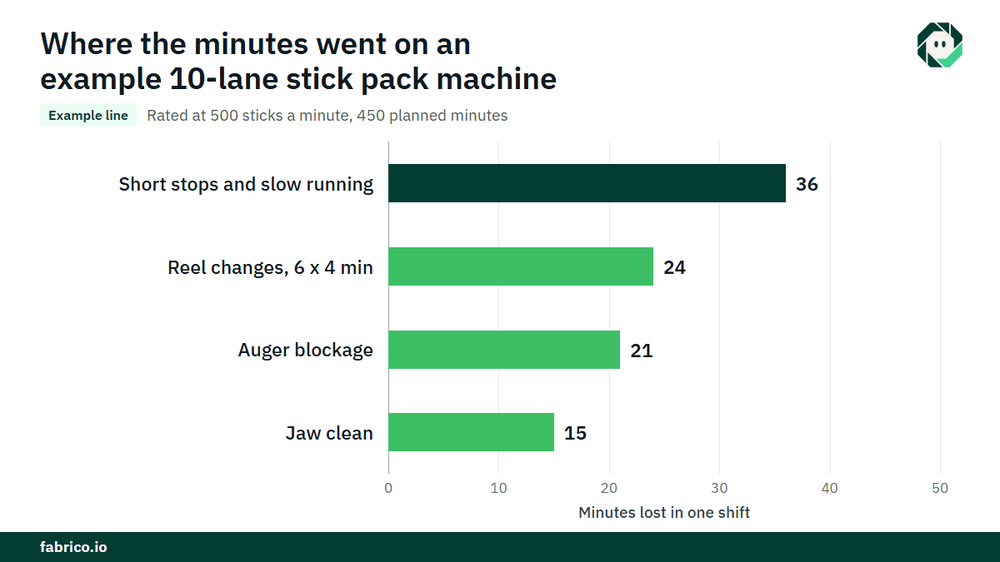
Sample line (illustrative numbers, not a customer): a 10-lane stick pack machine rated at 50 cycles a minute, so the ideal rate is 10 x 50 = 500 sticks a minute. The shift has 450 minutes of planned production time. Stops above the 2-minute cutoff total 60 minutes: six reel changes of 4 minutes (24), one auger blockage (21) and a jaw clean (15). Run time is 450 minus 60 = 390 minutes, so Availability = 390 / 450 = 86.7%.
At the ideal rate, 390 minutes should give 390 x 500 = 195,000 sticks. The counter shows 171,000, so Performance = 171,000 / 195,000 = 87.7%. Of the 24,000 missing sticks, 6,000 come from lane 7, closed for 120 minutes (120 x 50 = 6,000). The other 18,000, or 36 minutes at full rate, are short stops and slow running.
The checkweigher and the seal checks reject 3,420 sticks, so the good count is 167,580 and Quality = 167,580 / 171,000 = 98.0%. OEE = 0.867 x 0.877 x 0.980 = 74.5%. Check it the short way: 167,580 good sticks out of 450 x 500 = 225,000 possible is 74.5%.
Now price it. At a contribution of $0.03 a stick, €0.03 in a euro plant, lane 7 alone cost 6,000 x $0.03 = $180 this shift, or €180. The full gap of 225,000 minus 167,580 = 57,420 sticks is $1,722.60, or €1,722.60. The closed lane is the cheapest loss to fix here: one knife.
Where Fabrico fits
Fabrico is a computer vision enabled Manufacturing Performance Platform. On a sachet or stick pack line it starts with OEE and light MES: automatic downtime logging from the machine signal and OEE live by line and shift, so reel changes, jaw cleans and blockages are on the record without a paper log.
When the machine stops, the operator confirms the reason in one tap, so a closed lane or a splice fault gets its own code instead of a blank. Where a camera watches the forming and sealing area, a camera clip is kept as evidence for a stop. The camera suggests a reason, the operator decides.
Losses are priced in money and ranked by money, so the talk moves to what lane 7 cost this week. A stop that needs a technician becomes a work order to the right technician with its cost. One view across plants shows the same machine type side by side, and you start on one line with a decision date agreed in advance. See how computer vision works with OEE data.
Each plant gets a quote after a review of its lines.
Frequently asked questions
How do you calculate OEE on a multi-lane stick pack machine?
Set the ideal rate as rated cycles per minute times all lanes. Availability is run time over planned production time. Performance is the total count over run time times the ideal rate. Quality is good sticks over total sticks. Multiply the three.
Is a closed lane downtime?
Not on the machine: it is running, so a closed lane shows as a Performance loss with its own reason code. Measured lane by lane, the same time is an Availability loss for that lane. Machine OEE is the same either way.
What causes leaking seals on stick packs and sachets?
Most often product in the seal area, such as powder dust or a dripping nozzle. Jaw temperature, pressure or dwell away from the recipe, worn jaws and film tracking come next.
How do you count output per lane?
Some machines keep lanes apart up to the checkweigher and report by lane; others count by group. Where lanes are not kept apart, the cycle counter times the active lanes gives the machine count, and sampling by lane shows which lane makes the rejects.
See your stick pack line's losses in a demo
Bring one shift of machine data and your stop log. We will show where the lane, seal and dosing losses sit and what they cost.








Real Fabrico tiles, sample data.