






 Login
 Blog
OEE for Brewery Packaging Lines: Filler, Pasteuriser and Brand Changes

Key takeaways
- On a beer line the filler sets the pace, so line OEE is measured at the filler.
- Most filler minutes are lost to other machines: starved by the washer or depalletiser, blocked by the labeller or packer behind the pasteuriser.
- Brand changes, with new labels, crowns or ends and sometimes a beer flush, are usually the largest single loss.
- The tunnel pasteuriser is a long, slow machine. A stop behind it holds beer at temperature and can cost product as well as time.
- Price every loss in bottles or cans at the filler rate, so a labeller fault and a brand change sit on one list.
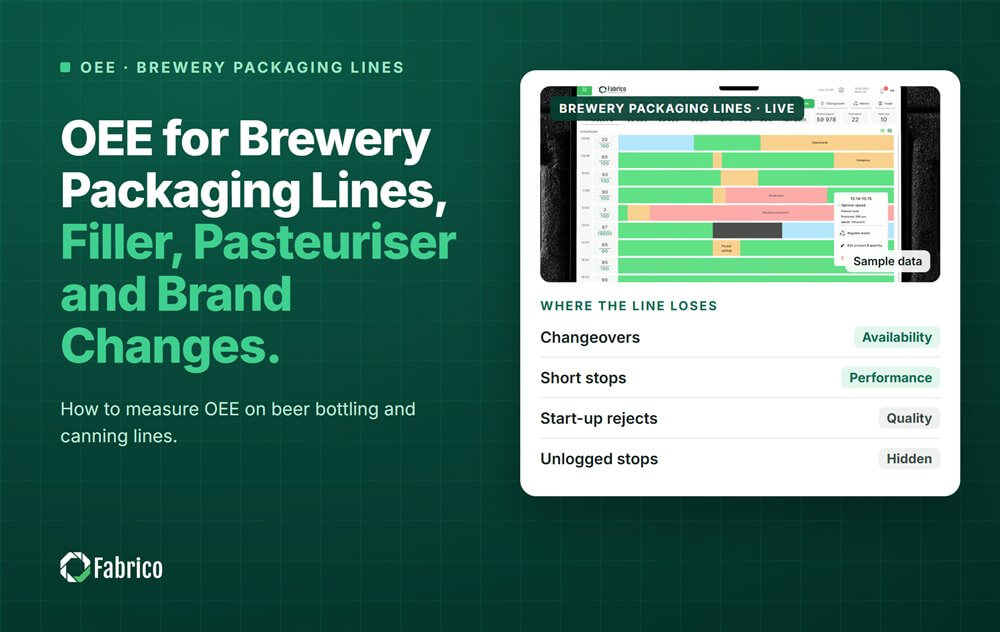
Brewery packaging OEE is measured at the filler: run time against planned time, bottles or cans filled against the filler's rated speed, and good containers at the end of the line. The real work is splitting the filler's lost minutes into its own stops, starved and blocked time, and brand changes.
Fabrico, a computer vision enabled OEE and light MES platform, does that split automatically from machine signals and asks the operator to confirm each reason in one tap. This guide is for packaging managers and line leads at breweries running glass, can and keg lines.
What is on a brewery packaging line?
- Depalletiser for new glass or cans, or a crate unpacker and bottle washer for returnable glass.
- Empty bottle inspector on glass lines.
- Filler with crowner or seamer, the pace machine, followed by fill height and closure checks.
- Tunnel pasteuriser, unless the beer is flash pasteurised or sterile filtered before filling.
- Labeller and coder, then multipack, case or crate packing and the palletiser.
Keg lines are separate: washing, sterilising and filling heads, usually measured in kegs an hour, with their own OEE.
Where does a beer line lose time?
| Area | Typical losses | Charged to |
|---|---|---|
| Depalletiser, washer, inspector | Layer pad faults, washer stops, inspector false rejects | Upstream (filler starved) |
| Filler and crowner or seamer | Bottle bursts and clean up, crown feed jams, seamer faults, fobbing | Filler |
| Tunnel pasteuriser | Zone temperature alarms, conveyor faults, hold mode | Pasteuriser |
| Labeller and packers | Label magazine empty, glue faults, packer jams | Downstream (filler blocked) |
| Whole line | Brand change, format change, beer flush, cleaning | Changeover |
Pooled data from craft brewers shows how much this matters. An OFS benchmark reported by Brewers Journal found lines filling only 54% of the time, with an average changeover of just over 49 minutes.
Why does the pasteuriser change the picture?
A tunnel pasteuriser holds many minutes of product on its deck. That gives it two habits that matter for OEE:
- It cannot simply stop. When the labeller behind it stops for long, the pasteuriser goes into a hold mode to protect the beer, and the filler is blocked once the tables in front of it are full.
- Restart takes time. After a long stop, gaps run through the pasteuriser, and the machines behind it see lack and then a rush of containers.
So a labeller fault costs filler minutes, and on some beers it can cost product quality as well. Code the minutes to the labeller, not to the filler crew. The accumulation table between the pasteuriser and the labeller is the buffer that decides how long a labeller stop can last before the filler feels it. A table holding 1,800 bottles in front of a 600 a minute line is about 3 minutes of protection.
The design idea behind this is the V curve: machines around the filler run faster so buffers can refill after a stop. Our guide to starvation and blocking explains how to read it from your data.
A worked shift on a bottling line
Sample line (illustrative numbers, not a customer): a filler rated at 600 bottles a minute for 330 ml glass, planned production time 450 minutes.
| Filler state | Minutes | Charged to |
|---|---|---|
| Brand change, labels and crowns | 35 | Changeover |
| Starved, bottle washer fault | 15 | Washer |
| Blocked, labeller down behind the pasteuriser | 25 | Labeller |
| Own stops: bursts, clean up and crown feed jams | 20 | Filler |
| Running | 355 |
- Availability = 355 / 450 = 78.9%.
- Performance: 198,000 bottles filled against an ideal of 355 x 600 = 213,000, so 93.0%. The crew ran slower on a high carbonation beer to stop fobbing.
- Quality: 2,400 fill height rejects, 300 broken bottles and 800 label rejects, 3,500 in total. Good bottles = 194,500, so 194,500 / 198,000 = 98.2%.
- OEE = 0.789 x 0.930 x 0.982 = 72.0%. Check: 194,500 / 600 = 324.2 minutes of ideal output, and 324.2 / 450 = 72.0%.
Now price it at a sample contribution of $0.12 a bottle (or €0.12 in a euro plant). The brand change cost 21,000 bottles, or $2,520. The labeller stop cost 15,000 bottles, $1,800, the same as the speed loss. The filler's own stops were 20 minutes, or $1,440.
The filler crew owns only about a fifth of the 95 lost minutes. The labeller and the brand plan own more. If the line report says "filler down 95 minutes", the crew gets the blame and the real causes keep running.
How do you cut brand change time on a beer line?
- Group brands by format. A brand change on the same bottle is shorter than a format change. Plan the week around formats.
- Prepare outside the stop. Labels, glue, crowns or ends and packaging at the machine before the last bottle of the old brand.
- Measure to the first good bottle at speed. Not to the moment the filler starts.
- Code the minutes over standard. Waiting for beer release, a missing label reel and a slow flush are different causes.
The changeover standards guide shows how to set a standard per brand pair.
What mistakes do breweries make with line OEE?
- Charging blocked and starved minutes to the filler crew.
- One rated speed for every format, so small packs look like a speed problem.
- Filtering out short stops, so crown feed jams never reach the Pareto.
- Counting only filler rejects and missing label and packer rejects at the end of the line.
- Treating each machine's OEE as if they all mattered the same, when only the filler sets output.
For the machine itself, see our filler OEE guide and labeller OEE guide.
Where does Fabrico fit in a brewery?
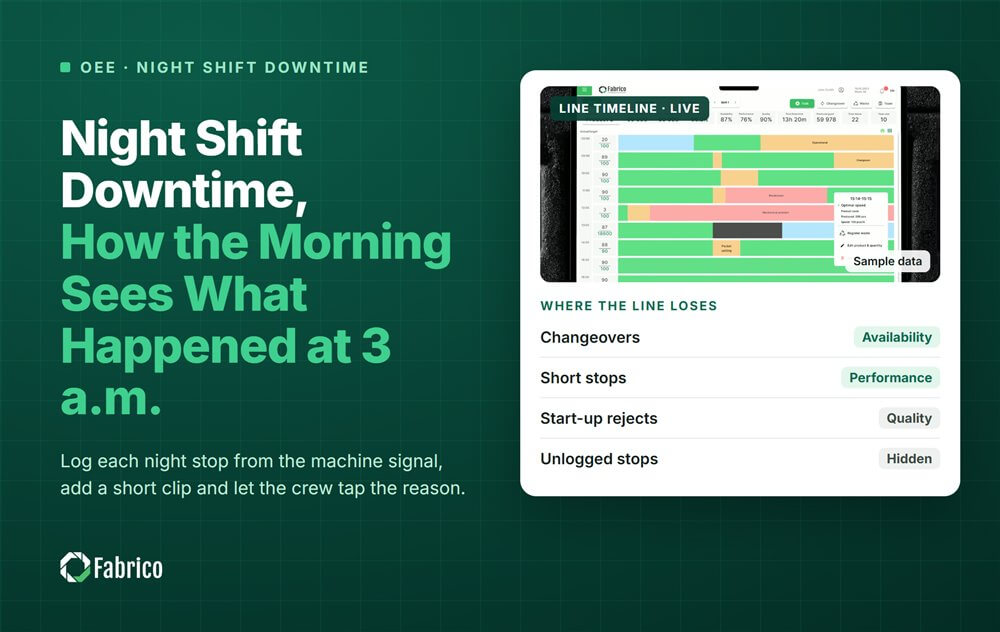
Fabrico is a computer vision enabled Manufacturing Performance Platform. OEE and light MES come first: automatic downtime logging that keeps own stops, starved and blocked time apart, and OEE live by line and shift.
- The operator confirms the reason in one tap, so a burst and a crown jam get different codes.
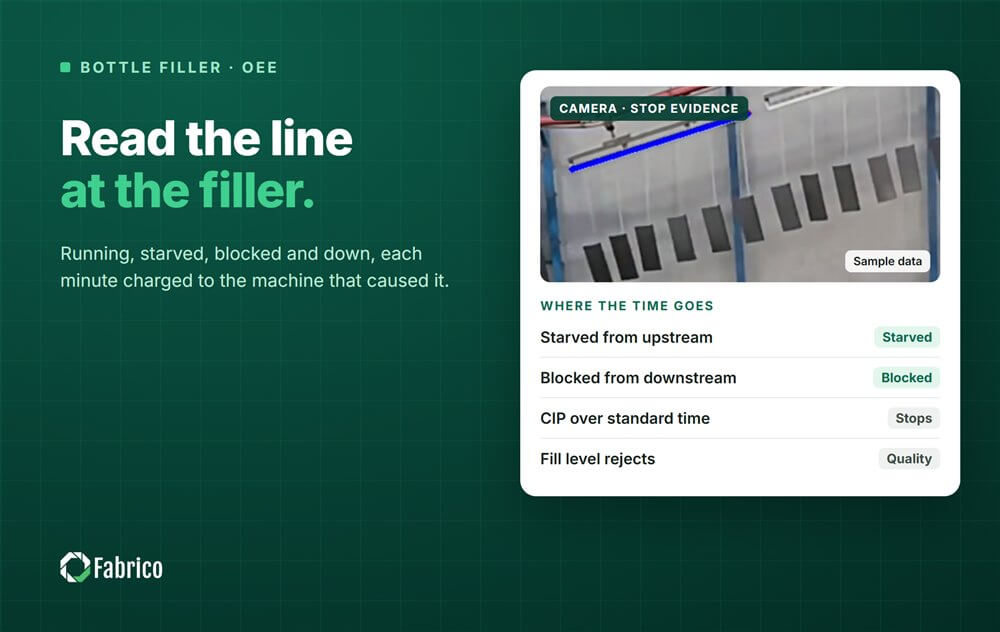
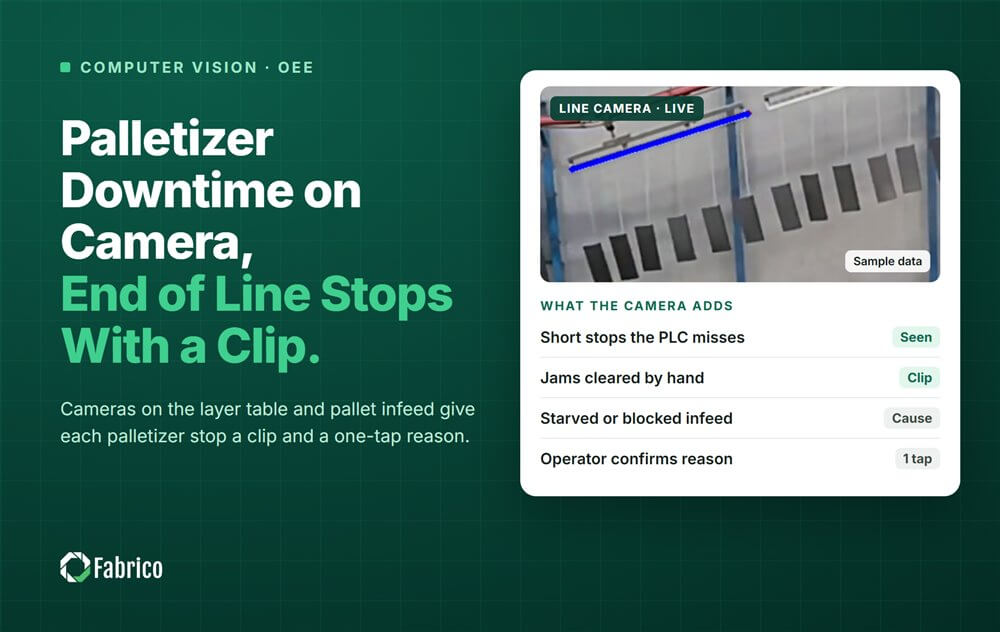
- A camera clip as evidence for a stop, where a camera watches the crowner or the labeller infeed.
- Losses priced in money and ranked, so a labeller stop that blocked the filler rises to the top.
- One view across plants, with the same brand change definitions in every brewery.
- A work order with its cost to the right technician when a stop is a breakdown.
You start on one line, with a baseline and a decision date agreed in advance. There is no free plan and there are no tiers: each plant gets a quote. See how stops are captured with computer vision OEE.
Frequently asked questions
How do you calculate OEE on a beer bottling line?
Measure at the filler. Availability is filler run time over planned production time, Performance is bottles filled over what the filler could fill at rated speed, and Quality is good bottles at the end of the line over bottles filled.
What is a good OEE for a brewery packaging line?
There is no standard. Lines with frequent brand changes score lower than lines that run one brand for days. The 85% world class figure from Nakajima came from dedicated lines, so compare your lines with their own trend first.
Should pasteuriser time count against the filler?
Count it in the line's OEE, but charge pasteuriser faults to the pasteuriser and stops behind it to the machine that stopped first. Judge the filler on its own stops.
Do keg lines need their own OEE?
Yes. A keg line has different machines, units and losses. Measure it in kegs, with its own rated speed and its own changeovers.
See your packaging line's losses in a demo
Bring one line and its current stop log. We will show the filler's own stops, its starved and blocked minutes and what each brand change cost.
Related articles


Real Fabrico tiles, sample data.