







 Login
 Blog
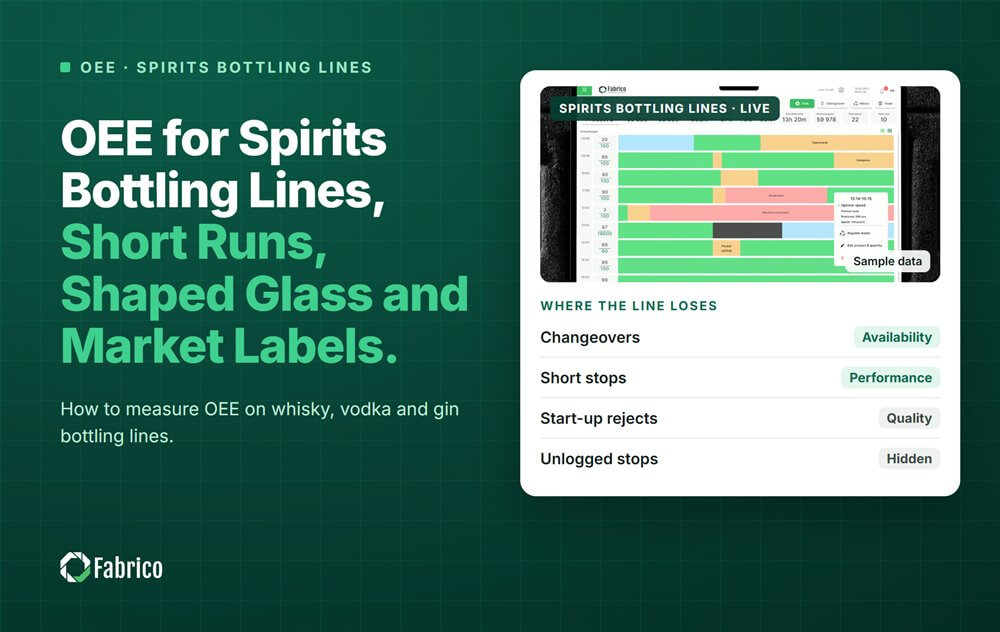
OEE for Spirits Bottling Lines: Short Runs, Shaped Glass and Market Labels

Key takeaways
- On most spirits lines, changeovers are the biggest loss. Split them into market changes (labels, stamps) and format changes (glass, closure).
- Group runs by bottle format, then run the market variants inside each format.
- Closure feeds and label applicators on shaped glass cause most short stops.
- Rejects are costly, because each bottle carries high value liquid, glass and decoration. Count them all, including relabelled bottles.
- Price lost minutes only at full contribution when the line is sold out, such as in the build before peak season.
On a spirits bottling line, OEE is usually set by changeovers, not by speed. Measure it at the filler or the slowest machine for each format, split changeovers into market and format changes, and count every bottle that needs relabelling or rework as a Quality loss.
Fabrico, a computer vision enabled OEE and light MES platform, logs those stops and changeovers automatically and keeps their minutes apart, so a plant can see which kind of change eats the week. This guide is for plant managers and packaging leads at spirits plants bottling whisky, vodka, gin, rum and liqueurs for many markets.
What makes spirits lines different?
- Many SKUs per line. One liquid can go to dozens of markets, each with its own labels, back label language, tax stamp or duty mark.
- Shaped and heavy glass. Premium bottles are tall, square or decorated, which makes handling, labelling and guide changes harder.
- Varied closures. Screw caps, bar top stoppers and special closures, each with its own feed system.
- Manual stations. Neck collars, gift boxes and seasonal packs often need people on the line.
- High value per bottle. A reject costs liquid, glass, closure and decoration, not just a few cents of packaging.
Where does a spirits line lose time?
| Loss | Typical causes | OEE factor |
|---|---|---|
| Market change | New labels, stamps, cases and codes, same bottle | Availability |
| Format change | New glass, guides, star wheels, closure head, labeller settings | Availability |
| Waiting for liquid | Blend not released by the lab, tank not ready | Availability, charged to the process side |
| Closure feed | Jams in the sorter or chute, stoppers not seated | Short stops |
| Labelling | Labels skewed on shaped glass, applicator faults, stamp misplaced | Short stops and Quality |
| Manual packing | Gift box station short of people, line slowed | Performance |
How should spirits plants handle changeovers?
Treat the two kinds of change as different losses with different standards.
- Market change. Same bottle and closure, new labels, stamps, cases and print. The work is materials, checks and the first good bottle approval. Most of it can be prepared while the line runs.
- Format change. New glass means new guides, change parts, closure heads and label settings. This is the long one, and the one to plan the week around.
Time each change from the last good bottle of the old SKU to the first good bottle of the new one at rated speed. Then split the steps into internal and external, the core idea of SMED. The sequencing by changeover cost guide shows how to order runs so a week has fewer format changes.
A first off check after each market change matters here. A wrong language label shipped to the wrong market is a far bigger cost than the minutes saved. Our guide to first off approval shows how to keep the check fast.
A worked shift on a spirits line
Sample line (illustrative numbers, not a customer): a line rated at 150 bottles a minute for a 70 cl bottle, planned production time 450 minutes.
| Event | Minutes | Bottles not made (x 150) |
|---|---|---|
| Market change, same bottle | 25 | 3,750 |
| Format change, new bottle and closure | 70 | 10,500 |
| Waiting for blend release | 15 | 2,250 |
| Closure feed jams, 20 x 1 minute | 20 | 3,000 |
| Label applicator faults | 10 | 1,500 |
| Running | 310 |
- Availability = 310 / 450 = 68.9%.
- Performance: 43,400 bottles against an ideal of 310 x 150 = 46,500, so 93.3%. The line ran slower while the gift box station was one person short.
- Quality: 500 skewed labels, 120 fill level rejects, 180 scuffed or broken bottles and 100 closure rejects, 900 in total. Good bottles = 42,500, so 42,500 / 43,400 = 97.9%.
- OEE = 0.689 x 0.933 x 0.979 = 63.0%. Check: 42,500 / 150 = 283.3 minutes of ideal output, and 283.3 / 450 = 63.0%.
The two changeovers took 95 minutes, more than half of the 140 lost minutes. If both had been market changes inside one format, the shift would have lost about 50 minutes to changeovers instead.
How do you price losses on a spirits line?
Use contribution margin, and only when the line is the constraint and the market takes the bottles. On the sample line above (illustrative numbers, not a customer), at a contribution of $2.00 a bottle (or €2.00 in a euro plant), the format change cost 10,500 bottles, or $21,000 a shift, in the weeks when the line is sold out.
Outside those weeks, the same minutes do not cost lost sales. They cost overtime, extra shifts or a later delivery. Agree the pricing rule with your controller before you report money, and say which rule each figure uses.
Rejects are priced differently. A rejected bottle costs its liquid, glass, closure and decoration, unless the liquid is recovered. In the sample, the 500 skewed labels are the largest reject group, and each one needs relabelling or scrapping. That points at the label applicator settings for that bottle shape.
What mistakes do spirits plants make with OEE?
- One changeover code for both market and format changes, so the long ones hide inside an average.
- Pricing every lost minute at full contribution, even in weeks when the line has spare capacity.
- Not counting relabelled bottles as rejects, because they were saved later.
- One rated speed for every bottle, even though tall or square glass runs slower.
- Leaving manual station shortages out of the stop log, so Performance drops with no reason.
For the machines themselves, see our guides to labeller OEE and case packer OEE.
Where does Fabrico fit on a spirits line?
Fabrico is a computer vision enabled Manufacturing Performance Platform. OEE and light MES come first: automatic downtime logging that keeps own stops, starved and blocked time apart, and OEE live by line and shift.
- The operator confirms the reason in one tap, so a market change and a format change get different codes.
- A camera clip as evidence for a stop, where a camera watches the closure feed or the labeller.
- Losses priced in money and ranked, with the pricing rule your controller agreed.
- One view across plants for bottling sites that serve different markets.
- A work order with its cost to the right technician when a stop is a breakdown.
You start on one line, with a baseline and a decision date agreed in advance. There is no free plan and there are no tiers: each plant gets a quote. Read how a light MES brings this to a bottling hall.
Frequently asked questions
What is a good OEE for a spirits bottling line?
There is no standard. High mix spirits lines with many market changes score well below dedicated lines. Track the share of time lost to changeovers and compare each line with its own trend.
Should market changes count as downtime?
Yes, as an Availability loss with its own code. Give market changes and format changes separate standards, so you can see which one grows.
How do you count relabelled bottles in OEE?
Count them as rejects in Quality, even if they are saved later. The rework took time, labels and people, and the first pass was not good.
Which machine should set the ideal rate?
The slowest machine for that format, often the filler or the labeller on shaped glass. Set it per bottle format, not one figure for the whole line.
See your bottling line's losses in a demo
Bring one line and its changeover log. We will show market and format changes, closure and label stops, and what each one costs.
Latest from our blog


Real Fabrico tiles, sample data.