


 Login
 Blog
OEE for Beverage Can Making Lines: Bodymakers, Spoilage and Tooling

Key takeaways
- On most can lines the bodymaker group sets the pace. The line's ideal rate is the sum of the bodymakers' rated output.
- With many parallel machines, measure Availability in machine-minutes: one bodymaker down is a tenth of the group, not a line stop.
- Decorator and necker stops that fill the accumulation block the front end. Charge that time to the machine that caused it.
- Spoilage is the Quality loss: every can that left a bodymaker and never reached a good pallet.
- Bodymaker tooling changes happen one machine at a time. Count them, stage the tool packs, and price the minutes.
Bodymaker 6 has been down for forty minutes for a tool change, and the other nine are running. The line counter still shows thousands of cans a minute, so nobody calls it a stop. On a line OEE that measures only full stops, those forty minutes do not exist, yet they cost the same cans as four minutes of the whole line standing still.
Can making lines are different from most packaging lines. The front end is a group of identical machines in parallel, the middle is a chain of ovens and coaters, and the back end runs cans in their thousands through printers, neckers and testers. Losses come one machine at a time, as a whole line, and as cans scrapped along the way.
This guide covers the line, the ideal rate, parallel machines, the decorator and necker, tooling changes, spoilage, data sources and a worked shift.
Where the time goes on a can making line
Aluminium coil is uncoiled and lubricated, then the cupper blanks and draws shallow cups. The cups go to the bodymakers, which redraw and iron them into tall can bodies and form the dome. Trimmers cut the top edge, the washer cleans the cans and the dryer dries them. The decorator prints the outside on a mandrel wheel and the pin oven cures the ink. Inside spray machines coat the inside, the internal bake oven cures it, and the necker forms the neck and flange in several stages. A light tester looks for pinholes and cracks, then the cans are palletized.
Time is lost at every one of those machines, but it is lost in different ways. A bodymaker stop costs one machine's share. A decorator or necker stop can stop the whole back end and, once the accumulation is full, the front end too.

The ideal rate: the bodymaker group
On most lines the bodymakers set the pace and the machines after them are built to handle the group's total output. The line's ideal rate is then the sum of each bodymaker's rated strokes per minute: ten bodymakers rated at 300 a minute give 3,000 cans a minute.
Use the rated speed for each bodymaker on the current can size and metal gauge, not a good day's average. If one bodymaker is rated lower because of its age or its tooling, use its own figure. And check the assumption: if your decorator or necker is the slower machine on a given can, that machine sets the pace, and the line's ideal rate is its rated speed. Our guide to finding the real constraint on linked lines covers how to tell.
Parallel machines: count machine-minutes
With ten bodymakers, the honest unit of time is the machine-minute. A 480-minute shift has 10 x 480 = 4,800 bodymaker-minutes. One bodymaker down for 40 minutes takes 40 of them; the whole group blocked for 10 minutes takes 100. Availability for the group is running machine-minutes over planned machine-minutes, and the same logic works for trimmers and inside spray machines.
This weights each stop by the capacity it removes, which is what the cans on the pallet feel. A line view that counts only full stops misses the single-machine losses. A view that averages machine OEE without weighting gets the same wrong answer from the other side. Our guide on how to calculate OEE for multiple machines shows both errors.
Decorator and necker stops
The decorator is where design changes, ink and print quality meet. Typical stops are blanket changes, ink and plate changes for a new design, cans not loading onto the mandrels, and print faults that send cans to scrap. The necker has many tooling stages in a row, and a can that is out of round or damaged can jam it.
Both sit downstream of the bodymakers, so their stops first fill the accumulation and then block the front end. When that happens, the bodymakers show as stopped with nothing wrong. Code that time as blocked and charge it to the machine that caused it. Otherwise the Pareto will point at the bodymakers and the decorator's problem will never get its own figure.
Typical stops and their causes
| Machine | Typical stop or loss | Usual cause | Effect on the line |
|---|---|---|---|
| Cupper | Stop, misfed cups | Coil change, lubrication, tooling | Starves all bodymakers |
| Bodymaker | Jam, tool change, breakdown | Tool wear, cup misfeed, metal defects | One machine's share |
| Trimmer | Jam, poor trim | Knife wear, set-up | Partial, then spoilage |
| Washer and ovens | Conveyor stop, temperature fault | Chemistry, burner or belt fault | Whole line |
| Decorator | Blanket or plate change, misload, misprint | Design change, ink, blanket wear | Back end, then front end blocked |
| Necker | Jam, crushed cans | Damaged cans, tooling stage | Back end, then front end blocked |
| Light tester and inspection | Rejects | Pinholes, cracks, damage upstream | Spoilage |
Tooling changes
Bodymaker tooling wears and is changed one machine at a time, while the rest of the group runs. Each change is a loss of one machine's share for as long as it takes. A gauge or can size change touches more of the line at once: bodymakers, trimmers, the decorator and the necker tooling.
The SMED method applies directly: separate the steps that need the machine stopped from those that can be done while it runs, and move as much as possible to the second group. Tool packs pre-set and staged at the machine, the right tools on a cart, and a written check sheet for the first cans. Our guide to SMED explains the method. Count each change from the last good can to the first good can at rated speed, so the tuning after the change is not lost.
Spoilage: the Quality loss
Spoilage is every can that left a bodymaker and did not reach a good pallet: trimmer rejects, damaged cans, misprints, coating faults, necker jams, light tester rejects. In OEE terms the Quality factor is good palletized cans over the cans the bodymakers made.
Measure it in two places at least: the bodymaker count at the front and the palletized count at the back. The gap is the spoilage. Then count rejects at each station, because a spoilage figure without a station does not tell anyone what to fix. Our guide to the OEE Quality factor explains what counts as good. Designed metal scrap, such as the cupper skeleton and the trim ring, is material yield and belongs in its own figure, not in OEE.
What each data source sees
- Stroke counters on each bodymaker give its output and when it ran.
- Can counters and reject counters along the line give where cans were lost.
- The PLCs give states and alarms, and often whether a machine is blocked or starved.
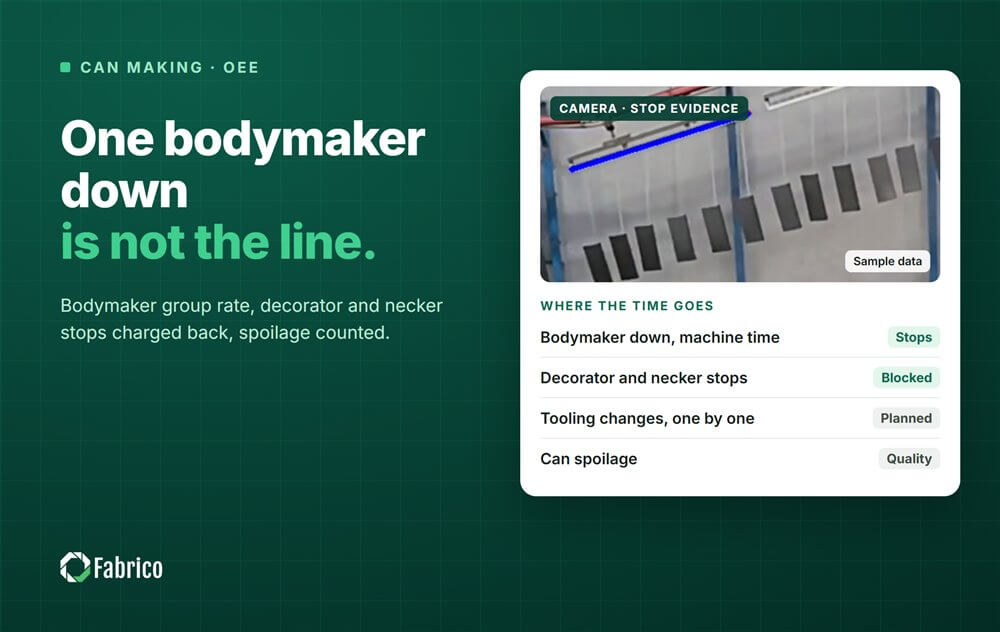
- A camera at the decorator infeed or the necker infeed shows what an alarm cannot: the can that went down, the jam building on the single filer. The clip is the evidence for the stop.
- The operator confirms the reason.
A worked shift
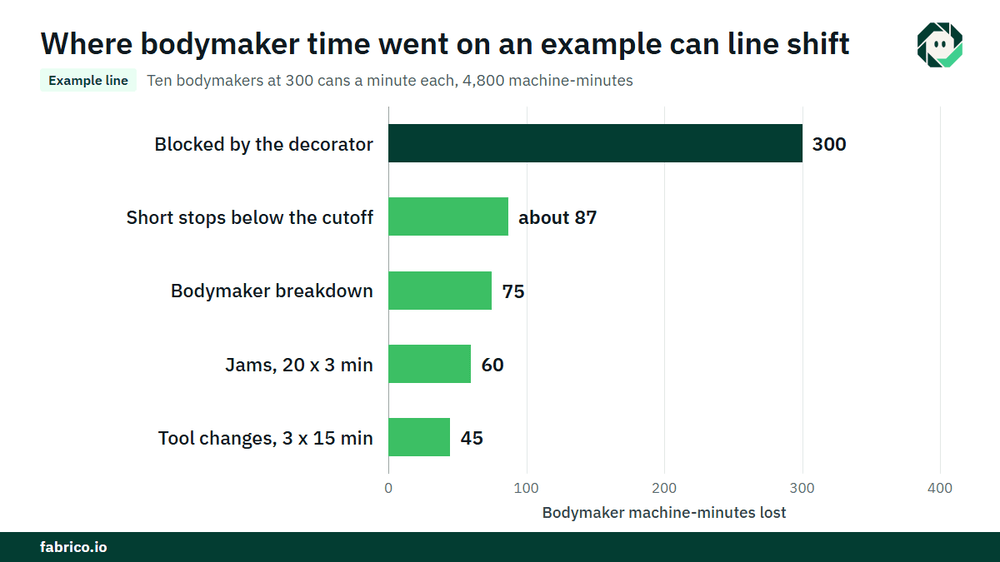
Sample line (illustrative numbers, not a customer): ten bodymakers rated at 300 cans a minute each, so the ideal rate is 3,000 cans a minute. The shift has 480 minutes of planned production time, so 1,440,000 cans are possible and the group has 10 x 480 = 4,800 bodymaker-minutes.
Bodymaker stops above the 2-minute cutoff: three tool changes of 15 minutes (45), twenty jams of 3 minutes (60) and one breakdown of 75 minutes, 180 machine-minutes. A blanket problem stops the decorator long enough to fill the accumulation, and all ten bodymakers are blocked for 30 minutes: 300 machine-minutes. Running time is 4,800 minus 480 = 4,320, so Availability = 4,320 / 4,800 = 90.0%.
At 300 a minute, 4,320 machine-minutes should give 1,296,000 bodies. The counters show 1,270,000, so Performance = 1,270,000 / 1,296,000 = 98.0%. The 26,000 missing are about 87 machine-minutes of short stops below the cutoff.
Spoilage is 25,400 cans, so 1,244,600 good cans reach the pallets and Quality = 1,244,600 / 1,270,000 = 98.0%. OEE = 0.900 x 0.980 x 0.980 = 86.4%. Check: 1,244,600 out of 1,440,000 possible is 86.4%.
Price it. At a contribution of $0.01 a can, €0.01 in a euro plant, the decorator stop cost 300 x 300 = 90,000 cans, or $900 (€900), and it belongs to the decorator, not the bodymakers. The spoilage, at $0.02 of metal and coating per scrapped can (€0.02), is 25,400 x $0.02 = $508, or €508. The three tool changes took 45 x 300 = 13,500 cans, $135 (€135).
Where Fabrico fits
Fabrico is a computer vision enabled Manufacturing Performance Platform. On a can making line it starts with OEE and light MES: automatic downtime logging from the machine signals and OEE live by line and shift, so a single bodymaker down is recorded as well as a full line stop.
The operator confirms the reason in one tap, so blocked by the decorator is coded as such and not charged to the bodymakers. Where a camera watches a station such as the decorator infeed, a camera clip is kept as evidence for a stop. The camera suggests the reason, the operator decides.
Losses are priced in money and ranked by money, so a tool change, a blanket problem and spoilage at the necker can be compared in one currency. A breakdown becomes a work order to the right technician with its cost. One view across plants compares can lines across sites, and you start on one line with a decision date agreed in advance. See how downtime tracking records each stop.
Each plant gets a quote after a review of its lines.
Frequently asked questions
How do you calculate OEE on a can making line?
Use the bodymaker group's total rated output as the ideal rate, unless another machine is slower on that can. Availability is running machine-minutes over planned machine-minutes, Performance is bodies made over the ideal for the running time, and Quality is good palletized cans over bodies made.
Is one bodymaker down a line stop?
No. It removes one machine's share of capacity. Count it in machine-minutes so it weighs what it costs in cans.
What is spoilage on a can line?
Every can that left a bodymaker and did not reach a good pallet: trimmer rejects, damage, misprints, coating faults, necker jams and light tester rejects. It is the Quality loss in OEE.
Which machine is the bottleneck on a can line?
On most lines the bodymaker group sets the pace. Check it for each can size, because on some sizes the decorator or necker can be the slower machine.
See your can line's losses in a demo
Bring one shift of bodymaker counts and the palletized total. We will show where the machine-minutes and the cans went, and what each loss costs.








Real Fabrico tiles, sample data.