


 Login
 Blog
OEE for Food Canning Lines: Seamer, Retort and Labelling

Key takeaways
- Measure line OEE at the seamer, the pacing machine, in cans a minute at its rated speed for that can size.
- Give batch retorts their own OEE; when they are full, the seamer is blocked, and that loss belongs to the retort area.
- Can size and product changes get their own codes and standard times; product line cleaning is measured, never shortened.
- Seam defects, fill errors, dented cans and retort holds are quality losses.
- Where the seamer PLC says only 'stopped', a camera clip at the infeed shows what happened, and the operator confirms the reason.
At 14:20 the crate loader in front of the retorts is full. All four retorts are mid-cycle, so the seamer stops, then the filler, and the next twenty minutes go into the shift log as 'seamer stopped'. The OEE report charges the seamer. The real cause sits in the retort room, and nobody fixes it there.
A food canning line is a continuous line with a batch step in the middle. This guide covers how to measure OEE on it: why the seamer sets the pace, the usual stops by station, how to treat the retort, changeovers, the quality losses from seam to label, and a worked shift with the losses priced.
The canning line and where the time goes
Empty cans come off a depalletiser, are rinsed upside down and fed to the filler, which fills the product and often tops up with brine, sauce or syrup. The double seamer puts the lid on and closes the can. A coder marks it, a crate loader packs cans into retort baskets, and batch retorts heat, hold and cool each load. After unloading and drying, cans are labelled, packed into trays or cases and palletised.
Many plants store unlabelled cans and label them later for each order. Then labelling is a separate line with its own OEE. The time on the main line goes in four places: seamer and filler stops, retort capacity, changeovers between can sizes or products, and handling damage on the way through.

The seamer sets the pace
The filler and seamer usually run as one synchronised unit, and the seamer's rated speed for a can size is the line's pace. Use it as the ideal rate: cans a minute for that can size, from the machine's rating or a tested maximum, not a good week's average. Smaller cans often run faster, so each size gets its own ideal.
Measure line OEE at the seamer, in cans. Count a can as good when it has passed the seam and fill checks and its retort load is released; if the load is not released, the can is a reject. Our guide to finding the real constraint on linked lines explains why the line figure belongs at the pacing machine.
Stops by station
| Station | Typical stops | OEE factor |
|---|---|---|
| Depalletiser and rinser | Layer pad not removed, cans down on the table, rinser jam | Availability, or starving the filler |
| Filler | Product supply from the kitchen, pocket or piston faults, spills on the flange | Availability; fill weight errors are quality |
| Seamer | Can jam at the infeed, lid magazine empty, double lids, seam out of spec at a check | Availability for long stops, Performance for short ones |
| Crate loader and retorts | Baskets full, no free retort, crate loader jam | Blocking the seamer |
| Labeller | Label magazine empty, glue problems, label off pitch | Availability on the labelling line |
| Tray or case packer | Case magazine empty, glue gun clog, film splice on the shrink wrapper | Availability, or blocking upstream |
Short seamer stops are the ones nobody writes down: a can down at the infeed, a lid that did not drop. Set a threshold, many plants use two to five minutes, keep it the same on all lines, and give stops above it a reason from a short list. Our guide to downtime reason code design shows how to keep that list usable.
The retort: a batch step inside a continuous line
A batch retort runs a cycle: load, come-up, hold at the process temperature, cool, unload. The cycle for each product and can size is set by the validated thermal process, and it is not a place to win minutes. What OEE can show is how well the retort room keeps up with the seamer.
Give the retorts their own OEE. Availability is the time retorts are processing against the time they were planned to process. Performance is loads completed against the loads the validated cycle time allows. Quality is loads released without a deviation. Our guide to OEE in batch manufacturing covers the method.
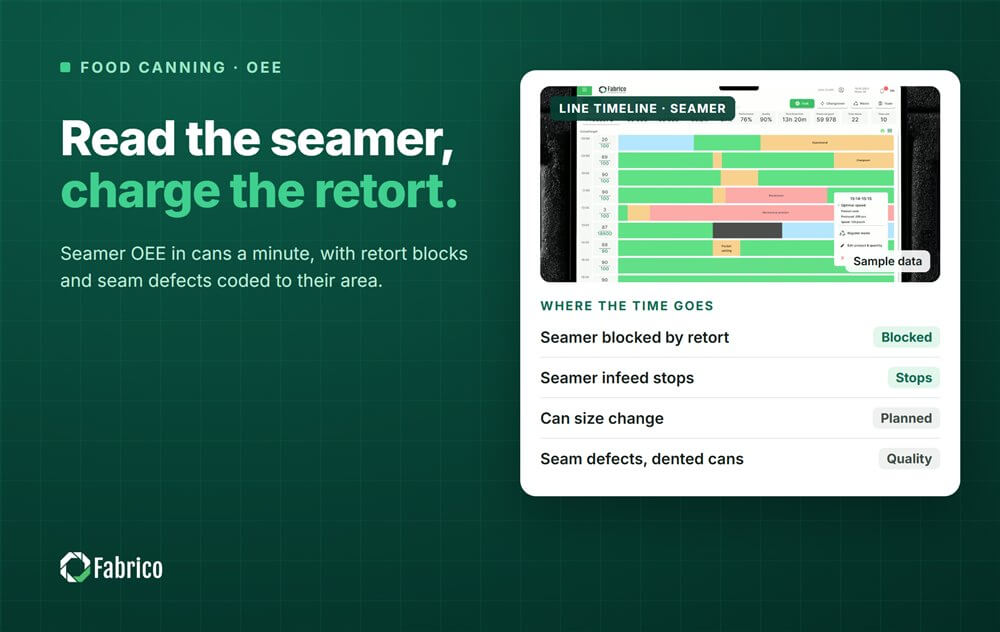
Then link the two. When all retorts are busy and the crate loader is full, the seamer has to stop, and many processes also set a maximum wait between seaming and the retort. Code that stop 'blocked by retort', charge it to the retort area, and look at what caused it: a slow unload, a retort out of service, baskets not back in time. Speeding up the seamer does nothing while the retorts are the limit.
Changeovers: can size and product
A can size change means change parts on the seamer and the filler, starwheels and guides, new lid stock, new crate loader and labeller settings, and often a different retort process. Log each part, record a standard time and give each minute over it a reason. Much of it is open to SMED: prepare and preset the change parts while the line still runs.
A product change can add cleaning of the filler and the product lines from the kitchen. That cleaning, and any allergen clean, is a food safety control: measure it, give it its own code, keep it apart from breakdowns, and never shorten it to lift OEE.
Quality: seams, fill, dents and labels
Quality is good cans over cans made. The usual losses on a canning line:
- Seam defects found at a seam check or teardown, and cans pulled after a seamer adjustment.
- Fill weight or headspace out of range, found by the checkweigher or the fill level check.
- Dented cans from conveyor impacts, crate loading and basket unloading.
- Buckled or panelled cans from pressure differences in the retort, and loads held after a process deviation.
- Missing or misplaced labels and codes.
Count each loss where it is found, but book it to the station that caused it: a dent made at the unloader is not a labeller problem. Fill above the declared weight does not reduce the good count, but it is product given away. More on this factor in our guide to OEE quality.
Data sources and the camera
The seamer PLC gives state, speed and count; the filler gives fill samples; the fill level check and the checkweigher give rejects. The retort controller records each cycle's start, steps and end, so retort OEE can be calculated from the cycle log. The labeller and packers give their own states. The operator gives the reason in one tap.
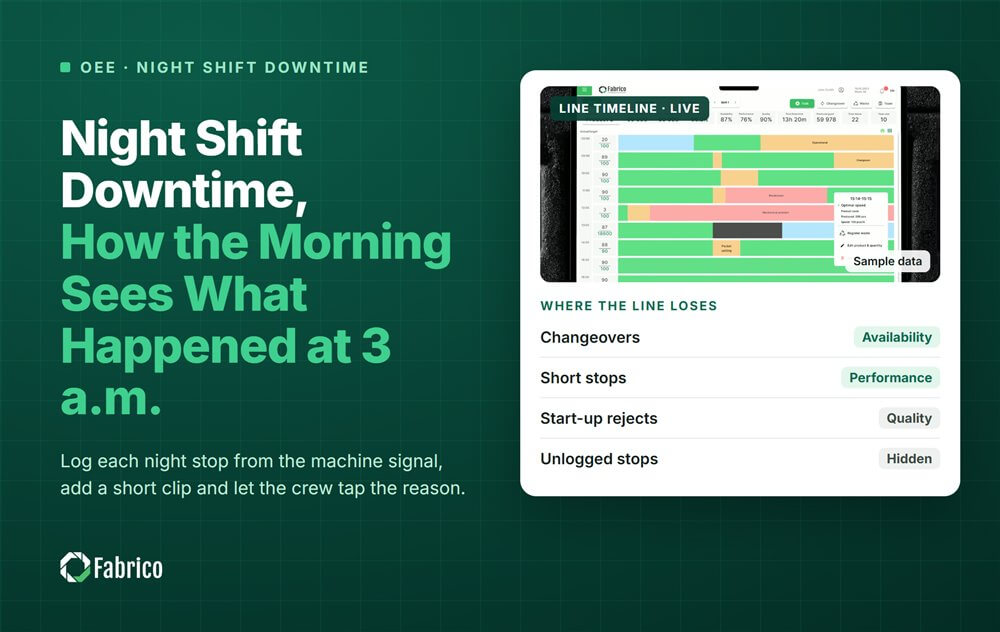
Where the seamer PLC says only 'stopped', a camera at the seamer infeed or the crate loader keeps a clip of what happened: a can down, a lid jam, a basket not cleared. The software suggests a reason, the operator confirms it, and the clip stays with the stop as evidence.
A worked shift on a canning line
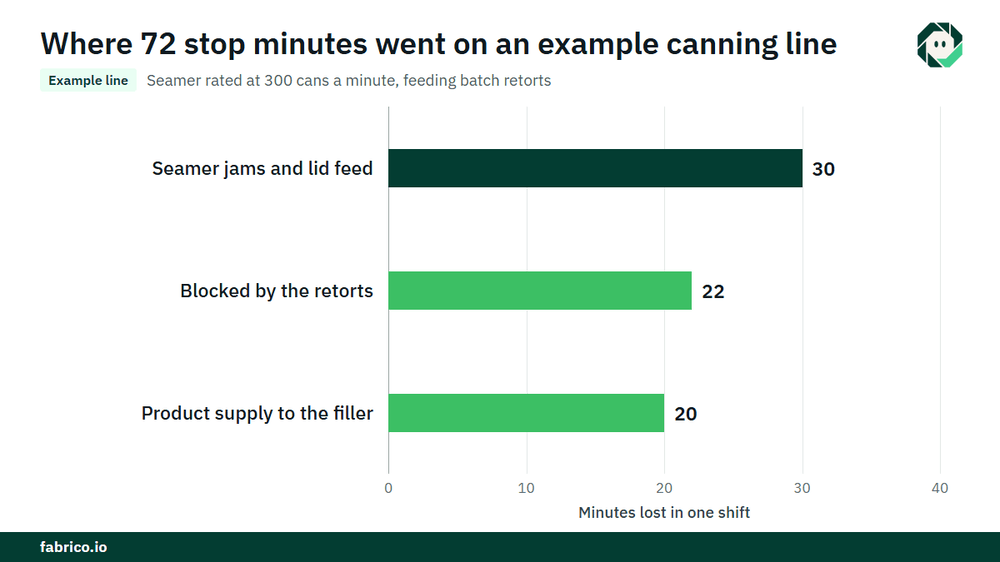
Sample line (illustrative numbers, not a customer): a seamer rated at 300 cans a minute for this can size, feeding batch retorts. Planned production time is 480 minutes.
- Stops: blocked by retort 22 minutes, seamer jams and lid feed 30, product supply to the filler 20. Total 72 minutes.
- Run time = 480 minus 72 = 408 minutes. Availability = 408 / 480 = 85.0%.
- Ideal output: 408 x 300 = 122,400 cans. Made: 110,160. Performance = 110,160 / 122,400 = 90.0%.
- Seam, fill and dent rejects: 1,160. Good cans: 109,000. Quality = 109,000 / 110,160 = 98.9%.
- OEE = 0.850 x 0.900 x 0.989 = 75.7%. Check: 109,000 / 300 = 363.3 minutes at ideal rate, and 363.3 / 480 = 75.7%.
Now price it. The speed loss is 122,400 minus 110,160 = 12,240 cans. Blocked by retort cost 22 x 300 = 6,600 cans. If the line is sold out and a can carries $0.15 of contribution (€0.15 in a euro plant), the speed loss costs $1,836 a shift and the retort blocking $990. Over 500 shifts a year that is $918,000 and $495,000, or €918,000 and €495,000. The second number is the case for looking at the retort room, not the seamer.
Mistakes plants make on canning lines
- Charging 'blocked by retort' stops to the seamer.
- Using one ideal rate for all can sizes.
- Counting cans as good before their retort load is released.
- Booking dents to the station that found them, not the one that made them.
- Trying to win minutes from the thermal process or the product line cleaning.
Where Fabrico fits
Fabrico is a computer vision enabled Manufacturing Performance Platform. On a canning line it starts with OEE and light MES: automatic downtime logging at the seamer, the filler, the retort area and the packers, and OEE live by line and shift.
- The operator confirms the reason in one tap, so 'blocked by retort' and 'seamer jam' stay apart.
- A camera clip as evidence for a stop where a camera watches the station, such as the seamer infeed or the crate loader.
- Losses priced in money and ranked by money, so the retort blocking and the seamer speed loss compare in dollars or euros.
- One view across plants for groups running several canning lines.
- For a breakdown, a work order to the right technician with its cost.
The thermal process, its records and the release of each load stay with the plant's own systems and procedures. You start on one line, with a measured baseline and a decision date agreed in advance. Each plant gets a quote after a review of its lines.
Frequently asked questions
How do you calculate OEE on a canning line?
Use the seamer as the pacing machine. Availability is run time over planned production time, Performance is cans made over what the seamer's rated speed allows in that run time, and Quality is good cans over cans made. Multiply the three.
Is the seamer or the retort the bottleneck?
It depends on the product and the can size. If the seamer often stops as 'blocked by retort', the retorts are the limit for that product. Log that reason separately and the answer shows up in the data.
How do you measure OEE for a batch retort?
Treat it as batch equipment: processing time against planned time, loads completed against what the validated cycle time allows, and loads released without deviation. The retort controller's cycle log gives most of the data.
Are dented cans a quality loss?
Yes. A dented or damaged can that is rejected was not good the first time. Book it to the station that caused it, so the fix goes to the right place.
Should labelling have its own OEE?
Yes, when unlabelled cans are stored and labelled later. The labelling line then has its own planned time, rate and stops, separate from filling and seaming.
See your canning line's losses in a demo
Bring the stops and rates from one seamer and its retorts, and we will show the losses priced in money, by station and by shift.
Related articles











Real Fabrico tiles, sample data.