







 Login
 Blog
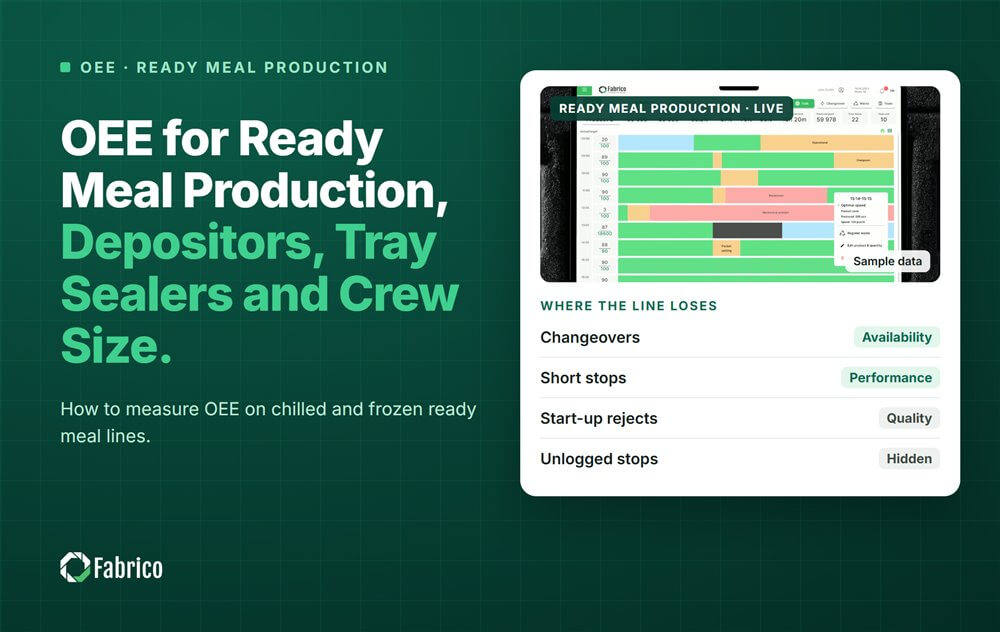
OEE for Ready Meal Production: Depositors, Tray Sealers and Crew Size

Key takeaways
- On a ready meal line the pace is often set by people at the topping stations, not by the tray sealer. Set the ideal rate for the standard crew.
- Running short of people is a speed loss with a reason. Do not lower the ideal rate to hide it.
- Product and allergen changes are usually the largest loss, because ready meal runs are short.
- Waiting for components from the kitchen is starved time, charged to the kitchen, not to the assembly crew.
- Giveaway from depositing sits outside OEE but often costs as much as a stop. Weigh it.
To measure OEE on a ready meal line, take the tray sealer or the slowest station as the count point, set the ideal rate for the standard crew, and split lost time into changeovers, waiting for the kitchen, own stops and short crew. Then weigh giveaway, because on ready meals the ingredient cost is high.
Fabrico, a computer vision enabled OEE and light MES platform, logs line stops automatically and asks the operator to confirm the reason in one tap, so short crew, kitchen delays and sealer faults land in different codes. This guide is for plant managers and CI leads at chilled and frozen ready meal plants.
What does a ready meal line look like?
- Kitchen. Components are cooked in batches, then cooled in blast chillers before assembly.
- Tray denester. Places empty trays on the line.
- Depositors. Machines dose rice, pasta, sauce or mash.
- Topping stations. People place protein, vegetables and garnish by hand.
- Tray sealer. Seals film on the tray, often with a modified atmosphere.
- Checks and packing. Checkweigher, metal detector or X ray, sleeve or carton, use by date label, case packing. Frozen meals pass a freezer first.
Where does a ready meal line lose time?
| Loss | Typical causes | OEE factor |
|---|---|---|
| Product changes | New recipe, new film and sleeve, allergen clean | Availability |
| Starved by the kitchen | Component not cooked or not chilled in time | Availability, charged to the kitchen |
| Short crew | Topping station unstaffed, line slowed | Performance |
| Machine short stops | Denester jams, depositor blockages, film breaks and splices | Short stops |
| Food safety stops | Line stopped to check after metal detector rejects | Availability, with its own code |
| Rejects | Underweight, seal faults, wrong date code | Quality |
Food safety checks follow the plant's HACCP plan and must never be shortened to win OEE. Code them so you can see how often they happen and why.
How do you set the ideal rate when people set the pace?
On many ready meal lines the tray sealer could run faster than the people can top trays. So the real pace is the standard crew at the agreed rate per recipe.
- Set the ideal rate per recipe for the standard crew size, and write it down.
- When the line runs one person short, book the slower rate as speed loss with the reason short crew.
- Never lower the ideal for the day because the crew is short. That hides a cost the plant can act on, through cover plans and training.
Measure the process, never the person. OEE here shows how the line ran with the crew it had, not who worked well. That matters for trust on the floor and, in many countries, for the works council.
How do changeovers and allergens hit ready meal OEE?
Ready meal plants run many recipes a day in short runs. Each change means new components, depositor settings, film, sleeves and labels, and sometimes a validated allergen clean.
- Sequence recipes so allergen meals run last before a clean.
- Stage the next recipe's components, film and sleeves before the last tray of the current one.
- Time each change to the first good tray at rated speed, and code the type: recipe change, allergen clean, format change.
See our guides to allergen changeover validation and sequencing by changeover cost.
A worked shift on a ready meal line
Sample line (illustrative numbers, not a customer): a chilled meal line with a tray sealer and a standard crew of eight on the topping stations, an ideal rate of 60 trays a minute for a 400 g pasta meal, and planned production time of 450 minutes.
| Event | Minutes | Trays not made (x 60) |
|---|---|---|
| Three product changes, one with an allergen clean (15 + 15 + 45) | 75 | 4,500 |
| Starved, sauce not ready from the kitchen | 20 | 1,200 |
| Film breaks and splices, 4 x 3 minutes | 12 | 720 |
| Denester jams, 10 x 1 minute | 10 | 600 |
| Metal detector reject checks, 2 x 4 minutes | 8 | 480 |
| Running | 325 |
- Availability = 325 / 450 = 72.2%.
- Performance: for 260 minutes the line was one person short and ran at 50 trays a minute. It made 16,900 trays against an ideal of 325 x 60 = 19,500, so 86.7%.
- Quality: 250 underweight, 150 seal faults, 80 label faults and 20 metal detector rejects, 500 in total. Good trays = 16,400, so 16,400 / 16,900 = 97.0%.
- OEE = 0.722 x 0.867 x 0.970 = 60.7%. Check: 16,400 / 60 = 273.3 minutes of ideal output, and 273.3 / 450 = 60.7%.
At a sample contribution of $0.80 a tray (or €0.80 in a euro plant), the changeovers cost $3,600 and the short crew cost 2,600 trays, or $2,080. The kitchen delay cost $960. The sealer and denester stops, which fill most of the stop log, cost far less.
Now weigh the giveaway. The trays averaged 8 g over the 400 g target. On 16,400 trays that is 131 kg of food given away. At a sample ingredient cost of $6 a kg, that is about $787 a shift, close to the kitchen delay, and it never shows up in OEE.
What mistakes do ready meal plants make with OEE?
- Using the tray sealer's rated speed when people set the real pace.
- Lowering the ideal rate on days with a short crew.
- Charging kitchen delays to the assembly crew.
- Leaving giveaway out of the loss report.
- Ranking stops by count, so frequent small sealer stops get attention before the changeovers.
For the machine itself, see our tray sealer OEE guide. Frozen meals add a freezer and different packing; our guide to frozen food OEE covers those steps.
Where does Fabrico fit on a ready meal line?
Fabrico is a computer vision enabled Manufacturing Performance Platform. OEE and light MES come first: automatic downtime logging that keeps own stops, starved and blocked time apart, and OEE live by line and shift.
- The operator confirms the reason in one tap, so short crew, kitchen delays and film breaks get different codes.
- A camera clip as evidence for a stop, where a camera watches the denester or the sealer infeed.
- Losses priced in money and ranked, so changeovers and short crew show their real cost.
- One view across plants for ready meal lines on several sites.
- A work order with its cost to the right technician when a stop is a breakdown.
You start on one line, with a baseline and a decision date agreed in advance. There is no free plan and there are no tiers: each plant gets a quote. Read how a light MES works on a food assembly line.
Frequently asked questions
How do you calculate OEE on a ready meal line?
Availability is run time over planned production time, Performance is trays made over the ideal at the standard crew rate, and Quality is good trays over trays made. Multiply the three.
Should a short crew lower the ideal rate?
No. Keep the ideal rate for the standard crew and book the slower running as speed loss with a reason. That keeps the cost of short staffing visible.
Is giveaway part of OEE?
No. A tray with too much food still counts as good. Weigh giveaway separately and price it at ingredient cost.
What is a good OEE for a ready meal line?
There is no standard. High mix lines with manual stations and allergen changes score lower than dedicated lines. Compare each line with its own trend first.
See your ready meal line's losses in a demo
Bring one line and its stop log. We will show changeovers, kitchen delays and short crew time, and what each one costs.
Latest from our blog




Real Fabrico tiles, sample data.