







 Login
 Blog
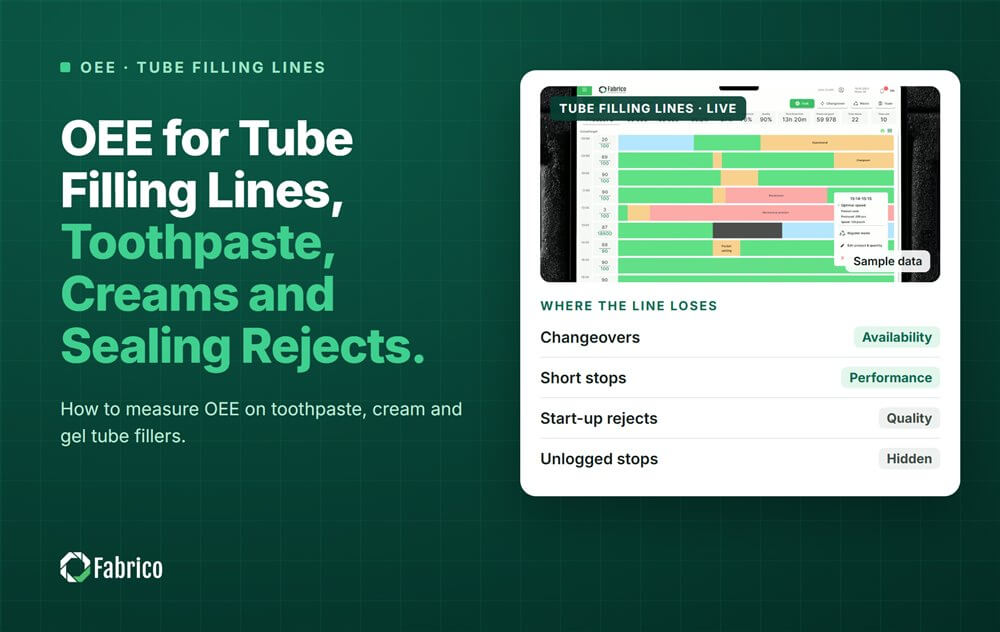
OEE for Tube Filling Lines: Toothpaste, Creams and Sealing Rejects

Key takeaways
- Most tube filler losses are product changes and short stops: tube magazine empty, eye mark faults and cartoner stops.
- Seal rejects are the typical Quality loss. They often rise right after a product change, while the sealing settles.
- A tube magazine that runs empty is a staffing and layout problem as much as a machine one. Code it on its own.
- Set the ideal rate per tube size and product, and count tubes, not cartons.
- Split the filler's own stops from the minutes the cartoner blocks it.
To measure OEE on a tube filling line, count tubes at the filler against its rated speed for that tube size, code each stop to the station that caused it, and count seal, weight and code rejects as Quality. On most lines, the product change and the small stops at the tube magazine are where the shift goes.
Fabrico, a computer vision enabled OEE and light MES platform, logs those stops automatically, keeps own stops apart from blocked time, and asks the operator to confirm each reason in one tap. This guide is for plant managers and CI leads in oral care and skin care plants that fill toothpaste, creams, gels and ointments into plastic, laminate or aluminium tubes.
How does a tube filling line work?
- Tube loading. Empty tubes go from boxes into a magazine, by hand or by an automatic loader.
- Orientation. A sensor reads the eye mark on the print so the seal lands in the right place.
- Filling. A piston or pump doses the product through a nozzle.
- Sealing. Hot air or heated jaws for plastic and laminate tubes, folding and crimping for aluminium.
- Coding, trimming and ejection. The batch code is pressed or printed into the seal.
- Cartoner and case packer. Tubes go into cartons, often with a leaflet.
Where does a tube filler lose time?
| Station | Typical stops | OEE factor |
|---|---|---|
| Tube loading | Magazine empty, tubes stuck, damaged tubes | Short stops |
| Orientation | Eye mark not found, print off register | Short stops, Quality |
| Filling | Product tailing onto the seal area, air in the hopper, weight drift | Quality, Performance |
| Sealing | Seal temperature alarm, weak or creased seals | Availability, Quality |
| Cartoner | Carton feed jams, leaflet faults, tubes not inserted | Blocked time for the filler |
| Whole line | Product change and wash, tube size change | Availability |
Why do tube fillers stop so often for small things?
A tube filler handles thousands of loose tubes a shift, each with a print to read and a seal to make. Small faults happen often and are cleared fast. A paper log keeps the long ones and drops the rest.
- Tube magazine empty. One operator often loads two machines. If both magazines run low at once, one waits.
- Eye mark faults. Print variation between tube lots, dust on the sensor or a wrong setting after a change.
- Product tailing. Thick products string from the nozzle and contaminate the seal area, which gives weak seals.
Count them. A one minute magazine stop repeated eighteen times is a real loss, and the fix may be a bigger magazine or staggered loading, not a faster machine. Our guide to operator downtime reason entry shows how to keep coding quick for the crew.
How do product changes affect tube line OEE?
A product change means emptying and washing the hopper, pump and nozzles, loading the new product and new tubes, and checking weight, seal and code on the first tubes. A tube size change adds tube holders, nozzle and sealing parts.
- Time each change from the last good tube of the old SKU to the first good tube of the new one at rated speed.
- Keep wash and format parts ready at the machine before the change starts.
- Run a first off check on seal, weight and code, and log how long it takes. Our first off approval guide covers this.
- Watch seal rejects for the first half hour after a change. If they spike, the sealing settings need a recorded recipe per tube.
A worked shift on a tube filling line
Sample line (illustrative numbers, not a customer): a tube filler rated at 120 tubes a minute for a 75 ml toothpaste tube, feeding a cartoner rated at 150. Planned production time is 450 minutes.
| Event | Minutes | Charged to |
|---|---|---|
| Product change with hopper and pump wash | 40 | Changeover |
| Tube magazine empty, 18 x 1 minute | 18 | Filler (loading) |
| Blocked by cartoner stops | 14 | Cartoner |
| Seal temperature alarms, 2 x 5 minutes | 10 | Filler |
| Eye mark faults, 12 x 0.5 minutes | 6 | Filler |
| Running | 362 |
- Availability = 362 / 450 = 80.4%.
- Performance: 40,100 tubes against an ideal of 362 x 120 = 43,440, so 92.3%.
- Quality: 450 seal rejects, 250 weight rejects, 100 code rejects and 200 start up tubes after the change, 1,000 in total. Good tubes = 39,100, so 39,100 / 40,100 = 97.5%.
- OEE = 0.804 x 0.923 x 0.975 = 72.4%. Check: 39,100 / 120 = 325.8 minutes of ideal output, and 325.8 / 450 = 72.4%.
At a sample contribution of $0.35 a tube (or €0.35 in a euro plant), the product change cost 4,800 tubes, or $1,680. The speed loss of 3,340 tubes cost $1,169. The tube magazine stops cost 2,160 tubes, or $756, more than the cartoner's blocked minutes at $588. That makes tube loading the first own loss to fix, and it is mostly about how the loading work is organised.
What mistakes do personal care plants make with tube OEE?
- Counting OEE in cartons at the end of the line, so tube rejects and filler stops blur together.
- Charging cartoner stops to the filler crew.
- One ideal rate for every tube size and product viscosity.
- No separate code for tube magazine empty, so a staffing problem looks like a machine problem.
- Not watching seal rejects after product changes.
For the cartoner itself, see our cartoner OEE guide. For the wider plant, our article on MES for cosmetics manufacturing takes the plant level view.
Where does Fabrico fit on a tube line?
Fabrico is a computer vision enabled Manufacturing Performance Platform. OEE and light MES come first: automatic downtime logging that keeps own stops, starved and blocked time apart, and OEE live by line and shift.
- The operator confirms the reason in one tap, so a magazine stop and an eye mark fault get different codes.
- A camera clip as evidence for a stop, where a camera watches the tube magazine or the sealing station.
- Losses priced in money and ranked, so small loading stops show their real cost.
- One view across plants for tube lines on different sites.
- A work order with its cost to the right technician when a stop is a breakdown.
You start on one line, with a baseline and a decision date agreed in advance. There is no free plan and there are no tiers: each plant gets a quote. See how computer vision OEE logs and codes stops.
Frequently asked questions
How do you calculate OEE on a tube filler?
Availability is run time over planned production time, Performance is tubes filled over the ideal at the rated speed for that tube size, and Quality is good tubes over tubes filled. Multiply the three.
What causes seal rejects on a tube filler?
Common causes are product on the seal area, sealing temperature or air flow out of range, tubes from a new lot that seal differently, and settings not reset after a change. Code them separately.
Should cartoner stops count against the tube filler?
Show them in the line's OEE, but charge them to the cartoner. Judge the filler on its own stops.
What is a good OEE for a tube filling line?
There is no standard. Lines with many SKUs and product washes score lower than dedicated lines. Track each line against its own trend, and price the gap.
See your tube line's losses in a demo
Bring one line and its stop log. We will show product changes, loading stops and seal rejects, and what each one costs.
Latest from our blog





Real Fabrico tiles, sample data.