


 Login
 Blog
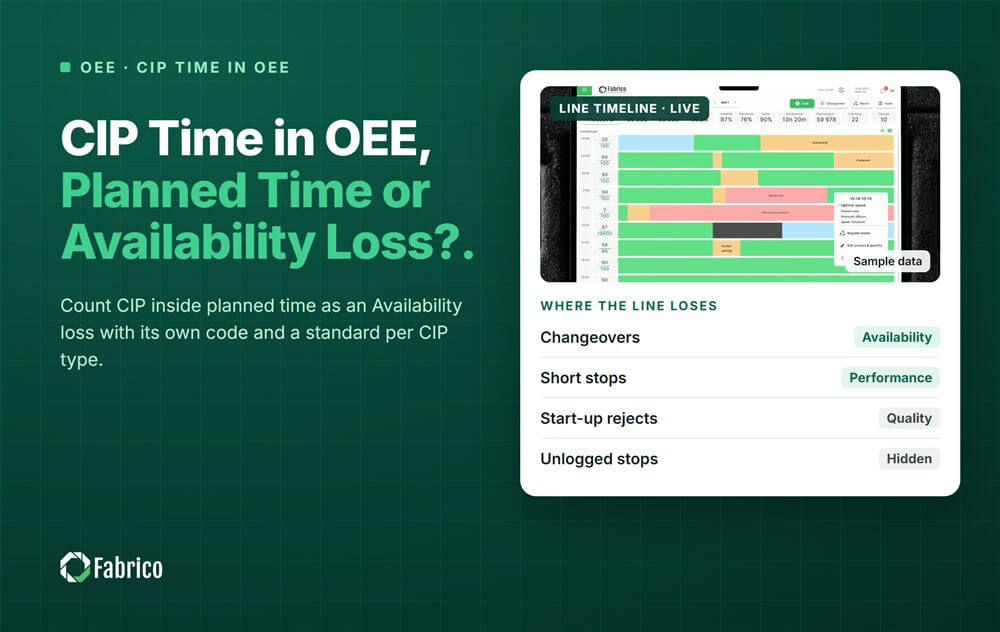
CIP Time in OEE: Planned Time or Availability Loss?

Key takeaways
- CIP stays inside planned production time as an Availability loss with its own reason code.
- A validated CIP cycle cannot be shortened without revalidation. Cutting it is a food safety breach.
- The minutes to win sit around the cycle: waiting, connecting, checking and restarting.
- A shared CIP set makes lines wait for each other. Time that queue.
- Set a standard per CIP type and track the minutes over it.
CIP time belongs in OEE, not outside it. Count the whole cleaning window as an Availability loss with its own code. Then look for minutes in the waiting and restarting around the validated cycle, which itself stays exactly as validated.
Fabrico, OEE and light MES software with AI cameras, logs each stop automatically and lets the operator mark it as CIP in one tap. It does not run or validate your CIP. That stays with your CIP system and your food safety team.
What is CIP, and why does it matter for OEE?
CIP means clean-in-place: the automated wash of tanks, pipes and fillers without taking them apart. On dairy, beverage and sauce lines it can be one of the biggest blocks of lost time in a week.
Cleaning weighs heavily in changeovers in general. In one self-reported survey of food manufacturers, the average changeover took just under one hour, and more than half named cleaning as the slowest part.
Should CIP count as planned downtime in OEE?
Usually not. OEE starts from planned production time: the shift minus planned stops such as breaks. A CIP inside a production shift costs output the line could have made. So most plants count it as an Availability loss under its own code.
Booking CIP as planned time makes OEE look better and hides the minutes. Christoph Roser lists shrinking the time basis this way as one of the three common ways OEE gets fudged. If your plant runs CIP in a slot with no production planned at all, report it next to OEE, so it is still seen.
Our guide to OEE vs Availability explains how these minutes move the factor.
Which parts of a CIP window can you shorten?
Split the window from the last good unit to the first good unit at rated speed. Only one part is fixed by validation.
- Waiting for the CIP set, when it is busy cleaning another tank or line.
- Connecting and setting up hoses, panels and the right program.
- The validated CIP cycle. This part stays as validated.
- Verification and sign-off, such as a swab or a visual check.
- Restart, until the line runs at rated speed with good product.
Everything except the cycle can often be prepared, moved or coordinated. That is the SMED idea: do outside the stop what does not need a stopped line.
Worked example: one CIP window, split
Sample line (illustrative numbers, not a customer). A filling line runs at 200 units a minute with a margin of USD 0.08 a unit. A lost minute costs USD 16 (about EUR 14.70). The line runs one CIP a day, 250 days a year.
| Part of the window | Today, minutes | After the fixes, minutes |
|---|---|---|
| Waiting for the CIP set | 25 | 5 |
| Connecting and setting up | 10 | 4 |
| Validated CIP cycle | 45 | 45 |
| Verification and sign-off | 8 | 8 |
| Restart to rated speed | 7 | 5 |
| Whole window | 95 | 67 |
The validated cycle is 45 of the 95 minutes, or 47%. The other 50 minutes sit around it. Starting the CIP when the set is free, staging the connections and a tighter restart cut the window to 67 minutes.
That saves 28 minutes per CIP: 28 x USD 16 = USD 448. Over 250 CIPs a year, that is USD 112,000 (about EUR 103,000). The cycle itself did not lose a second.
How do you log CIP so the numbers stay honest?
- Give CIP its own reason code, apart from format changes and allergen cleans.
- Take the cycle start and end from the CIP controller where it gives a signal.
- Time the parts around the cycle: waiting, connecting, checking and restart.
- Set a standard per CIP type, and track the minutes over it, not the cycle itself.
For the verification step, see our guides to ATP swab testing and to the riboflavin test for spray ball coverage. For changeover timing in general, read changeover time.
Which CIP mistakes hurt OEE or food safety?
- Booking CIP as planned time, so the minutes vanish from OEE.
- Shortening the validated cycle. That is a food safety breach, not an improvement.
- One code for all cleaning, so CIP, allergen cleans and wipe-downs blur together.
- Not timing the wait for a shared CIP set, often the largest part you can change.
- Stopping the clock when the cycle ends, so the slow restart never shows.
Where does Fabrico fit?
Fabrico is a computer vision enabled Manufacturing Performance Platform. OEE and light MES come first, and CIP is one more reason on the stop log.
- Automatic downtime logging, so each CIP window is timed by the machine signal.
- The operator confirms the reason in one tap, so CIP and allergen cleans get their own codes.
- Every loss priced in money, so a CIP window has a cost.
- Losses ranked by money, so the waiting minutes rise to the top.
It is the OEE layer of a light MES. You start on one line, with a baseline and a decision date agreed in advance. There is no free plan and there are no tiers: each plant gets a quote.
Frequently asked questions
Is CIP planned downtime in OEE?
In most plants, no. A CIP inside a production shift costs output, so it counts as an Availability loss with its own reason code. If your plant runs CIP in a slot with no production planned at all, report those minutes next to OEE so they stay visible.
How long does CIP take?
The cycle takes as long as its validated program, which differs by plant and equipment. The whole window is longer: waiting for the CIP set, connecting, the cycle, checks and restart. Time the window from the last good unit to the first good unit at rated speed.
Can CIP time be reduced?
Yes, around the validated cycle. Start the CIP when the set is free, prepare the connections before the line stops, and tighten the restart. The cycle itself can only change through revalidation by your food safety team, never to improve OEE.
What is the difference between CIP and a changeover?
CIP is the automated cleaning of closed equipment such as tanks and pipes. A changeover is the switch from one product to the next, which may include a CIP, format parts and settings. Give each its own code, so you can see which one costs more.
Should CIP times come from the CIP system or the operator?
Take the cycle start and end from the CIP controller where it gives a signal, because that clock is exact. The operator then confirms the reason for the whole stop in one tap. Keep all clocks on one time server, so the two records line up.
See your CIP windows split up
Bring one week of CIP logs. We will show where the minutes around the cycle go and what they cost.
Latest from our blog


Real Fabrico tiles, sample data.