


 Login
 Blog
Line Camera Policy Template: What to Write Before the First Camera

Key takeaways
- Write it before installation, and agree it with the works council where there is one.
- Purpose: measure the process. Stops, cycles and OEE (overall equipment effectiveness) by line and shift. Never rate or rank named people.
- Delete clips fast. The European Data Protection Board (EDPB) says ideally automatically, after a few days; beyond 72 hours needs more justification.
- Not consent. The EDPB says employers should not rely on consent for video.
- Confirm retention, processing location and access features with the vendor first.
By the numbers
- 29% of large US manufacturers use AI or machine learning at facility or network level, and another 23% are piloting it. (Deloitte, 2025)
- 28% of large US manufacturers rank vision systems as a first or second investment priority for the next 24 months. (Deloitte, 2025)
- 51% of top global manufacturers in Europe were implementing at least one AI use case in operations in 2019, with product quality control among the three best starting use cases. (Capgemini Research Institute, 2019)
A line camera policy is a short written rule: what the camera measures, what it may see, how long clips stay and who watches. Write it, sign it and tell staff before the first camera goes up.
Fabrico is a computer vision enabled Manufacturing Performance Platform. Its OEE and light MES (manufacturing execution system) software logs stops automatically, prices each loss in money and shows OEE by line and shift. Below is a plain template with sample sentences to adapt.
Why write the camera policy before the first camera goes up?
Because people will ask what the camera is for, and the answer must exist. The EDPB Guidelines 3/2019 on video devices say an employee is in most cases not expecting to be monitored by the employer (paragraph 37).
In Germany the timing is not a choice. Under section 87(1) no. 6 BetrVG, the works council co-determines technical equipment that can monitor behaviour or performance.
A written policy also protects operators: a camera aimed at the process ends blame instead of starting it. See our guide to production line cameras without surveillance.
What should the purpose and view sections say?
1. Purpose. One purpose, stated narrowly. The camera watches the process, not the person.
Sample: "The camera on [line] measures the process: stops, cycles and OEE by line and shift. It is never used to rate or rank named people."
2. What the camera may and may not see. Name the field of view, and what stays out of it.
Sample: "The camera views the infeed and the filler outfeed, not break areas or office screens. People may pass through the frame but are never its subject."
Plan the view with our guide to camera placement and lighting on a production line.
What should it say about recording, retention and access?
3. Recording. Choose short event clips around a stop or continuous video. Clips keep far less footage. Agree the choice with the works council and your data protection officer.
Sample: "The system keeps short clips around stops longer than [threshold]. There is no continuous recording."
4. Retention and deletion. The EDPB guidelines say footage should be erased ideally automatically, after a few days. Keeping it beyond 72 hours needs more justification (paragraph 121).
Sample: "Clips are deleted automatically after [hours]. The stop record (time, minutes, confirmed reason) stays."
5. Who can view clips, and why. Name roles, not people, and one reason to watch.
Sample: "The line leader, shift supervisor and improvement lead may view a clip to find a stop's cause. Each view is logged."
How do you tell staff, and what is the legal basis?
6. Informing staff. A sign at each camera, and a briefing on each shift before go-live, nights included.
Sample: "A sign at the camera says what it watches, why, and whom to ask."
7. Legal basis. The EDPB guidelines say employers should not rely on consent for video, because of the power imbalance at work (paragraph 47).
Sample: "The data protection officer sets the legal basis in writing. It is not consent."
8. Works council. In Germany, the policy goes to the works council before switch-on. Our works council approval guide for OEE monitoring walks through that meeting.
Which AI uses must the policy rule out?
9. Banned and high risk uses. The EU AI Act, Article 5(1)(f), has banned AI that infers emotions at work since 2 February 2025, except for medical or safety reasons. Its Annex III point 4(b) makes AI that monitors and evaluates workers' performance and behaviour high risk. Regulation (EU) 2026/1744 moves those duties to 2 December 2027.
The EDPB guidelines add that the GDPR's biometric rules (Article 9) apply only when templates uniquely identify a person (paragraphs 80 to 82).
Sample: "The system does not infer emotions, recognise faces or score named people."
10. Review date and owner. Name one owner and a date, and review after any camera move.
Sample: "The plant manager owns this policy and reviews it every 12 months."
This is not legal advice: check with your data protection officer and, in Germany, your works council.
Worked example: what does a filled-in policy look like for one line?
Sample line (illustrative numbers, not a customer): Line 4, a yogurt cup line on three shifts, with one camera over the filler outfeed. The plant chose 20 second clips around stops longer than 2 minutes. It sees about 25 such stops a shift.
- Clips a day: 25 x 3 shifts = 75.
- Video kept a day: 75 x 20 seconds = 1,500 seconds = 25 minutes.
- Continuous recording would keep 24 x 60 = 1,440 minutes a day.
- Share kept: 25 / 1,440 = 1.7% of the day. With deletion after 48 hours, no more than 50 minutes of clips exist at once.
| Section | Sample wording for Line 4 | Owner |
|---|---|---|
| Purpose | Stops, cycles, OEE by line and shift; no rating of people | Plant manager |
| View | Filler outfeed only; break areas and screens out of frame | Improvement lead |
| Recording | 20 second clips around stops over 2 minutes; no continuous video | Improvement lead |
| Retention | Clips deleted automatically after 48 hours | Data protection officer |
| Access | Line leader, shift supervisor, improvement lead; views logged | Plant manager |
| Informing staff | Sign at the camera; briefing on all 3 shifts | HR manager |
| Legal basis | Set in writing; not consent | Data protection officer |
| Works council | Agreed before switch-on | HR manager |
| Banned uses | No emotion inference, face recognition or scoring of people | Data protection officer |
| Review | Every 12 months and after any camera move | Plant manager |
Method note: Sample line, illustrative numbers, not a customer. Every result above comes from the inputs listed and the formula shown with it, so you can repeat the calculation with your own line's numbers.
Result: one page that answers what operators ask first.
What should you confirm with the camera vendor?
Before you sign, ask the vendor's technical team, ours included, to confirm in writing:
- Where the video is processed: at the line or in the cloud.
- How long clips are kept, and whether deletion runs automatically.
- Whether people can be masked or blurred before anything is stored.
- Who can view clips, and whether each view is logged.
Never write a retention period or feature into the policy before the vendor confirms it. Our data protection guide for plant software lists more questions.
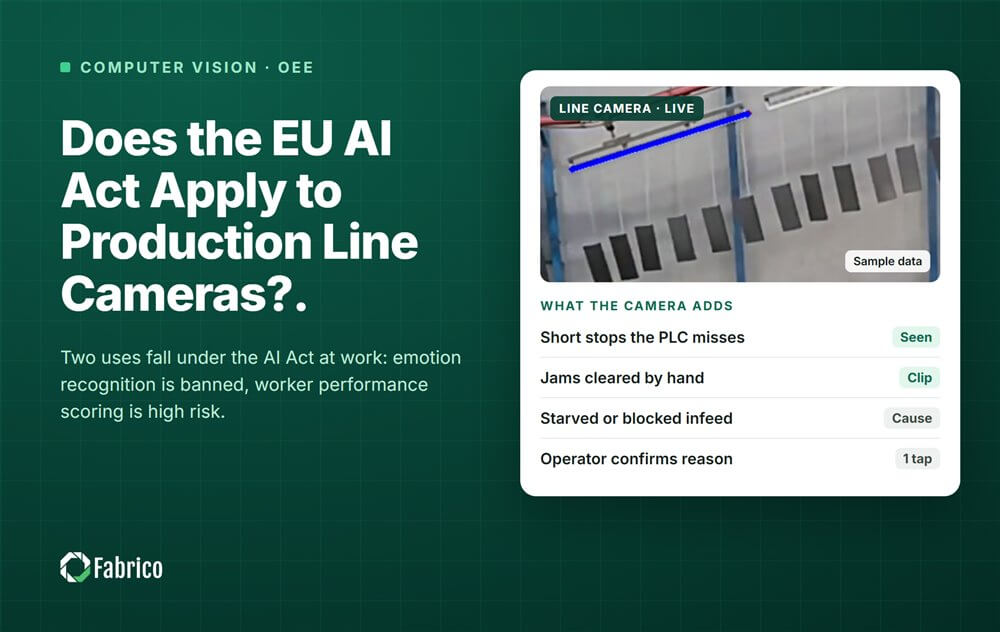
Fabrico measures the process. The camera may suggest a likely stop reason; the operator confirms it in one tap, and the clip stays as evidence.
You start with a pilot on one line. There is no free plan and there are no tiers: each plant gets a quote. The computer vision OEE page shows how it works.
Proof from a named plant: Ficosota raised factory-wide OEE from 53.1% to 59.6%, with good output up 23.2% a month from June to September 2026. Read the Ficosota case.
The European Data Protection Board notes that an employee "is in most cases not likely expecting to be monitored by his or her employer." (EDPB, Guidelines 3/2019 on video devices)
Frequently asked questions
What should a cameras in the workplace policy include?
Ten parts: the purpose, what the camera may and may not see, recording, and retention with deletion. Then who may view clips, how staff are told and the legal basis. Close with the works council, banned AI uses, and a review date with an owner.
How long can a plant keep line camera clips?
The EDPB Guidelines 3/2019 say footage should be erased ideally automatically, after a few days. Keeping it beyond 72 hours needs more justification (paragraph 121). Keep the stop record, which holds the time, the minutes and the confirmed reason, and delete the clip itself early.
Can staff consent to being on camera?
Consent is the wrong basis at work. The EDPB guidelines say employers should not rely on consent for video, because of the power imbalance between employer and staff (paragraph 47). Your data protection officer should set the legal basis in writing before the first camera goes up.
Does a camera that records nothing need works council approval?
In Germany, yes. Section 87(1) no. 6 BetrVG covers technical equipment that can monitor behaviour or performance. The Federal Labour Court says objective suitability is enough, and the employer's intent is irrelevant (BAG 1 ABR 43/12). So a camera that only counts still needs a works agreement.


Real Fabrico tiles, sample data.