


 Login
 Blog
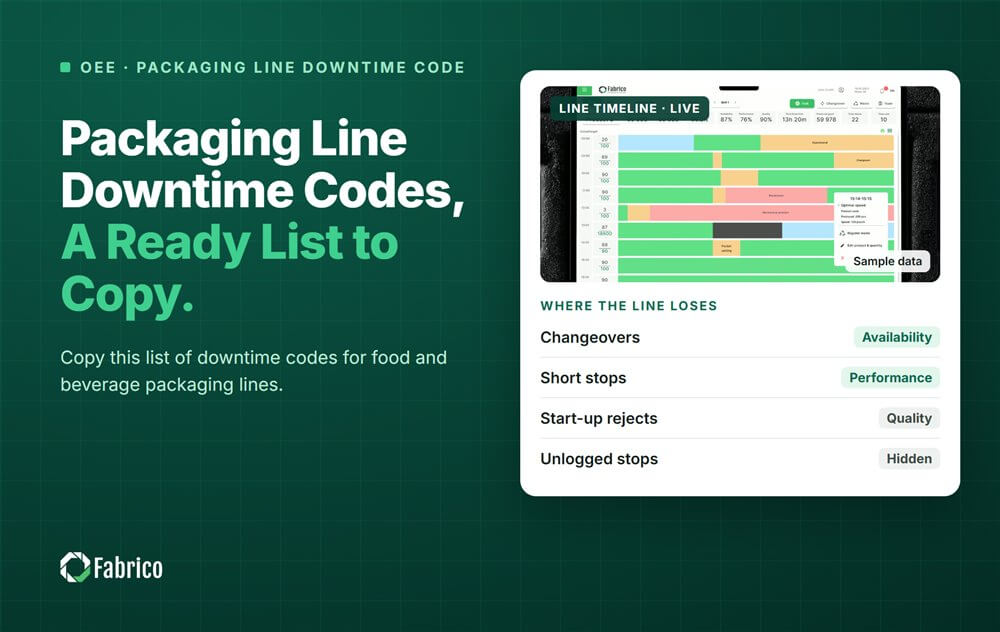
Packaging Line Downtime Codes: A Ready List to Copy

Key takeaways
- Use the same 8 groups on every line and every plant; vary only the reasons under them.
- Map each code to one OEE loss before you go live.
- Keep starved and blocked apart from a machine's own faults.
- Give changeover overruns and material problems their own codes, or they land on the crew.
- Review the list every two weeks for the first two months, then every quarter.
A usable downtime reason code list for a packaging line has two levels: 8 groups that every machine shares, and fewer than 10 reasons per machine under them. Each code maps to one OEE loss, so the list feeds the OEE report without any manual sorting.
Fabrico, an OEE and light MES platform, logs each stop automatically and asks the operator to confirm the reason in one tap. That only works when the list is short enough to scan in a few seconds, which is why the list below stays small on purpose. Copy it, cut what your line does not need, and rename the rest in your own plant's words.
How should a downtime code list be structured?
Think in three layers. The operator only ever sees the last two.
- Loss type: which part of OEE the stop hits. This is set once per code and never asked.
- Group: breakdown, changeover, material, quality, starved or blocked, short stop, planned, utilities.
- Reason: the specific cause at that machine, such as "caps out" or "label web break".
The six big losses give you the loss types: equipment failure and setup or adjustment hit Availability; idling, minor stops and reduced speed hit Performance; defects and reduced yield hit Quality. If a code cannot be placed in one of those, it is not a good code yet.
What does a ready code list for a packaging line look like?
| Group | Example reasons | OEE loss |
|---|---|---|
| Breakdown | Electrical fault, mechanical failure, air pressure low, sensor failed, drive or motor fault | Availability: equipment failure |
| Changeover | Format change, SKU change, cleaning between SKUs, centerline adjustment, changeover over standard | Availability: setup and adjustment |
| Material | No product from process, no bottles or cans, labels out or wrong, caps out, film or blanks out, glue empty | Availability (charge to supply) |
| Quality | Quality hold, checkweigher reject stop, wrong date code, metal detector stop | Availability, with rejects in Quality |
| Starved or blocked | Starved by upstream machine, blocked by downstream machine | Charged to the machine that stopped first |
| Short stop | Jam, fallen container, misfeed, sensor trip, cleared by the operator | Performance: minor stops |
| Planned | Planned maintenance, CIP, validated allergen clean, break, meeting, no orders | Planned time, kept out of the OEE loss |
| Utilities | Compressed air, power, steam, chilled water, network | Availability (charge to utilities) |
Under each group, add only the reasons that really happen at that machine. A filler needs "bottle jam at infeed" and "capper torque fault". A case packer needs "blank magazine empty" and "glue nozzle clog". A labeller needs "label web break" and "glue skip". Our guide to operator friendly reason codes covers wording, and downtime reason code design goes deeper on the taxonomy.
How many reason codes is too many?
The test is speed. If an operator needs more than a few seconds to find the code, they will pick the first one on the screen or "Other". In practice that means:
- 8 groups, the same everywhere.
- Fewer than 10 reasons per machine and group combination that the operator actually sees.
- Codes that nobody used for three months are retired or merged.
- "Other" stays, but it must be rare, and every "Other" gets a short note.
Short stops are the exception that needs care. They are the most frequent stops and the least often written down. No standard sets the threshold for a minor stop: it is typically a minute or two, and the plant decides the cutoff. Decide it once, write it down, and use it on every line. Our guide to micro stops explains the trade offs.
Which codes should never be mixed?
- Planned and unplanned. A changeover has a standard time; the minutes over it get their own code. Otherwise every overrun disappears into planned time. See planned vs unplanned downtime.
- Own fault and starved or blocked. A labeller waiting for bottles is not a labeller problem.
- Machine and material. Warped blanks or a bad label roll look like a machine fault but trace back to a supplier or to storage.
- Validated cleaning and everything else. CIP and allergen cleans are food safety steps. Code them, measure them, but never treat them as a loss to shorten.
What does the list change in practice?
Sample line (illustrative numbers, not a customer): a juice line where last week's log shows one big code, "Filler stopped", with 32 stops and 120 minutes. The new list splits the same minutes into four reasons.
| New code | Group | Stops | Minutes | Who acts |
|---|---|---|---|---|
| Bottle jam at filler infeed | Short stop | 23 | 46 | Line crew: guide rails |
| Caps out | Material | 3 | 30 | Material supply |
| Capper torque fault | Breakdown | 2 | 28 | Maintenance |
| Starved by blow moulder | Starved | 4 | 16 | Blow moulder owner |
| Total | 32 | 120 |
- Before: one code, one owner, no action. "The filler is bad."
- After: four owners. The jams are frequent and short (2 minutes each on average), the caps run out rarely but for 10 minutes each, the capper fails twice for 14 minutes each, and 16 minutes belong to another machine.
- The crew can fix the guide rails this week. Material supply can set a reorder point for caps. Only 28 of the 120 minutes are a maintenance job.
How do you roll out a new code list?
- Start from real stops. Take the last month of stops and group them. The list should describe what happens, not what might happen.
- Try it on one line first, with the crews of every shift, and review it after two weeks.
- Ask the operators which codes they could not find, and rename those in their words.
- Review every two weeks: merge codes that mean the same thing, split codes that hide two causes.
- Copy the groups to the next line, then add that line's machine reasons.
- Keep one list across plants where the machines are similar, so a stop means the same thing in every site, even when the screens are in different languages.
Where Fabrico fits
Fabrico is a computer vision enabled Manufacturing Performance Platform. OEE and light MES come first, with computer vision on stops.
- Automatic downtime logging from the machine signal, so the stop exists before anyone picks a code.
- The operator confirms the reason in one tap from the short list for that machine.
- A camera clip as evidence for a stop, where a camera watches the station, so "Other" gets a real reason.
- Losses ranked by money, so the code list turns into a priority list.
- One view across plants with the same groups everywhere.
You start with a pilot on one line, with a baseline and a decision date agreed in advance. There is no free plan and there are no tiers: each plant gets a quote. See how a stop gets its reason and its clip on our computer vision OEE page.
Frequently asked questions
What is a downtime reason code?
It is the label that says why a machine or line stopped, such as "caps out" or "label web break". Each code belongs to a group and maps to one OEE loss.
How many downtime reason codes should a packaging line have?
Use about 8 groups for the whole plant and fewer than 10 reasons per machine and group that the operator sees. If people cannot find a code in a few seconds, the list is too long.
Should starved and blocked be reason codes?
Yes, but charge the minutes to the machine that stopped first. The waiting machine was fine; its own Availability should not carry another machine's fault.
Is changeover counted as downtime?
The standard changeover time is often treated as planned. The minutes over the standard are a loss and need their own code, so overruns do not hide.
What should we do with the "Other" code?
Keep it, make it rare, and ask for a short note each time it is used. Review the notes every two weeks and turn repeat notes into new codes.
Try the list on one line
Bring one line and last month's stop log. We will show how the same minutes look with a short code list and a price on each stop.
Latest from our blog


Real Fabrico tiles, sample data.