


 Login
 Blog
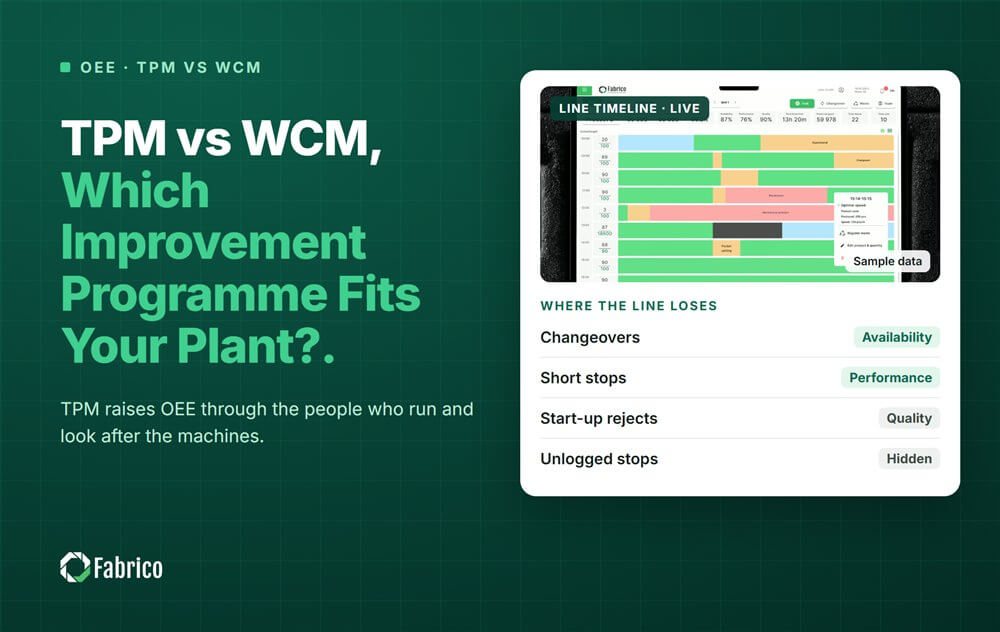
TPM vs WCM: Which Improvement Programme Fits Your Plant?

Key takeaways
- TPM is built around OEE. Its main objective is to increase OEE.
- Pick TPM when machine losses dominate; pick WCM when every project must show up in money across plants.
- WCM's Cost Deployment pillar prices the losses, so projects follow money.
- Most of the TPM toolkit, such as autonomous care, also lives inside WCM.
- Both need the same base: honest loss data by line and shift.
In the sample below, TPM and WCM look at the same 410 minutes of capper stops. They pick the same fix but report it in different units.
Fabrico is OEE and light MES software with AI cameras. It logs stops automatically and prices every loss in money, the data both programmes need. This guide is for plant and CI leaders choosing between TPM and WCM, or trying to run parts of both.
What is TPM?
Total Productive Maintenance (TPM) was developed by Seiichi Nakajima between 1950 and 1970. The first PM Prize went to Nippondenso in 1971. Today the Japan Institute of Plant Maintenance (JIPM) describes TPM with eight pillars.
The goal is clear: the main objective of TPM is to increase overall equipment effectiveness (OEE). Operators take care of their own machines, teams attack the big losses, and everyone works from the same loss data. Our guide to total productive maintenance covers the pillars, and OEE and TPM explains how the two connect.
What is WCM?
The World Class Manufacturing (WCM) programme most plants mean today was developed at Fiat with Hajime Yamashina from 2005. It has 10 technical pillars. One of them is Cost Deployment, the "analysis of the losses and costs (losses within the costs)".
WCM plants are audited and scored out of 100. Bronze starts at 50 points, silver at 60, gold at 70, and world class at 85. The audit gives a group a common scale across plants.
How are TPM and WCM different?
| TPM | WCM | |
|---|---|---|
| Origin | Seiichi Nakajima, Japan, 1950 to 1970 | Fiat with Hajime Yamashina, from 2005 |
| Structure | Eight pillars (JIPM) | 10 technical pillars |
| Main goal | Increase OEE | Cut losses where they cost most |
| How projects are picked | By the big losses on the equipment | By Cost Deployment, losses priced in money |
| Scoring | PM Prize | Audit out of 100: bronze 50, silver 60, gold 70, world class 85 |
In short, TPM asks where the machine loses time. WCM asks the same question, then asks what that loss costs.
Which one fits your plant?
- Choose TPM if your main problem is machine losses and the team needs a clear, equipment-first starting point.
- Choose WCM if you run several plants, need one audit scale across them, and finance must see every project in money.
- Either way, start where the losses are. A programme with no loss data becomes a set of posters.
Worked example: how do TPM and WCM look at the same loss?
Sample line (illustrative numbers, not a customer): a filling line has frequent short stops at the capper. Four weeks of machine data.
| TPM view | WCM view | |
|---|---|---|
| The loss | Idling and minor stops: 410 minutes | Same 410 minutes on the constraint |
| The number that drives action | Performance on the capper is 81% | USD 32,800 at USD 80 a constraint minute |
| Who acts | The line team with autonomous care and a focused improvement team | A project chosen in Cost Deployment, ranked first by money |
| How success is shown | Performance back above 90% | Minutes down and the money confirmed by finance |
Both views lead to the same fix: the cap chute and the cap feed. The difference is the language. TPM speaks in OEE and minutes. WCM speaks in money, which makes it easier to compare this project with one on another line.
What do both programmes need from the data?
- Each stop logged with its start time and length, from the machine signal.
- A reason for each stop, confirmed at the line, not guessed at the end of the shift.
- The six big losses kept separate, as our guide to OEE and the six big losses explains.
- For WCM, each loss priced in money with an agreed rate per constraint minute.
Without this, TPM teams argue about which machine is worst, and WCM cost studies go out of date before they are finished.
Can you run TPM and WCM together?
Some plants do. WCM includes much of the TPM toolkit, such as autonomous care and focused improvement. The risk is two sets of meetings, two sets of boards and two languages for the same loss.
Pick one programme as the frame and borrow tools from the other. If you need the money view, use Cost Deployment inside a TPM plant. If you run WCM, keep OEE as the shop floor number. Our article on running kaizen events with OEE data shows one way to do that.
Where does Fabrico fit?
Fabrico is a computer vision enabled Manufacturing Performance Platform. It is OEE software first. It logs stops automatically, prices each loss in money and ranks the losses by what they cost. That is the loss data both programmes need, and pricing every loss daily is cost deployment done every day.
The operator confirms the reason in one tap. When a stop needs a repair, Fabrico can raise a work order to the right technician with its cost, as a side benefit.
There is no free plan and there are no tiers: each plant gets a quote.
Frequently asked questions
What is the difference between TPM and WCM?
TPM focuses on raising OEE through operator care and teams that attack equipment losses, with the equipment as the starting point. WCM covers the same ground with more pillars and adds Cost Deployment, which prices every loss so projects follow the money. The choice is mostly about how much the money view matters.
Is WCM better than TPM?
Neither is better in general. TPM is a strong start when machine losses dominate. WCM suits groups that want one audit scale across plants and a money view of every project. Both fail without honest loss data from the machines, logged by line and shift.
What are the WCM audit levels?
WCM plants are scored out of 100 points. Bronze starts at 50, silver at 60, gold at 70 and world class at 85. The audit gives a group of plants one common scale, so progress can be compared across sites over time.
What is the main goal of TPM?
The main objective of TPM is to increase overall equipment effectiveness, or OEE. It does this through the people closest to the machines. Operators care for their own equipment, and teams remove the big losses one by one. Progress shows up as a higher OEE on the lines.
Can a plant use TPM tools inside WCM?
Yes. WCM already includes much of the TPM toolkit, such as autonomous care and focused improvement. The key is one frame, one set of meetings and one loss language. Then the line team does not report the same loss twice in two different ways.
Get the loss data your programme needs
Bring one line and your current TPM or WCM board. We will show the same losses from the machine, in minutes and in money.
Latest from our blog


Real Fabrico tiles, sample data.