


 Login
 Blog
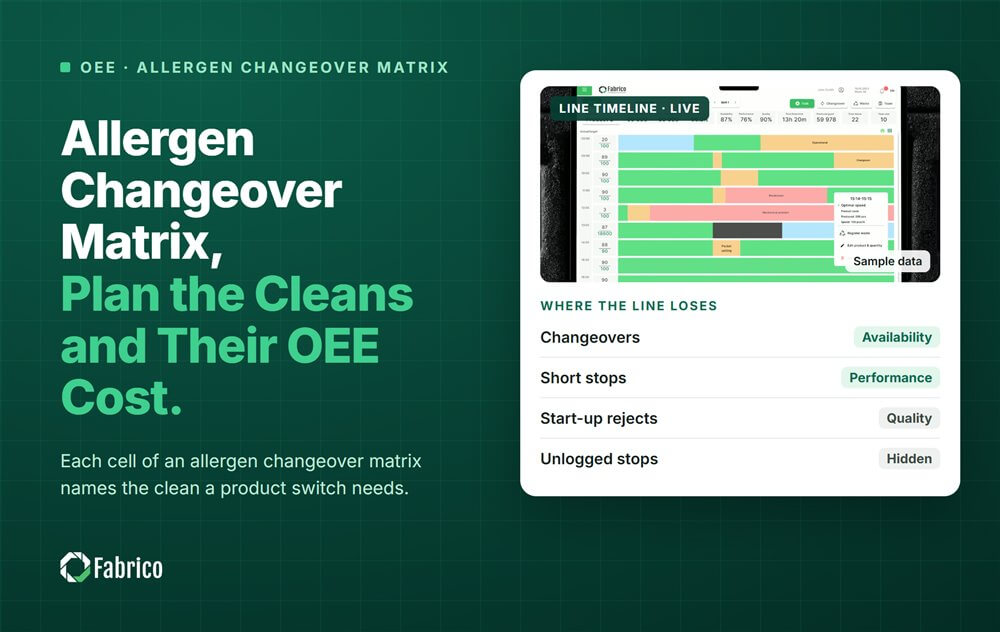
Allergen Changeover Matrix: Plan the Cleans and Their OEE Cost

Key takeaways
- The matrix comes from the food safety plan. OEE only measures it.
- A validated allergen clean cannot be shortened without revalidation.
- Code allergen cleans apart from ordinary format changes.
- Price every cell in lost minutes and money.
- The run order is where minutes are won, not the clean itself.
An allergen changeover matrix is a grid of every product switch on a line. Each cell says which clean the switch from product A to product B needs. Add the time each clean takes, and the same grid shows what your run order costs in lost minutes.
Fabrico, OEE and light MES software with AI cameras, logs each changeover as its own stop and prices the lost minutes. It does not set your cleans: those come from your validated food safety plan. This guide shows how the matrix and OEE fit together.
What is an allergen changeover matrix?
It is a table with every product on the line down the side and again across the top. The cell where row A meets column B holds the clean needed to go from A to B. Your food safety team sets each cell, and the levels are part of your validated plan.
Many plants use a few clean levels, from light to heavy:
- No clean: both products carry the same allergens.
- Dry clean: removing product and dust without water.
- Wet clean: a full wash of product contact parts.
- Validated allergen clean: the full procedure, with verification before restart.
The matrix is not symmetric. Going from an allergen-free product to one with milk may need little. Going back the other way needs the full clean.
How does an allergen clean count in OEE?
A changeover runs from the last good unit of product A to the first good unit of product B at rated speed. The clean, the checks and the ramp-up all sit inside that window. In OEE the whole window is an Availability loss.
Some plants book allergen cleans as planned time, because they are on the schedule. That hides them. Christoph Roser lists shrinking the time basis this way as one of the three common ways OEE gets fudged. A clean on the schedule still costs output.
One rule stands above the number. An allergen clean between allergen classes is validated and cannot be shortened without revalidation. Cutting it to raise OEE is a food safety breach. Our guide to allergen changeover validation covers the food safety side.
Worked example: what a run order costs
Sample line (illustrative numbers, not a customer). A line makes three products: A has no allergens, B contains milk, and C contains milk and nuts. The food safety plan gives these clean times in minutes.
| From \ To | A | B | C |
|---|---|---|---|
| A | 20 | 45 | |
| B | 90 | 25 | |
| C | 120 | 90 |
The line runs each product once per cycle, then starts again with A.
- Order A, B, C, back to A: 20 + 25 + 120 = 165 minutes of cleans.
- Order A, C, B, back to A: 45 + 90 + 90 = 225 minutes of cleans.
The second order costs 60 minutes more per cycle, with exactly the same validated cleans. At 120 units a minute and a margin of USD 0.15 a unit, a lost minute costs USD 18 (about EUR 16.50). So 60 minutes cost USD 1,080 per cycle.
With five cycles a week, that is USD 5,400 a week (about EUR 4,970), and 300 minutes of Availability. On two 480 minute shifts a day, five days a week, those 300 of 4,800 planned minutes are 6.3 points of Availability. Nobody had to touch a clean to win them back.
How do you measure an allergen changeover?
- Time the whole window: last good unit of the old product to first good unit of the new one, at rated speed.
- Split it into parts: the clean, the verification and sign-off, and the restart.
- Compare each changeover with the standard time in its matrix cell, and track the minutes over it.
- Move preparation outside the stop: tools, chemicals, the next product's materials and the paperwork can be ready before the line stops.
Step 4 is SMED: turning internal work into external work. It never means cutting a validated step. Our SMED guide explains the method, and our article on ATP swab testing covers the verification step.
Which mistakes make allergen changeovers look better or worse?
- Booking them as planned time, so the minutes disappear from OEE.
- One code for every changeover, so allergen cleans and format changes blur together.
- No standard per cell, so an overrun of 20 minutes never shows.
- Not timing the wait for verification, which can be a large part of the window.
- Shortening a validated clean. This is not a mistake in OEE. It is a food safety breach.
Where does Fabrico fit?
Fabrico is a computer vision enabled Manufacturing Performance Platform. It is the OEE and downtime layer of a light MES, with AI cameras on stops.
- Automatic downtime logging, so each changeover is a timed stop.
- The operator confirms the reason in one tap, so an allergen clean gets its own code.
- Every loss priced in money, so each cell of the matrix has a cost.
- OEE live by line and shift, with changeovers kept inside the calculation.
Fabrico does not set your cleans or plan your run order. Those stay with your food safety and planning teams. For more on changeover timing, read our guide to changeover time. There is no free plan and there are no tiers: each plant gets a quote.
Frequently asked questions
What is an allergen changeover matrix?
It is a grid that lists every product on a line twice, down the side and across the top. Each cell says which clean is needed to switch from one product to the other, from no clean to a full validated allergen clean. The food safety team sets each cell.
Is an allergen clean planned downtime in OEE?
No. In OEE a changeover, cleaning included, is an Availability loss even when it is on the schedule. Booking it as planned time hides real lost output. Keep it in the calculation, give it its own reason code, and track it against a standard per product switch.
Can you shorten an allergen changeover?
You can shorten the parts around the clean: preparing tools, chemicals and materials before the line stops, and a faster restart. The validated clean itself cannot be shortened without revalidation. Cutting it to improve OEE is a food safety breach, whatever the number shows.
How can a plant reduce the number of allergen cleans?
By changing the run order, not the clean. Running products from fewer allergens to more allergens within a cycle often needs lighter cleans between them. Your planning and food safety teams decide the order together. The matrix shows what each order costs.
How long does an allergen changeover take?
It depends on the line, the products and the validated procedure. In one self-reported survey of food manufacturers, the average changeover took just under one hour, and more than half named cleaning as the slowest part. Time your own changeovers per matrix cell.
Price your own allergen matrix
Bring your matrix and last month's changeovers. We will show what each cell and each run order cost.
Latest from our blog


Real Fabrico tiles, sample data.