


 Login
 Blog
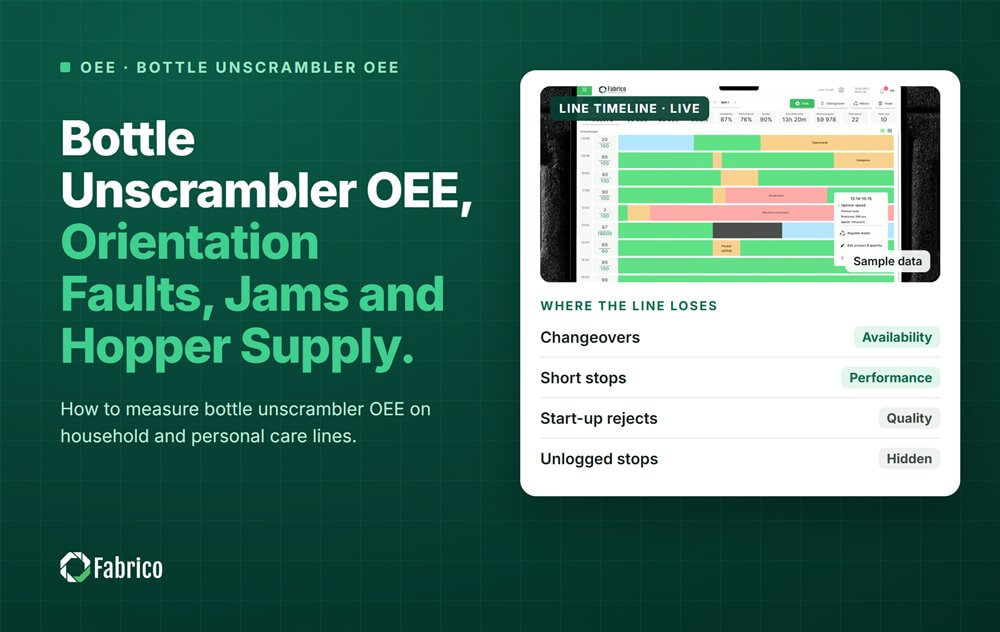
Bottle Unscrambler OEE: Orientation Faults, Jams and Hopper Supply

Key takeaways
- Most unscrambler losses are short jams in the orientation pockets and waits for bulk bottle supply.
- An empty hopper is a supply stop, not a machine fault; code it apart.
- Misoriented bottles that are sent round again cost speed, not quality.
- Deformed or damaged bottles thrown away are the unscrambler's Quality loss.
- Only stops longer than the air conveyor buffer starve the filler.
Bottle unscrambler OEE measures the machine that turns bulk empty bottles into a single upright stream for the filler: how long it runs, how close to its rated speed, and how many bottles it loses. On household and personal care lines its usual losses are orientation pocket jams, deformed bottles, an empty hopper and air conveyor jams.
Fabrico, an OEE and light MES platform, logs each unscrambler stop with its reason and keeps own stops apart from supply waits and starved time. This guide covers where the unscrambler's time goes, how to measure each OEE factor, format changes, and a worked shift on a cleaner line.
Where does the unscrambler's time go?
An unscrambler takes loose bottles from a bulk hopper, lifts them on an elevator, drops each one into a pocket or puck that turns it upright, rejects bottles it cannot orient, and sends the rest to the filler on an air or belt conveyor.
| Station | Typical stops | Usually whose loss |
|---|---|---|
| Bulk hopper and elevator | Hopper empty, wrong bottle lot loaded, bridging in the hopper | Material supply or line crew |
| Orientation pockets | Bottle stuck in a pocket, two bottles in one pocket | Line crew or settings |
| Upright and drop | Bottle falls over, lands the wrong way, deformed bottle jams | Bottle quality or settings |
| Reject and recirculation | Misoriented bottles sent back, recirculation full | Settings |
| Air conveyor to the filler | Light bottles jamming, static build up | Line crew |
| Outfeed backed up | Bottles waiting for the filler | Filler (blocked) |
Deformed, warped or light bottles look like machine faults, but they often trace back to the bottle supplier or to storage. A code for bottle quality keeps that visible. Our filler OEE guide shows the same stops from the filler's side.
How do you measure Availability, Performance and Quality on an unscrambler?
- Availability = run time / planned production time. Own faults reduce it; in the full view, so do hopper waits and blocked time.
- Performance = upright bottles out / (run time x rated bottles a minute). Set the rated speed per bottle format. Bottles sent round again lower it.
- Quality = good bottles out / bottles handled. Deformed and damaged bottles thrown away count against it.
The unscrambler is usually built faster than the filler, about 10% in the V-curve design, so it can refill the conveyor after a stop. Running at the filler's pace, it will not reach full Performance against its own rated speed, and that gap is not a loss to chase.
How do you separate the unscrambler's own stops from line effects?
- Code an empty hopper as a supply stop, with the bottle lot in the note.
- Read the outfeed when the machine stops: bottles backed up means blocked by the filler.
- Report Availability twice: all causes, and own causes only.
- Rank own causes by count and by minutes. Pocket jams are frequent and short; air conveyor jams are rare but can starve the filler.
Then check which stops reached the filler. Most unscrambler jams are cleared in a minute and end inside the conveyor buffer. Our guide to starvation and blocking explains how to tell.
What happens at a format changeover on an unscrambler?
A new bottle shape can mean new pockets or pucks, new guides, different air settings on the conveyor and a different hopper load. Record the settings per format, keep each format's change parts on its own trolley, and check the first bottles before the line runs at speed. Our guide to first off approval after changeover shows a simple check.
A worked shift on an unscrambler
Sample line (illustrative numbers, not a customer): a household cleaner line where the filler runs 120 bottles a minute and the unscrambler is rated at 140. The air conveyor between them holds 2 minutes of bottles. The shift has 450 minutes of planned production time, and the contribution margin is $0.25 a bottle, or €0.25 in a euro plant.
| State | Minutes | Charged to |
|---|---|---|
| Running | 402 | None |
| Hopper empty, 2 x 8 minutes | 16 | Material supply |
| Orientation pocket jams, 18 x 1 minute | 18 | Unscrambler |
| Deformed bottle jams, 6 x 1.5 minutes | 9 | Unscrambler (bottle quality) |
| Air conveyor jam, 1 x 5 minutes | 5 | Unscrambler |
| Total | 450 |
- Availability, all causes = 402 / 450 = 89.3%.
- Availability, own causes only = (450 minus 16) / 450 = 434 / 450 = 96.4%.
- Performance against its own rated speed = 120 / 140 = 85.7%, the designed spare speed.
- Quality: 48,240 bottles handled, 240 deformed bottles thrown away: 48,000 / 48,240 = 99.5%.
- Which stops reached the filler: each 8 minute hopper wait starves it for 8 minus 2 = 6 minutes, 12 in total, and the air conveyor jam for 5 minus 2 = 3 more.
- 15 filler minutes x 120 = 1,800 bottles, at $0.25 = $450 this shift, or €450.
The 18 pocket jams took the most own minutes, but they ended inside the buffer. The two empty hoppers cost the most money, and they are a supply routine, not a machine problem.
Which mistakes do plants make with unscrambler OEE?
- Booking an empty hopper as a machine fault, so the supply routine never changes.
- Counting recirculated bottles as rejects. They cost speed, not quality.
- No code for bottle quality, so supplier problems land on the crew.
- Filtering out short stops, so pocket jams never reach the ranking. See our guide to micro stops.
- Chasing Performance against the rated speed when the machine runs at the filler's pace by design.
Where Fabrico fits
Fabrico is a computer vision enabled Manufacturing Performance Platform. OEE and light MES come first: automatic downtime logging that keeps own stops, supply waits and starved or blocked time apart, and OEE live by line and shift.
- The operator confirms the reason in one tap, so a pocket jam and a deformed bottle get different codes.
- A camera clip as evidence for a stop, where a camera watches the drop or the air conveyor.
- Losses priced in money and ranked, so the stops that starve the filler come first.
- One view across plants for the same bottle formats on different lines.
You start with a pilot on one line, with a baseline and a decision date agreed in advance. There is no free plan and there are no tiers: each plant gets a quote. See how stops are captured on our computer vision OEE page.
Frequently asked questions
How do you calculate bottle unscrambler OEE?
Availability is run time over planned production time, Performance is upright bottles out over what it could deliver at rated speed for that format, and Quality is good bottles over bottles handled. Multiply the three.
What causes unscrambler jams?
Bottles stuck in orientation pockets, two bottles in one pocket, deformed or light bottles, and jams on the air conveyor from static or worn guides.
Do misoriented bottles count as rejects?
Not if they are sent round again. They cost time, so they lower Performance, not Quality.
Should an empty hopper count against the unscrambler?
Show it in the full view, but code it as a supply stop so the people who load the hopper see it.
When does an unscrambler stop the filler?
When the stop lasts longer than the conveyor buffer between them. Short jams usually do not.
See your unscrambler's losses in a demo
Bring one line and its current downtime log. We will show the unscrambler's own stops, its supply waits and what reached the filler.
Latest from our blog


Real Fabrico tiles, sample data.