


 Login
 Blog
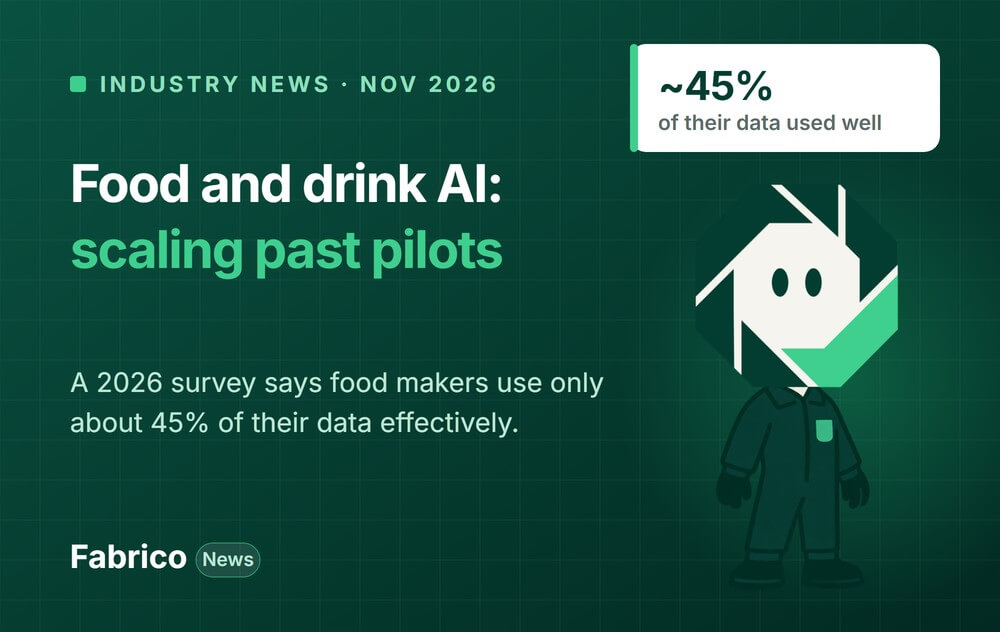
Food and Beverage Makers Struggle to Scale AI Past Pilots, Rockwell Survey Says

News, 11 November 2026. Every news figure below comes from a linked source, and the full list is at the end.
In short: A Rockwell Automation survey published on 28 October 2026 says nearly 90% of food and beverage manufacturers use AI or plan to soon. Yet they report effectively using only about 45% of the data they collect, and the release's own FAQ asks why they are struggling to scale AI beyond pilot projects.
- The gap is rarely the AI model. It is line data that is missing, late or defined differently from line to line.
- An AI project can only learn from the stop reasons, counts and speeds your lines record today.
- Below: what the survey says, what it means for a food or drink plant, and three steps to make a pilot worth scaling.
What the survey found
On 28 October 2026, Rockwell Automation published food and beverage findings from its 2026 State of Smart Manufacturing Report. The release does not give the sample size or the countries covered.
- AI use: nearly 90% of food and beverage manufacturers already use AI and machine learning, or plan to do so in the near future.
- Data use: food and beverage manufacturers report effectively using only about 45% of the data they collect. The FAQ section of the release gives that food and beverage scope.
- Outlook: respondents expect AI-supported manufacturing processes to grow from about 37% today to more than 60% by 2030. The release attributes it to "industry respondents" and does not say whether that means food and beverage only.
- People: 93% of manufacturers expect smart manufacturing to reshape their workforce, and 40% reported reskilling employees in the past year.
Greg Schmidt, Vice President, CPG Global Industry at Rockwell Automation, said: "Many manufacturers have moved beyond asking whether AI can deliver value." He added that scaling successful pilots requires connected data, integrated operations and a clear link between AI initiatives and business outcomes.
A note on sources: Rockwell sells automation and manufacturing software, and we sell manufacturing software too. Read both of us with that in mind.
What it means for a food or beverage plant
A pilot usually runs on one line with a motivated team and some hand-cleaned data. It works. Then it is copied to the next line, and the results fade.
In our view, the reason is usually the data under the model, not the model itself. Line 2 names its stops differently from line 1. Rated speeds are missing for half the products. Short stops are not recorded at all. Counts arrive at the end of the shift, typed from a sheet.
The 45% figure also hides a second problem: some data that matters is never collected. A model cannot learn a stop reason that nobody entered.
The data an AI use case needs, line by line
| AI use case | Line data it needs first |
|---|---|
| Predict the next stop | Every stop with a start, an end and a consistent reason |
| Explain lost output | Rated speed per product, actual counts, planned time |
| Shorter changeovers | Changeover start and end per product pair |
| Fewer rejects | Reject counts per shift and product, with a reason |
| Energy per unit | Meter readings next to run, idle and stop time |
This is our own view, not a finding of the survey. Every row is ordinary OEE and light MES data, collected the same way on every line.
Three steps to make a pilot worth scaling
- Tie the pilot to one business number. For example, changeover minutes on line 3, or packs lost to short stops on the wrapper. If nobody can say what the pilot should move, nobody can say whether it worked. Our guide to running a computer vision OEE pilot sets out success criteria.
- Fix the definitions before the model. One stop-reason list for all lines, a rated speed per product, one shift calendar. This is the work that makes a second line comparable to the first. See AI-ready OEE master data.
- Scale the data rules, not the dashboard. Copy the definitions and the daily review to the next line first, then the analytics. More in scaling from a pilot line to a plant.
Where OEE, cameras and light MES help
OEE gives every line the same three numbers, availability, performance and quality, so a gain on one line can be compared with another. That is what makes a pilot result believable to the next plant.
A light MES records stops, reasons and counts as they happen, which is the training and testing data for any later AI use case.
Where there is no machine signal, such as manual packing or a line without a PLC count, an AI camera (an add-on) that counts output turns an unmeasured step into data.
How Fabrico does it
Fabrico is a cloud OEE and light MES platform. Stops come from the machine signal, and operators add reasons on a tablet or phone from one shared list. Where no signal exists, AI cameras (an add-on) count output, and you can open their video for any moment on the timeline. The video is streamed on request, not stored. We have no link to Rockwell or to the survey.
Want your next AI pilot to start from clean line data? Book a demo and bring one line's stop list.
What people ask next
What did Rockwell's 2026 State of Smart Manufacturing Report find for food and beverage?
Rockwell's release of 28 October 2026 says nearly 90% of food and beverage manufacturers use AI and machine learning or plan to soon, and that they report effectively using only about 45% of the data they collect. Respondents expect AI-supported processes to grow from about 37% today to more than 60% by 2030.
Why do AI pilots stall in food plants?
In our view, mostly because of the data under them: stop reasons named differently on each line, missing rated speeds, unrecorded short stops and counts typed in after the shift. A pilot that works on one hand-cleaned line then fades on the next.
What data does a food plant need before AI?
Stops with a start, an end and a consistent reason, a rated speed per product, real counts and rejects per shift, and one shift calendar for all lines. That is the same data OEE and a light MES collect.
Sources
Checked on 11 November 2026. Dates are the publication dates shown on each page.
Related articles



Latest from our blog



Real Fabrico tiles, sample data.