


 Login
 Blog
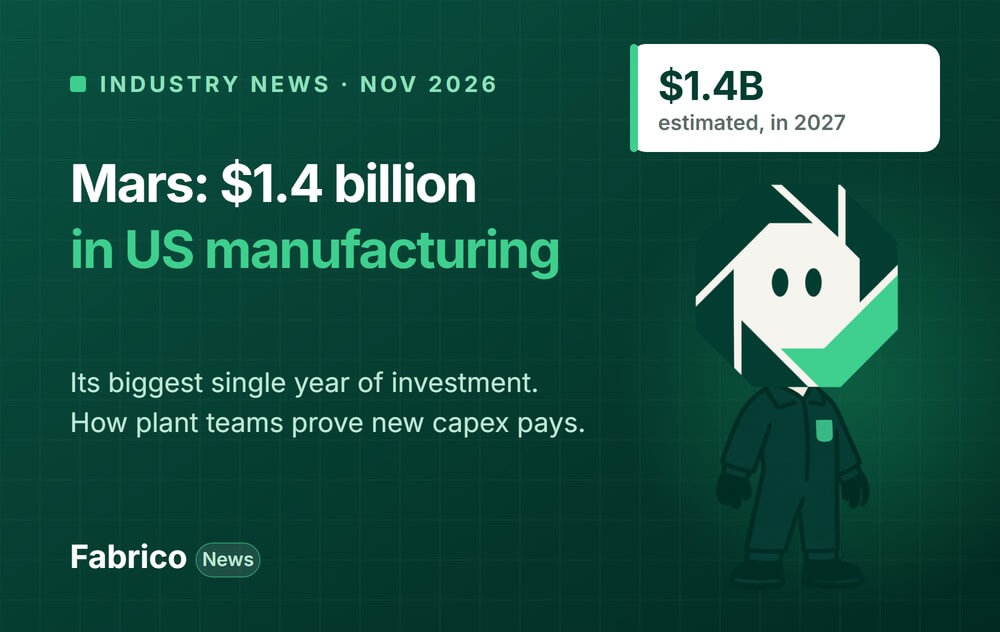
Mars Plans $1.4 Billion for US Manufacturing in 2027: What It Means for Plant Teams

News, 11 November 2026. Every news figure below comes from a linked source, and the full list is at the end.
In short: Mars said on 10 November 2026 that it will invest an estimated $1.4 billion in its US manufacturing and operations in 2027, which it says is the most it has invested in a single year. The money goes to new lines, upgraded plants and modernised older sites.
- Spending like this raises the bar for every food and consumer goods plant: a capex request has to show what it will return.
- A modernisation project needs a before and an after, measured the same way. Without a baseline, nobody can prove the return.
- Below: what Mars announced, what it means for plant teams, and three steps before your next capex request.
What Mars announced on 10 November 2026
In a release dated 10 November 2026, Mars said it plans to invest an estimated $1.4 billion in US manufacturing and operations in 2027, "the most Mars has invested in a single year".
It builds on more than $9 billion invested in US operations since 2017. Mars says 94% of the Mars products sold in the US are made there.
The release names three manufacturing sites:
- Waco, Texas: $165 million invested since 2024, with recent projects on energy efficiency and operational excellence. The site makes over 56 billion pieces of SNICKERS, STARBURST and SKITTLES a year, and marks 50 years this month.
- Salt Lake City, Utah: $60 million for two dedicated Trü Frü lines inside a $240 million factory that opened last year for Nature's Bakery. The site can make more than 1 billion Nature's Bakery bars a year, and will now have capacity for 17 million Trü Frü frozen products a year.
- Columbus, Ohio: a $49 million project brings TEMPTATIONS Lickable Treats production to the US, with modern mixing and filling. Capacity will exceed 400 million pouches a year. Mars has invested $162 million in the site since 2022.
Mars has 80,000 US Associates and runs more than 60 factories, research labs and offices in the US, plus veterinary clinics and hospitals. It added 15 facilities in the last year through its acquisition of Kellanova. It says the investments aim to modernise long-standing facilities, strengthen supply chain resilience and enhance operational excellence and the geographic availability of its services.
CFO Claus Aagaard said the company's commitment to American manufacturing has "never been stronger".
What it means for plant teams
Three kinds of project sit in the Mars release, and most food plants will recognise them: new lines for a growing brand, a new product moved into an existing site, and steady spending on an older plant's efficiency.
Each one is judged on output. A new line is judged on how fast it reaches its rate. A moved product is judged on whether the new site makes it as well as the old supply did. An efficiency project is judged on minutes, kilograms or kilowatt-hours saved per good unit.
All three need a measured starting point. Without one, a project can only claim savings, not show them. A request that can show them is easier to approve.
The question every capex request should answer
Example data, not Mars's. A plant asks for a second packing line because the first one cannot keep up. Before it signs, it measures the existing line for four weeks:
| Where the planned time went | Share |
|---|---|
| Good output at rated speed (OEE) | 58% |
| Stops, including changeovers | 24% |
| Slow running and short stops | 14% |
| Rejects | 4% |
If changeovers and the top two stop reasons can be cut so OEE reaches 66%, the line makes 66 / 58 = about 14% more. That may close the gap for this year, or it may not. Either way, the request now has numbers, and the new line has a baseline to beat.
Three steps before your next capex request
- Baseline the line you want to replace or extend. Four to eight weeks of OEE by shift, with stop reasons, speed loss and rejects. Our guide to presenting OEE to the board shows how to turn that into money.
- Price the cheaper option first. Work out what the measured losses are worth before you price the new equipment. See new line cost vs recovering capacity.
- Write the after into the contract. State the rated speed, the OEE or output expected in week 4, 8 and 12, and how both are measured. Then track the new line with the same definitions as the old one. Legacy equipment has its own options, covered in modernising legacy equipment.
Where OEE, cameras and light MES help
OEE turns a vague request for more capacity into a split of where the time goes, line by line and shift by shift.
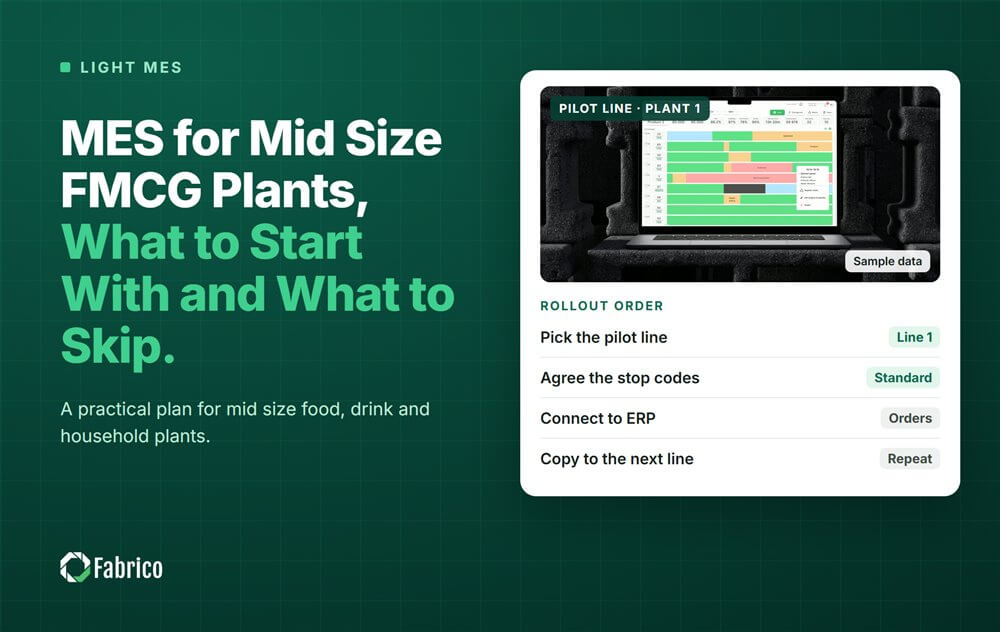
A light MES keeps the stop reasons, so the after is measured the same way as the before, and the gain is visible within weeks, not at year end.
For manual steps with no machine count, such as hand packing next to an automated filler, an AI camera (an add-on) that counts output closes the gap in the data. Then the whole line has a baseline, not only the automated part.
How Fabrico does it
Fabrico is a cloud OEE and light MES platform. Stops come from the machine signal, and operators add the reason at the line. Where there is no signal, AI cameras (an add-on) count output. OEE and losses in money show by line and shift, before and after a project. Data can leave through Excel or CSV export or the REST API, so finance can check the return in its own model. We have no link to Mars; the figures above are from its release.
Planning a capex request for 2027? Book a demo and bring the line you want to replace.
What people ask next
How much will Mars invest in US manufacturing in 2027?
An estimated $1.4 billion in US manufacturing and operations, according to its release of 10 November 2026. Mars says it is the most it has invested in a single year, on top of more than $9 billion since 2017.
Which Mars plants does the release name?
The release names Waco, Texas ($165 million since 2024), Salt Lake City, Utah ($60 million for two Trü Frü lines) and Columbus, Ohio ($49 million for TEMPTATIONS Lickable Treats, and $162 million since 2022).
How do you show that a plant investment paid off?
Measure the line before the project, with the same definitions you will use after it: planned time, stops with reasons, speed against the rated speed, and rejects. Then compare the same weeks of the year, so seasonal mix does not hide or inflate the gain.
Sources
Checked on 11 November 2026. Dates are the publication dates shown on each page.
Related articles



Latest from our blog



Real Fabrico tiles, sample data.