


 Login
 Blog
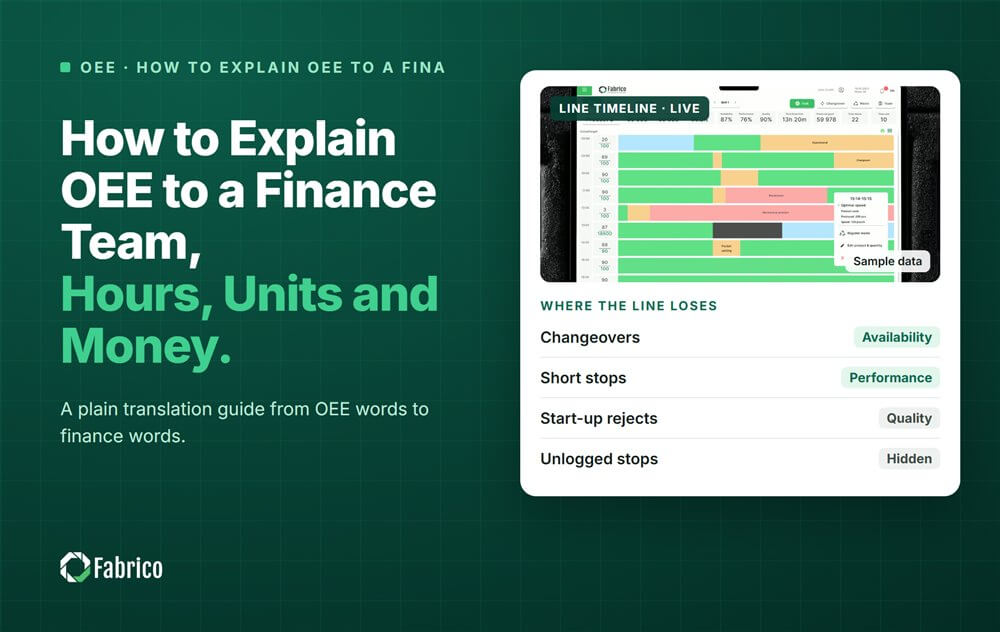
How to Explain OEE to a Finance Team: Hours, Units and Money

Key takeaways
- Explain OEE (overall equipment effectiveness) to finance as good units not made, bottleneck hours lost, and what those hours would have earned.
- Price a lost hour at contribution margin per bottleneck hour, never at revenue or a machine-hour rate.
- A lost hour is cash only if the output would have sold, or if the loss forced overtime, scrap or extra spend.
- Agree the definitions and the pricing rule with the controller before you show any number.
- Lead with hours and money. Keep the OEE percentage for the plant.
To explain OEE to finance, translate it into three things finance already counts. Those are good units the line did not make, hours lost on the bottleneck, and the margin those hours would have earned. Leave the percentage for the plant. Finance wants to know which losses cost cash and which only cost capacity.
Budget review for next year. The controller asks what the ice cream line's OEE losses are worth before funding a project. The plant has percentages, but no money.
This guide is for plant managers and OpEx (operational excellence) leads in FMCG (fast-moving consumer goods) groups. They report to a controller or CFO (chief financial officer). It gives a word-for-word translation, a pricing rule and finance's likely questions. It comes from Fabrico, a platform for OEE and light MES (manufacturing execution system) with computer vision on stops.
Why does OEE confuse a finance team?
OEE is a ratio of time, and finance counts money and units. A point of OEE has a different value on each line, so the percentage alone tells a controller nothing.
- A percentage has no unit. Finance cannot add it to a P&L (profit and loss) line.
- The three factors cost different things. A stop costs time; a reject costs time and material.
- A loss on a machine with spare speed and a buffer may cost no output at all.
- Plants define OEE differently, so two lines at the same OEE can hide very different losses.
Our guide to what OEE means covers the basics in plain words.
Which OEE words map to which finance words?
Use this table in the first meeting, and keep the finance word on each slide after it.
| OEE word | What it means on the line | Finance word |
|---|---|---|
| Planned production time | Hours the line was meant to make product | Scheduled hours |
| Good count | Units right the first time | Saleable units |
| Ideal cycle time, rated speed | The fastest the machine can make one unit | Capacity per hour |
| Availability loss | Stops and changeover overruns | Lost hours |
| Performance loss | Slow running and short stops | Lost hours nobody booked |
| Quality loss | Rejects and rework | Scrap material plus lost hours |
| Bottleneck | The machine that sets line output | The constraint: the hours that carry a price |
| Hidden factory | Output lost inside hours already paid for | Unused capacity |
The last row has a source. Robert C. Hansen's book Overall Equipment Effectiveness (2001) named the hidden factory and linked OEE to net profit for business cases. Our OEE calculation guide shows how each factor is worked out.
How do you put a price on a lost hour?
Price an hour lost on the bottleneck at contribution margin per bottleneck hour. That is selling price minus truly variable cost, times the good units the bottleneck makes in an hour.
- Find contribution per unit: price minus truly variable cost, which is mostly material.
- Multiply by the bottleneck's rated good units per hour.
- Apply it only to hours lost on the bottleneck, or on a machine that stopped it.
- Add cash costs only where they happened: overtime, scrap material, extra freight.
Throughput accounting does not spread fixed costs over products, so price a stop at contribution per bottleneck hour, never at a machine-hour rate. Depreciation does not change because a freezer stopped. Our guides to pricing a bottleneck minute and contribution margin per line-hour go deeper.
For scale only: Siemens' True Cost of Downtime 2024 puts a lost hour in FMCG at 36,000 USD. Use your own line's number, and show how you got it.
Which OEE losses are cash, and which are capacity?
A lost hour is cash only when something real changes. Otherwise it is capacity: useful, but not yet money.
- Cash: the lost output would have sold, because the plant is sold out on that product.
- Cash: the loss forced overtime, a weekend run or express freight.
- Cash: rejects threw away material the plant paid for.
- Capacity: the line caught up inside normal hours, at no extra cost.
- Capacity: freed hours with no order, no overtime cut and no investment pushed out.
What will finance ask, and how do you answer?
Expect five questions. Have the answer to each ready on one slide.
- Who measured the baseline? Machine counts and stop logs, not end of shift notes.
- Is this the bottleneck? Show which machine sets output, and price only its hours.
- Is the plant sold out? Sales confirms which hours could have been sold.
- Is labour fixed? If crews are paid anyway, do not add idle wages on top of contribution.
- Is scrap counted twice? Price rejects at material, since the lost hours already carry the margin.
Lock the OEE definitions with the controller first. The ISO 22400 OEE definitions give both sides one set of element names to agree on.
This page covers the controller meeting. For the board pack, see how to present OEE to the board.
A worked example: one month on an ice cream line, in finance words
Sample line (illustrative numbers, not a customer): an ice cream stick line where the moulding freezer is the bottleneck. It is rated at 300 sticks a minute, or 18,000 an hour. October had 400 planned production hours and an OEE of 68%. A stick sells for $0.48, and its truly variable cost is $0.33.
| Loss, in OEE words | Freezer hours | Good sticks lost | Finance view |
|---|---|---|---|
| Stops and changeover overruns (availability) | 52 | 936,000 | Lost hours |
| Slow running and short stops (performance) | 66 | 1,188,000 | Lost hours nobody booked |
| Rejects (quality) | 10 | 180,000 | Lost hours plus scrap material |
| Total | 128 | 2,304,000 | Hidden factory this month |
- OEE = hours the good sticks would take at rated speed / planned hours = 272 / 400 = 68.0%.
- So 400 minus 272 = 128 freezer hours were lost, and 128 x 18,000 = 2,304,000 good sticks.
- Contribution per stick = $0.48 minus $0.33 = $0.15. Per freezer hour: 18,000 x $0.15 = $2,700.
- Ceiling value of the losses = 128 x $2,700 = $345,600 for the month.
- Sales confirms that 40 of the 128 hours fell in weeks when the plant was sold out. Lost cash margin = 40 x $2,700 = $108,000.
- Rejects threw away material: 180,000 sticks x $0.33 = $59,400, cash whether or not the hours could be sold.
- Cash this month = $108,000 + $59,400 = $167,400, or €167,400 in a euro plant at the same unit prices.
- The other 88 hours are capacity, worth 88 x $2,700 = $237,600 only if they are sold or cut a cost.
Finance now hears two numbers it can test: $167,400 of cash this month and $237,600 of capacity with a condition attached. Saying "OEE is 68%" would have started a debate about the percentage. The two numbers start a decision about which loss to fix first.
Mistakes plants make when explaining OEE to finance
- Leading with the OEE percentage instead of hours and money.
- Pricing lost hours at revenue, not at contribution.
- Adding idle wages on top of contribution when crews are paid anyway.
- Calling freed capacity a saving before anyone buys the output or cuts a cost.
Where Fabrico fits
Fabrico is a computer vision enabled Manufacturing Performance Platform. OEE and light MES come first, and each loss carries a price that a controller can check.
- Every loss priced in money, with the pricing rule you agree with the plant's controller at the start.
- Losses ranked by money, so the meeting starts with the loss that costs most.
- Automatic downtime logging, so the baseline comes from the machine, not from memory.
- OEE live by line and shift, so finance sees the same numbers the plant sees.
You start on one line, with a baseline and a decision date agreed in advance. There is no free plan and there are no tiers: each plant gets a quote. Book a demo and bring your controller.
Frequently asked questions
How do you explain OEE to finance in simple terms?
Say that OEE shows how much of the line's paid time made good product at full speed. Then turn the gap into hours lost on the bottleneck and the margin those hours would have earned. Finance reads hours and margin at once, while a percentage needs a long explanation and still leaves the money unclear.
How do you work out what one OEE point is worth?
Take one hundredth of the line's planned hours: that is one OEE point, in hours. Multiply by contribution margin per bottleneck hour to get its ceiling value. Then ask sales how much of it could have been sold. Only that share, plus scrap material and overtime saved, is cash.
Should a lost hour be priced at revenue or margin?
At margin. Revenue includes material the plant never bought for the units it never made, so pricing at revenue overstates the loss. Use contribution margin per bottleneck hour. Never use a machine-hour rate with depreciation and overhead, because those costs do not change when a machine stops.
Is an OEE improvement a cash saving?
Only when something real changes. The extra output must sell, or the freed hours must cut overtime, a shift, a co-packer or an investment. If none of those happens, the improvement is spare capacity. That is still worth having, but finance will not book it as a saving, and it should not.
Which OEE numbers does a CFO care about?
Usually three: hours lost on the bottleneck, the money those hours represent, and how much of that money is cash. A CFO also wants the trend over months on fixed definitions, and the top losses in money with an owner for each. The OEE percentage itself matters least.
Show finance your line's losses in money
Bring one line and your controller to a demo. We will show last month's losses as hours, money and cash, on fixed definitions.
Latest from our blog


Real Fabrico tiles, sample data.