


 Login
 Blog
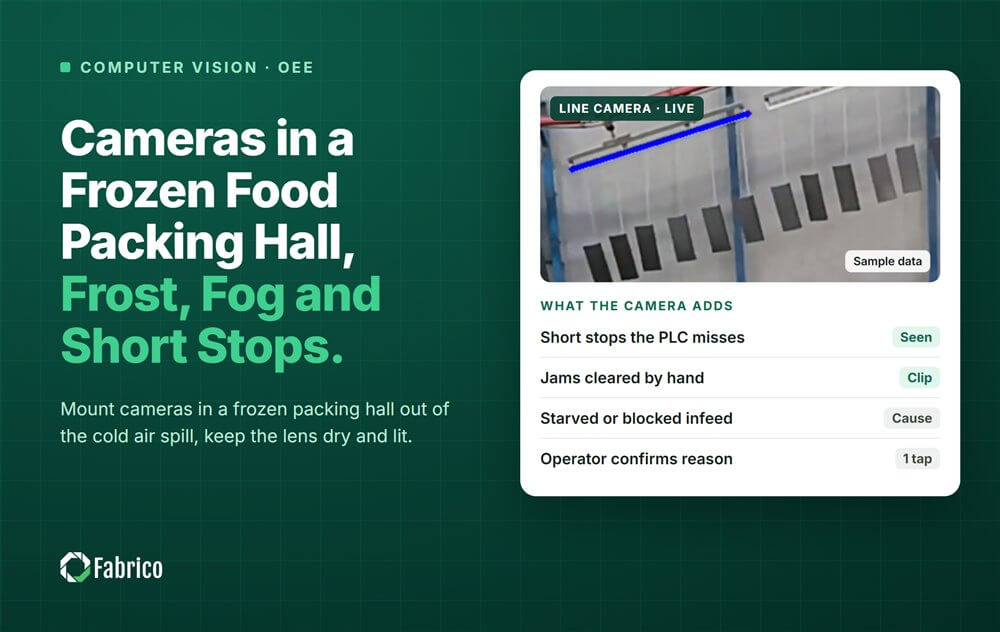
Cameras in a Frozen Food Packing Hall: Frost, Fog and Short Stops

Key takeaways
- Fog forms when a cold lens meets warmer, wet air: at the freezer exit, at open doors and after sanitation.
- Mount cameras where the temperature stays steady, out of the cold air that spills from the freezer.
- Put the lens in the sanitation sign-off, and give each camera a fixed lamp.
- Cold short stops have their own look: frozen clumps at the weigher, bag seal faults, cartons that spring open.
- On a sample line, fog after sanitation hid 4 of 6 seal faults, in the very minutes they peak.
In a frozen food packing hall, a camera loses its view to four things: fog on the lens, frost, wash-down water and dim light. Mount it where the air stays at one temperature, keep the lens dry and give it a fixed lamp, and stop detection stays reliable.
Fabrico is OEE (overall equipment effectiveness) and light MES (manufacturing execution system) software, with AI cameras as an add-on. The cameras count output and record stops, each stop keeps a short clip, and the operator confirms the reason in one tap. For OEE around the freezer itself, see OEE for frozen food production.
What makes a frozen packing hall hard for a camera?
Cold, wet air and big temperature changes over a few metres. A camera sees one field of view in one lighting range. Changing light and a blocked view are the documented error sources for camera stop detection. A cold hall adds fog, frost, wash-down water and people in thick gloves, many times a shift.
Why does the lens fog up, and how do you stop it?
Fog forms when warm, wet air touches a surface colder than its dew point. In a frozen hall that surface is often the camera: at the freezer exit, at doors to warmer rooms, during a defrost, and when the hall warms for sanitation and cools again.
- Mount out of the cold air spill. Step back from the exit and look down on the belt from the side, not into the opening.
- Keep the temperature steady. A camera that swings between cold and warm air fogs most.
- Ask about lens heating. Some housings keep the glass slightly warm. Ask the camera supplier what suits your hall.
- Service it where it lives. A cold camera carried into a warm workshop fogs inside and out. Let it warm up in a sealed bag first.
Fog comes in short spells. Note the times in the first test week, and a pattern appears.
Where should cameras go at the freezer exit, bagger and cartoner?
- Freezer exit belt. Look down on the outfeed a few metres after the opening. The clip shows an empty belt, gaps in the loading, or product piling up because packing is blocked.
- Weigher and bagger. Frame the weigher discharge and the bagger jaws. The clip shows a bag held at the jaws, an open seal, or no bags because product clumped.
- Cartoner in the cold room. Frame the infeed and the closing station. The clip shows a jam or a carton that did not close.
Put a camera only where the machine signal is blind, such as a belt that runs with no product. Our guide to camera placement and lighting on a production line covers angle, height and speed; this one adds the cold hall rules.
What do short stops look like in a frozen packing hall?
Short and frequent, and most never reach a paper log.
- Frozen clumps. Pieces freeze together and bridge in the weigher feed. The clip shows product stopped above the weigher.
- Bag seal faults. Cold, stiff film seals less well while the jaws are still warming up, and ice on the seal area leaves a bag open.
- Cartons springing open. Glue holds less well on cold board.
- Slower fixes in gloves. A jam takes longer to clear in thick gloves. The camera marks when product stopped and moved again; it does not time the person.
Stops under your threshold land in Performance, where nobody sees them. Our guide to micro stops and computer vision shows how a camera brings them back.
How do you protect cameras during wash-down?
- Use a housing made for wash-down. Check it against your water pressure, temperature and chemicals with the supplier.
- Mount it rigid, out of the hose path. A knocked camera changes the scene the model learned.
- Never aim the hose at the lens. Drops on the glass blur the first minutes of the run.
- Put the lens in the sanitation sign-off: dry, clear and aimed before the first product.
The start-up after sanitation is the riskiest time. The hall is wet and warm and cools fast, so the lens fogs just as seal faults and clumps peak.
Worked example: what did fog hide on a sample frozen line?
Sample line (illustrative numbers, not a customer): a frozen vegetable line with a weigher and bagger rated at 50 bags a minute, 1 kg bags, then a cartoner in a cold room. The shift has 450 minutes of planned production time and starts right after sanitation. A camera watches the weigher discharge and the bagger jaws.
With a clear lens, the camera marked these short stops in one shift:
| Short stop | Stops | Minutes | Bags lost |
|---|---|---|---|
| Frozen clumps bridging above the weigher | 30 x 0.5 min | 15 | 750 |
| Bag seal fault, bag pulled at the jaws | 18 x 1 min | 18 | 900 |
| Cold film jammed at the bag former | 12 x 1 min | 12 | 600 |
| Total | 60 | 45 | 2,250 |
- Short stops took 45 of 450 minutes, or 10% of the shift: 45 x 50 = 2,250 bags.
- At a contribution of $0.30 a bag (or €0.30 in a euro plant): 2,250 x $0.30 = $675 a shift.
- Over 500 shifts a year, if the line is sold out: $337,500.
Now the fog. Before the fixes, the lens fogged for the first 20 minutes after sanitation. Six of the 18 seal faults came in those minutes, while the jaws were still warming up and the film was cold.
- Before: the camera caught 2 of the 6 and raised 9 false stops from drifting fog.
- After moving it out of the cold air spill, adding the lens to the sign-off and fitting a housing the supplier advised: 5 of 6 caught, 1 false stop.
- The 4 missed seal faults were 4 minutes, or 200 bags: $60 a shift, or $30,000 a year, with no clip to explain them.
The bigger cost was trust. Nine false stops in 20 minutes make the screen look broken, and a crew that stops trusting it stops tapping reasons.
Which cold hall risks and fixes belong on your checklist?
| Risk | Where and when | Effect on detection | Fix |
|---|---|---|---|
| Fog | Freezer exit, doors, defrosts, after sanitation | False and missed stops | Out of the cold air spill, steady temperature, lens heating |
| Frost and ice | Cold rooms, near evaporator fans | A blurred, white view | Away from fan air, lens checked each round |
| Wash-down water | During and after sanitation | Wet lens, knocked camera | Wash-down housing, rigid mount, lens in the sign-off |
| Dim or changing light | Cold rooms, night shifts | Missed counts | A fixed lamp |
| Glare | Ice, wet floors, shiny film | False alarms | Move the lamp or the camera |
| Gloves, thick clothing | Weigher, bagger, cartoner | View blocked during a fix | Above head height, far side |
| New product or bag size | Changeovers | The scene drifts | Recheck the view |
How do you keep cameras on the product, not the people?
Frame belts, weigher discharges, jaws and cartons, not the cold room doors or the warm-up area. Report OEE by line and shift, never by named operator. In Germany, the works council co-determines any equipment that could monitor performance, even a camera that records nothing. Our works council approval guide covers the steps.
Where Fabrico fits
Fabrico is a computer vision enabled Manufacturing Performance Platform. OEE and light MES come first, and cameras are an add-on.
- Automatic downtime logging, with cameras only where the machine signal is blind.
- AI cameras count output and record stops, each with a short clip as evidence.
- The operator confirms the reason in one tap.
- OEE live by line and shift, with losses ranked by money.
- A work order with its cost when a stop is a breakdown.
Questions about camera hardware for your temperatures go to the technical team for each plant. Named result: ABB, a Fabrico customer, reports 20% less downtime (see the ABB story).
You start with a pilot on one line. Devices are connected in about a month, and the full rollout takes 3 to 4 months. There is no free plan and there are no tiers: each plant gets a quote. See it on the computer vision OEE and MES page.
Frequently asked questions
Why does a camera fog up in a frozen food plant?
Because the lens is colder than the air around it. When warm, wet air reaches a cold lens, its moisture condenses on the glass. Mount out of the cold air spill, keep the camera at a steady temperature and ask the supplier about lens heating.
Can cameras work in a cold room below freezing?
Yes, if the camera and housing are made for that range. Check the temperature range, wash-down and cleaning chemicals with the supplier before you buy. Then test the view on cold, wet and night shifts before you trust its counts.
Where should the first camera go on a frozen packing line?
Where the machine signal tells you least and short stops are most frequent. That is often the weigher and bagger, where clumps and seal faults cause stops of a minute or less. The freezer exit belt comes next: a running belt with no product is starved, not running.
Does the camera replace the PLC on a frozen line?
No. The PLC (programmable logic controller) stays the clock and knows the machine's own faults. The camera adds what it cannot see, such as a belt with no product. Our computer vision vs PLC comparison shows where each one wins.
See your packing hall's short stops in a demo
Bring one frozen packing line and its last shift report. We will show where its short stops hide, the clips and what each one cost.
Latest from our blog


Real Fabrico tiles, sample data.