


 Login
 Blog
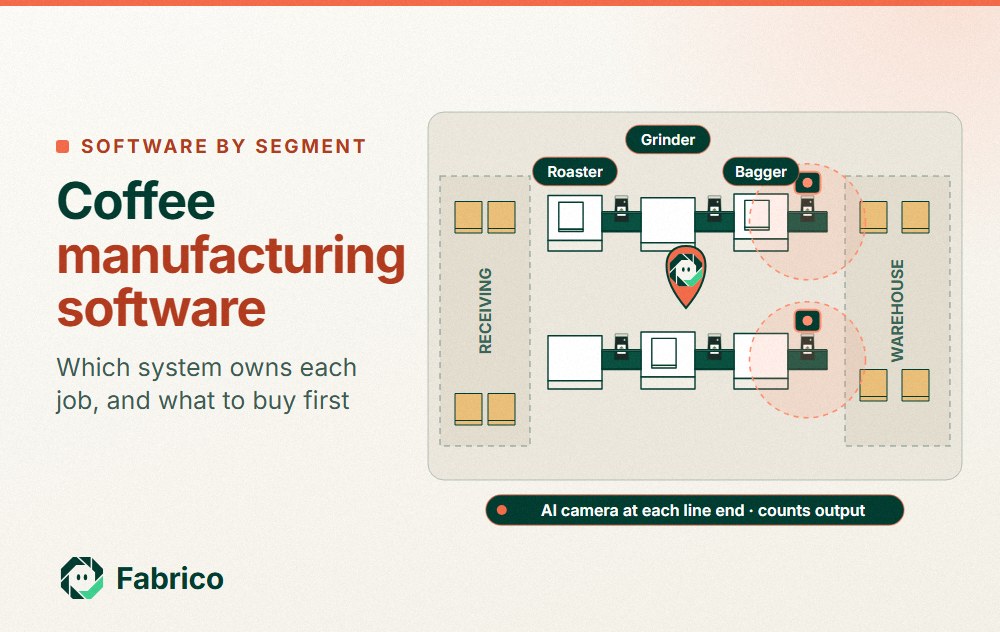
Coffee Manufacturing Software: What to Buy First

In short: coffee manufacturing software is a stack, not one product: an ERP for green lots and orders, roast profile software on the roasters, a quality and lab system, a planning tool for roasts and packing runs, a warehouse system, and OEE with a light MES on the grinders and packing lines. When packing lines keep missing the plan, start with the line layer.
- Green coffee lots and EU deforestation paperwork belong to purchasing and the ERP.
- Roast profile software is its own category. It controls the curve at the roaster; the packing hall needs its own numbers.
- Coffee production scheduling software is a separate buy too. It needs measured batch and changeover times to work.
- In the sample shift below, 40 recovered packer minutes are worth about EUR 842 a shift and about EUR 425,000 a year.
Green coffee comes in by the bag, leaves the roaster by the batch, rests in silos, and leaves the plant by the bag, brick, capsule and pallet. Each step writes its records into a different system.
Supply is not the pressure point this season. The USDA Foreign Agricultural Service forecasts world coffee production for 2026/27 at a record 189.7 million 60 kg bags, 10.8 million more than the year before, and notes that coffee prices dropped 25 percent in the seven months before its July report. When green coffee gets cheaper, the margin a roaster keeps depends more on what the lines convert per hour, and that is the number most plants measure least well.
Below is which system owns which job in a roasting and packing plant, which one to buy first, and a worked packing shift that ends in euros. Fabrico makes the line layer.
The coffee manufacturing software map
A typical split, from green coffee intake to dispatch:
| System | What it owns in coffee | Run by | Link to line data |
|---|---|---|---|
| ERP | Green contracts and lots, blends as bills of materials, orders, costs | Finance, purchasing | Sends SKUs and rates; gets good output and losses back |
| Roast profile software | Roast curves per blend and roaster, charge and drop logs | Roastmaster, quality | Batch start and drop show on the line timeline |
| Quality and lab | Cupping, colour, moisture, residual oxygen samples, HACCP, acrylamide records | Quality | Held and reworked packs counted once quality decides |
| Planning tool | Roast batch order, silo time, grind and pack sequence | Planner | Gets measured batch and changeover times |
| Warehouse WMS | Green bags in, finished pallets out, stock rotation | Logistics | Pallet count per packing run, if the WMS asks |
| OEE and light MES | Batches on roasters, units on packers, stops, reasons, OEE and losses in money | Production, CI | This is the line layer Fabrico makes |
Two rows carry new legal weight. The EU Deforestation Regulation requires that, from 30 December 2026, products placed on, sold within, or exported from the EU are free from deforestation, and coffee is one of the covered commodities. That proof starts with green coffee contracts and lots, so it sits with purchasing, the ERP or a compliance tool.
Roasting carries the other one. The European Commission notes that Regulation (EU) 2017/2158 makes mitigation measures for acrylamide mandatory for all concerned food business operators, and lists coffee among the main contributors to exposure. The roast records behind that belong to roast profile software and the quality system.
The row that often has no owner is the last: why the 500 g line lost an hour on Tuesday, and what that cost. Measuring the line means a timeline per machine and shift: when the roaster dropped each batch, when the packer ran, stood or ran slow, and the reason the operator gave. That is where OEE and a light MES start, and the walkthrough below shows the screens. For the food-wide map, see food manufacturing software.
What you see: a shift timeline, unclassified time waiting for a reason, and the operator's line-down screen, on sample lines rather than a coffee plant. Book a demo.
Plays from YouTube. Google may set cookies when you press play. Privacy policy.
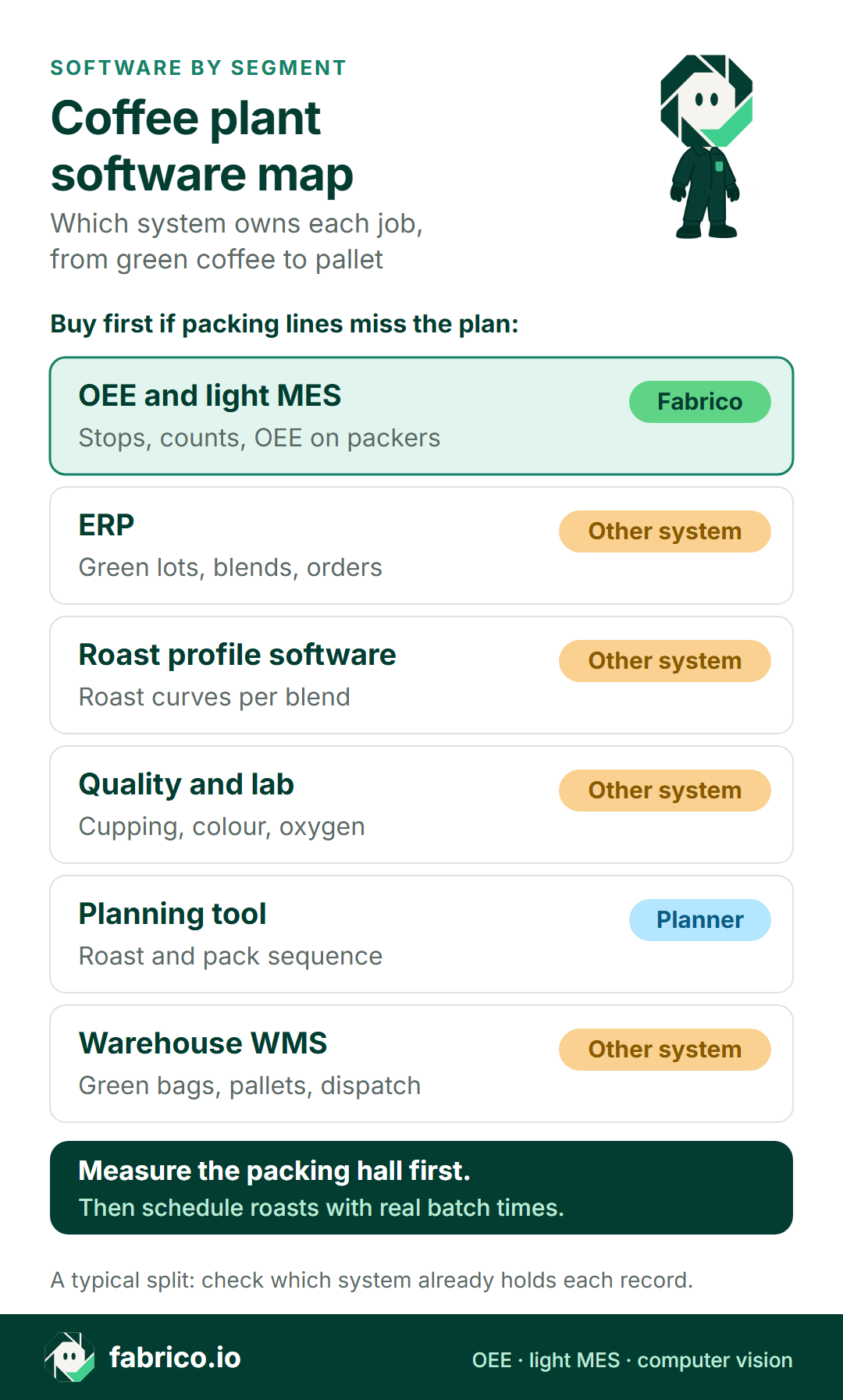
Text version of this infographic
- Coffee plant software map card: OEE and light MES for stops, counts and OEE on packers as Fabrico, next to the ERP, roast profile software, quality and lab, a planning tool and a warehouse WMS as other systems, with the advice to measure the packing hall first.
How coffee plant systems hand over records
Each system in the map passes something to the next. Five hand-offs carry most of it, and the ones that run through a spreadsheet are where a plant loses track.
The hand-off that breaks most often is the silo. If batches from several green lots share one silo and nobody logs the fill, a recall traces a packing run only to a group of lots, and widens. A silo fill log with batch numbers and times is the cheapest fix; line data then shows which packer ran from that silo, when, and how many good packs it made.
A recall follows one green lot through five records:
| Record | Held in | Where the hand-off breaks |
|---|---|---|
| Green lot received | ERP | Lot booked by contract, not by bag |
| Lot charged to each roast batch | Roast profile software | Charge log not linked to the ERP lot |
| Roast batches in each silo | Planning tool or silo log | Silo fill kept on a whiteboard |
| Packing run times and good packs | Line data | Holds times and counts, not lots |
| Pallets dispatched | WMS | Pallet not tied to a packing run |
Coffee production scheduling software is its own buy
Scheduling in a coffee plant is a puzzle with more pieces than most food lines. The planner has to fit:
- Green availability: which origin lots are in, and which blends they allow.
- Roast order: light to dark, regular before decaf or flavoured, to limit cleaning and carry-over.
- Silo time: roasted coffee keeps giving off gas. A peer-reviewed study in the Journal of Agricultural and Food Chemistry notes that CO2 is steadily released during storage or more abruptly during grinding, which is why roasted beans rest before packing.
- Grind and pack sequence: whole bean, filter and espresso grinds, then bag, brick and capsule formats, each with its own change.
Planning tools and the planning part of an ERP do this job. What line data gives the planner is the input most plans lack: how long each roast batch, grind change and blend change really took, by line. Those times leave the line layer by export or API, in a form a planning tool can read. The difference between the two jobs is in production planning vs scheduling.
Where a coffee plant loses hours
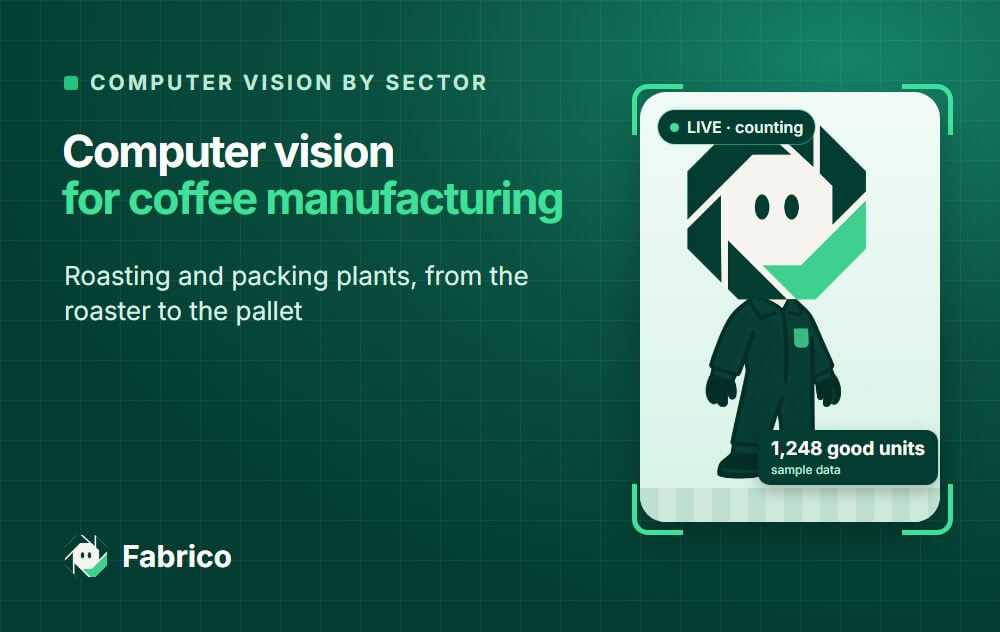
The roaster waits for green coffee or a blend decision; packers wait for silos that are not yet ready; grind changes need a purge; valve stations, lid feeds and film splices cause short stops; nitrogen or vacuum faults put product on hold; and capsule lanes close one by one. The capsule line detail is on OEE for coffee capsule lines, the lid and seal stops on capsule lid and seal stops, and the roastery and packing station walk-through on computer vision for coffee manufacturing.
The machines set the ceiling. One sample roaster and two packing stations show how far apart the stations in one plant run:
| Station | Published rating | What it means for the line data |
|---|---|---|
| Drum roaster, mid-size | Sample figures, not a maker's rating: a batch roaster of about 120 kg a batch on 15-minute cycles, so 4 batches and up to 480 kg an hour | Count batches and batch cycle time, not kilograms per minute; a late drop shows up downstream as a silo wait |
| Capsule filler and sealer | Opem, a capsule filling machine maker in Parma, rates its 8-lane PEGASO CR-8P linear filler at up to 560 capsules a minute | At that rate one lost minute is hundreds of capsules, so short stops and closed lanes matter more than long breakdowns |
| Vacuum brick packer | Vacuum brick packers degas and seal each pack of ground coffee in its own chamber | Vacuum and seal faults stop the machine or create held packs; both belong in the quality count |
These are maximums, not what a shift delivers. The gap between the rating and the packs on the pallet is what OEE measures: time lost to stops (availability), output lost to running slow or to short stops (performance), and packs rejected or held (quality). The split between short stops and slow running is explained in reduced speed loss vs minor stops.
Coffee line failure modes and their early signs
Most coffee plants lose the same handful of hours. The table lists what goes wrong, what the line data shows before anyone complains, and the usual fix.
| Loss | Early sign in line data | Fix |
|---|---|---|
| Packer starved by a late roast batch | "Silo empty" or "no product" stops that cluster after blend changes or at shift start | Sequence roasts from the pack plan backwards and log silo fills with batch numbers |
| Grind change overruns | Changeover minutes by grind type spread wide, with the first good pack well after the restart | Fix the purge quantity per change and write the steps into one standard, as in changeover standards for FMCG lines |
| Valve or film short stops | Many stops under two minutes that bunch after a new valve reel or film splice | Splice and reel checks at the change, with the stop reason kept separate from jams |
| Seal or vacuum faults | Held packs rise after a jaw temperature change or a vacuum alarm | Count held packs as a quality loss the same shift; quality decides release or rework |
| Capsule lanes closing | Speed falls in steps rather than stopping, so availability looks fine and performance drops | Track lane state as its own reason, so a closed lane is not hidden in "running slow" |
| Coffee packed too fresh | Bloated or leaking packs on blends with short silo rest | Set a minimum rest per blend in the plan and check it against the drop time |
Worked example: one coffee packing shift in money
Sample figures for illustration only. The capsule filler rating above is sourced; the roaster and the plant below are samples, not real ones.
A roastery packs 250 g valve bags of ground coffee on one packing line fed from silos. The sample roaster from the table above (about 120 kg a batch, 15-minute cycles) feeds it. The packer's ideal rate is 30 bags a minute. A shift is 8 hours with 30 minutes of planned breaks and cleaning, so planned production time is 450 minutes.
In one shift the line data shows:
- 40 minutes of silo waits, because two roast batches dropped late after a blend change;
- 30 minutes for two grind changes, including the purge;
- 20 minutes of longer valve and film stops;
- 9,720 bags counted at the packer, of which 243 were rejected for weight or seal.
| Step | Calculation | Result |
|---|---|---|
| Run time | 450 planned minus 90 lost (40 + 30 + 20) | 360 minutes |
| Availability | 360 / 450 | 80.0% |
| Performance | 9,720 counted / (360 x 30 ideal) | 9,720 / 10,800 = 90.0% |
| Quality | (9,720 minus 243) / 9,720 | 9,477 / 9,720 = 97.5% |
| OEE | 0.800 x 0.900 x 0.975 | 70.2% |
| Check | 9,477 good / (450 x 30 = 13,500 possible) | 70.2% |
Now price it. With a sample contribution margin of EUR 0.80 per bag, one minute of packer run time at this shift's performance and quality is worth 30 x 0.90 x 0.975 = 26.3 good bags, or EUR 21.06. An hour of packer downtime costs EUR 1,263.60 in lost margin.
The fix in reach is not the whole 90 minutes. Sequencing roasts from the pack plan cuts the silo waits from 40 to 10 minutes, and one grind change standard cuts the two changes from 30 to 20 minutes. That recovers 40 minutes a shift:
- Per shift: 40 x 30 x 0.90 x 0.975 = 1,053 good bags, x EUR 0.80 = EUR 842.40.
- Per month: two shifts a day on 21 production days is 42 shifts, so EUR 842.40 x 42 = EUR 35,380.80.
- Per year: 12 months of 42 shifts is 504 shifts, so EUR 842.40 x 504 = EUR 424,569.60.
OEE rises from 70.2% to 78.0% (9,477 + 1,053 = 10,530 good bags out of 13,500). The roaster can supply it: 10,530 bags of 250 g is about 2.6 tonnes of roasted coffee a shift, against 3.84 tonnes in 8 hours at the sample roaster's 480 kg an hour (120 kg x 4 batches x 8 hours). That pace needs every 15-minute cycle on time; on slower profiles, with charge and drop, and with roast loss, since beans lose mass as they roast, the margin shrinks, which is why the silo waits are worth timing. In this sample, they were a sequencing problem, not a capacity one.
Two checks before anyone quotes these numbers. First, the money only counts if the market takes the extra bags; if the line already meets demand, the same 40 minutes come back as overtime or a shift not run, which is cheaper to price from the labour plan. Second, sensitivity: at a margin of EUR 0.50 a bag the same 40 minutes are worth EUR 526.50 a shift and EUR 265,356 a year, and if performance were 85% instead of 90%, each recovered minute yields 24.9 good bags instead of 26.3. The calculation itself is the standard one in OEE calculation.
What to buy first, by symptom
Buy for the problem that costs most this year. The rest can follow.
| What hurts most | Start with | Why |
|---|---|---|
| Packing lines miss the weekly plan and nobody can say why | OEE and light MES on the packer and the roaster that feeds it | It shows whether the packer is slow or starved by late roasts |
| Roast colour drifts batch to batch | Roast profile software | The curve is controlled and logged at the roaster |
| EU customers ask for green lot due diligence | The ERP or a compliance tool | Green lot records start at purchasing, not on the line |
| The roast and pack plan is rebuilt by hand | A planning tool or ERP planning | Sequencing is its own category. Feed it measured times. |
| Oxygen, seal or weight complaints | Lab, quality system and inspection at the sealer | Oxygen and seal checks are samples and inspection jobs |
| Pallets or green bags go missing | A WMS | Stock location and dispatch are warehouse jobs |
Most plants end with roast profiles at the roaster, green lots in the ERP, lab results in the quality system, and OEE on the lines. Book a demo to see roast batches and packing stops on one timeline, with the lost minutes priced by line.
OEE and light MES from roaster to palletiser
The line layer reads roaster batch start and drop, grinder run state and packer counts, and the operator adds the reason. Which station needs which signal or camera is on computer vision for coffee manufacturing.
Hand-packed gift boxes and cafe packs have no machine count. There the camera add-on counts output, and its video is streamed on request, not stored in Fabrico. More in the FMCG camera guide.
Five questions that sort coffee software vendors
Use them on every vendor on the shortlist, with a week of stop sheets open.
| Question | What a good answer shows |
|---|---|
| Which roast data does it read, and which stays in roast profile software? | Batch start, drop and count on the line timeline; curves and profiles left where they are. |
| Can a "silo empty" stop be charged to the roastery? | The packer shows the wait, but the loss lands on the late roast batch, not on the packing crew. |
| Are grind changes and blend changes separate types? | Each with its own minutes, including the purge, so the planner sees which change costs more. |
| How is held product from a nitrogen or vacuum fault counted? | A stop reason for the fault, and the held or reworked packs counted once the lab decides. |
| What comes from the ERP, and what goes back? | Blends, SKUs and rates in; good output and losses out. Ask who keeps the link working. |
What a coffee plant manager can do this week and this quarter
This week, with paper and the data you already have:
- Pick the packing line that missed the plan most often last month, and the roaster that feeds it.
- For five shifts, write the drop time of every roast batch next to the packer's stop sheet. Mark each "silo empty" stop with the batch it waited for.
- Time every grind and blend change from the last good pack to the first good pack, purge included.
- Split the packer's short stops into valve, film, seal and jam. Four reasons are enough to start.
- Put your own margin per pack into the worked example above and price one shift.
This quarter, once the week shows where the minutes go:
- Measure the chosen packer and its roaster automatically, by machine signal or the camera add-on, so the shift report stops depending on handwriting.
- Agree a minimum silo rest per blend with the planner.
- Write one grind change standard and compare changeover minutes before and after, by grind type.
- Send measured batch and changeover times to the planning tool every week instead of the planner's estimates.
Fabrico in a roasting and packing plant
Fabrico makes cloud OEE and light MES software. For a coffee plant it does three things:
- Roaster and packer on one timeline: batches on the roaster and units on the packers, each with its own OEE, so a late roast and the packer it starved show side by side.
- Changeovers in money: grind changes, blend changes and silo waits timed and priced by line, ready for the planner and the planning tool.
- Hand packs counted: the camera add-on counts gift and cafe packs at tables where no machine counts.
Roast profiles, green lot and EUDR records, lab results and HACCP stay in the systems that own them in the map above. Quality inspection is not part of Fabrico. Production planning and scheduling are not part of Fabrico today. The full feature list is on the MES and OEE software page, and the cameras are on the computer vision add-on page.
Questions coffee plant managers ask
What software does a coffee roasting plant need?
Most run an ERP for green contracts, lots, blends and orders; roast profile software on the roasters; a quality and lab system for cupping, colour, moisture and oxygen checks; a warehouse system; and OEE with a light MES on the grinders and packing lines. Larger plants add a planning tool for the roast and pack sequence.
Is roast profile software the same as an MES?
No. Roast profile software controls and logs the roast curve for each blend on each roaster. An MES or light MES records what the lines did: batches, units, stops, reasons and OEE. Many plants run both.
What does coffee production scheduling software need from the lines?
Measured times: how long each roast batch, grind change and blend change really took, by line. Scheduling roast batches and packing runs is the job of a planning tool or the planning part of an ERP, and it works only as well as those times.
Does the EU Deforestation Regulation change which software we buy?
It changes the paperwork for green coffee. Due diligence and green lot records start at purchasing and live in the ERP or a compliance tool, so the EUDR question belongs in that evaluation, not the line software one.
Which coffee line should go live first?
Usually the packing line that misses the plan most often, with the roaster that feeds it. Measuring both shows whether the packer is slow or starved by late roast batches, and the worked example above prices the difference.
Book a demo to see what a week of late roast batches costs a packing hall, priced per shift.
Related articles
Latest from our blog


Real Fabrico tiles, sample data.