

The term integration is used loosely in the OEE and CMMS software market: vendors describe API connections between separate systems as integration in the same breath as describing truly native unified platforms. The distinction matters significantly for data quality.
See our roundup of the analytics platforms where this integration choice matters.
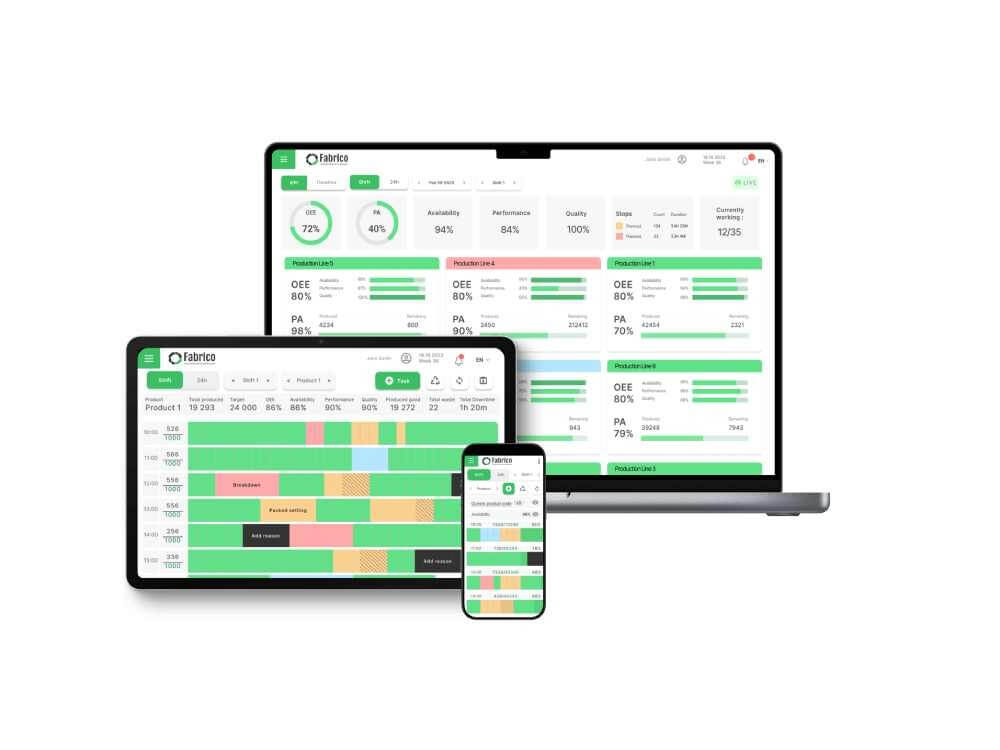
Native integration means OEE and CMMS functionality share a single database, a single asset data model, and a single application layer, there is no data synchronization between systems because there is only one system.
When an OEE downtime event occurs on Asset ID 12345, the CMMS work order created for that event references the same Asset ID 12345 with the same attributes, the same PM history, and the same spare parts list, because they are the same record in the same database.
API integration means two separate systems exchange data through programmatic calls. The OEE system knows Asset ID 12345 as Line3-Press1. The CMMS knows the same machine as Hydraulic Press Line 3. A mapping table connects these two identifiers.
When the OEE system creates a maintenance alert, an API call creates a CMMS work order, but if the mapping table is out of date, or if the OEE event attribute set does not match what the CMMS work order requires, the work order is created with errors or not created at all.
Action latency, the time from OEE detecting a problem to a maintenance technician receiving an actionable work order, differs by integration architecture. Native integration: OEE event detected, work order created in same system, technician notified via mobile app.
Total latency: under 30 seconds. The technician receives a work order with the asset history, recent PM records, recommended spare parts, and LOTO procedure, because all this data is in the same system as the OEE event.
API integration: OEE event detected, API call to CMMS (1 to 5 seconds), CMMS creates work order with mapped asset ID and limited context (only what the API payload includes), technician notified. Total latency: 30 seconds to 5 minutes depending on API polling frequency and call success rate.
The work order may have incomplete context if the API payload does not include all relevant information. The practical consequence of higher action latency: maintenance technicians who arrive at a machine without full context (what broke, what was the last PM, what parts are needed) spend 10 to 20 minutes gathering information that native integration provides at work order creation.
For a 20-person maintenance team responding to 50 unplanned events per month, this information-gathering overhead costs 167 to 333 hours per month, $10,000 to $20,000 per month in fully-loaded labor at $60 per hour.
The long-term costs of maintaining an API integration between OEE and CMMS systems compound over time in ways that are easy to underestimate at procurement. API version changes: both OEE and CMMS vendors release new software versions that may change API schemas, response formats, or authentication methods.
Each API version change potentially breaks the OEE-CMMS integration and requires developer time to repair. Mid-market manufacturers using Zapier or Make.com automations for their OEE-CMMS connection experience this as unexpected breakages during software updates, often discovered when maintenance work orders stop appearing for OEE events, sometimes days after the break occurred.
Data model divergence: as both systems add new features, their underlying data models diverge. Asset attributes added to the CMMS (new criticality levels, new PM schedule types) do not appear in the OEE system.
OEE data attributes (new loss categories, new quality rejection codes) do not appear in CMMS work orders. The gap between systems widens with each software release.
Total five-year API integration maintenance cost for a mid-market manufacturer: $40,000 to $100,000 in developer time, excluding the business cost of integration breaks and data quality degradation. Native architecture: zero integration maintenance cost because there is no integration to maintain.
The architectural choice at procurement time is a 5-year cost decision, not just a day-one decision.
See Fabrico live. Request a demo.
Request a demo












 Login
Login
 Blog
Blog