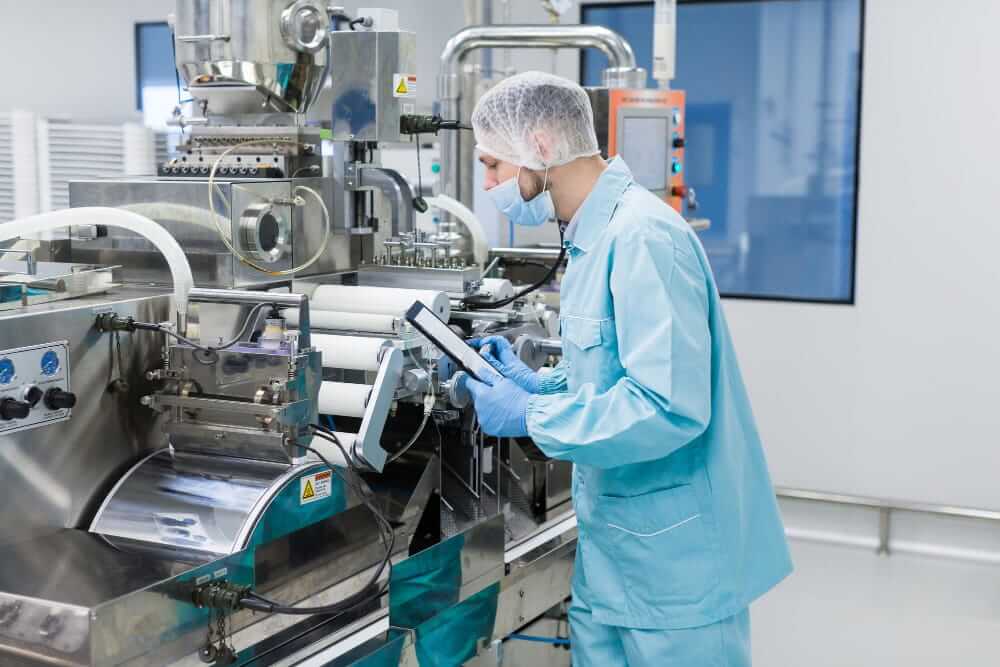
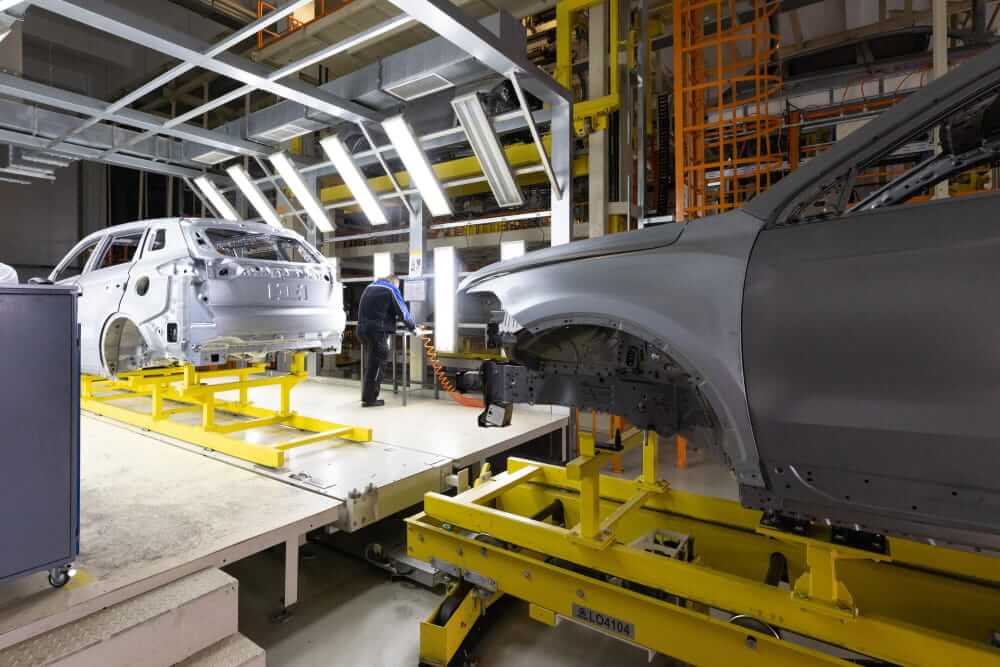
What is OEE? Overall Equipment Effectiveness is a single score for how well a machine runs versus its full potential, combining availability, performance, and quality.
Key Takeaways: OEE (Overall Equipment Effectiveness) measures how much of your scheduled production time is being used to produce good quality output at ideal speed. It's the most comprehensive single-number indicator of manufacturing performance available. But knowing your OEE score is only useful if you know which of its three components — availability, performance, or quality — is the biggest opportunity, and if you have a system that turns the diagnosis into a maintenance action. That's what Fabrico provides.
Overall Equipment Effectiveness is a manufacturing metric that combines three performance dimensions into a single number:
The formula: OEE = Availability × Performance × Quality
Each component is expressed as a percentage. OEE is the product of all three — which means it's always lower than each individual component. A machine running at 90% availability, 95% performance, and 98% quality achieves: 0.90 × 0.95 × 0.98 = 83.8% OEE.
This compounding multiplication is mathematically significant: moving from 70% to 85% OEE requires improvement across multiple components simultaneously. You can't get to 85% OEE with perfect performance and quality if availability is at 80%. The three components are multiplicatively connected — weakness in any one component limits the total.
OEE's three components map directly to six categories of production loss, commonly called the Six Big Losses:
Availability losses (two types):
Performance losses (two types):
Quality losses (two types):
The Six Big Losses framework makes OEE actionable: instead of trying to improve a single number, improvement teams target specific loss categories with specific countermeasures. Equipment failures need better preventive maintenance. Setup losses need SMED. Minor stoppages need autonomous maintenance and error-proofing. Reduced speed needs process optimization and condition monitoring. Quality losses need equipment condition management and process control.
OEE multiplies three numbers, so a weakness in any one drags the whole score down.
Availability is the share of planned production time the machine was actually running. Breakdowns and changeovers reduce it.
Performance compares actual speed against the ideal cycle time. Micro-stops and slow running erode it, often invisibly.
Quality is the share of parts made right the first time. Scrap and rework cut into it.
Because the three are multiplied, 90% on each gives roughly 73% OEE, not 90%.
Most manufacturers who implement OEE monitoring discover that knowing the OEE score is only half the problem. The other half is knowing what to do about it — and doing it fast enough to matter.
OEE software exists on a spectrum from passive monitoring to active action enablement:
Passive monitoring (dashboards only): The OEE score is displayed on a screen. When it drops, someone has to notice, decide to investigate, call maintenance, and manually create a work order. Total time from OEE drop to maintenance response: 20–45 minutes. Value: visibility into losses, no acceleration of response.
Active OEE software (like Fabrico): When OEE drops below threshold, the system automatically creates a CMMS maintenance work order within 60 seconds, pre-populated with asset context and loss information, and pushes a mobile notification to the assigned technician. Total time from OEE drop to maintenance response: under 2 minutes. Value: faster response and the production-maintenance data connection that makes every intervention more effective.
The difference between 20–45 minute response and 2-minute response on a plant experiencing 15 unplanned failures per month:
This is why Fabrico's core design principle is "OEE diagnoses, CMMS cures." OEE monitoring without maintenance execution integration is half a system. It tells you where you're losing — but it doesn't automatically initiate the repair that recovers the loss.
Standard OEE monitoring has a fundamental limitation: it captures what machine signals can detect. PLCs report machine run/stop states and production counts. They don't capture:
Fabrico's computer vision — Inefficiencies Zoom-In — captures all of these losses with video evidence. In typical Fabrico deployments, computer vision identifies 8–15% additional OEE losses that PLC monitoring classifies as normal operation. These losses have names, root causes, and elimination paths — but only if they're visible.
Complete OEE measurement in Fabrico combines three data sources: machine signals from PLCs (for availability and cycle time), production counters (for output counts), and computer vision cameras (for events sensors can't detect). The result is the most complete picture of what's actually happening in your production operation — the foundation for improvement decisions that deliver results.
Many plants start by calculating OEE on whiteboards and spreadsheets. The math is simple, but the data collection is not.
Operators forget to log micro-stops, and slow cycles go unrecorded, so the reported score flatters reality.
Fabrico's Native OEE pulls availability, performance, and quality straight from the machine, removing manual logging and guesswork.
Fabrico's Computer Vision with Inefficiencies Zoom-In catches the micro-stops and slow cycles people miss.
A score alone does not improve anything. The Fabrico AI Agent points to the specific losses worth attacking first.
See how Fabrico turns OEE from a weekly report into a live improvement tool.
The "world-class 85% OEE" benchmark is the most cited and most misapplied number in manufacturing performance management. Understanding when it applies — and when it doesn't — is the difference between setting a motivating improvement target and setting one that demoralizes your team.
The 85% benchmark was calibrated for high-volume, single-model discrete assembly with minimal changeover. Applying it uniformly:
The right target for your operation is determined by your process type, your product mix, and the structural constraints of your manufacturing model. Fabrico helps you establish this target through process-specific OEE configuration — classifying planned downtime correctly, setting ideal cycle time to demonstrated best rate, and benchmarking against comparable operations in Fabrico's deployment network.
The Fabrico OEE improvement path:
The manufacturers who achieve sustainable OEE improvement don't do it by monitoring a dashboard. They do it with integrated OEE and CMMS in a platform where every detected production loss creates a maintenance action opportunity — and where every maintenance action's outcome is measured against subsequent OEE data to verify it worked.
That's the system Fabrico provides.


Uzmanlarımızla 1'e 1 görüşme planlayın veya doğrudan Ücretsiz Planımızın bir parçası olun.
Kredi Kartı gerekmez!





 Login
Login
 Blog
Blog