


 Login
 Blog
Landing AI Alternatives: LandingLens, Model Platforms and OEE Cameras

In short: Landing AI alternatives split by how much your team wants to build. Roboflow and Ultralytics Platform also let you label, train and deploy your own vision models. MVTec HALCON and MERLIC put deep learning inside classic machine vision software. If the real goal is OEE rather than inspection, Fabrico records stops from the machine signal and, with its camera add-on, counts output where no signal can.
- LandingLens is Landing AI's no-code platform to label images, train models and deploy them to the cloud, the LandingEdge app, Docker or your own cloud.
- Landing AI's homepage leads with Agentic Document Extraction, its document product. LandingLens has its own product page and docs, and its latest release note is dated 2 September 2026.
- A model is one part of an inspection station. Lighting, triggers, the reject and the PLC link are the rest, and each needs an owner.
- Inspection and OEE are different jobs, joined by the reject count.
- Facts come from each vendor's own site or docs, as of 11.11.2026, linked in place. No prices, no verdicts.
A process engineer labels a few hundred images of dented cans, trains a model and gets a good score by Monday. Then the real work starts: the light, the trigger, the reject arm, the PLC, and the report the quality manager wants every morning.
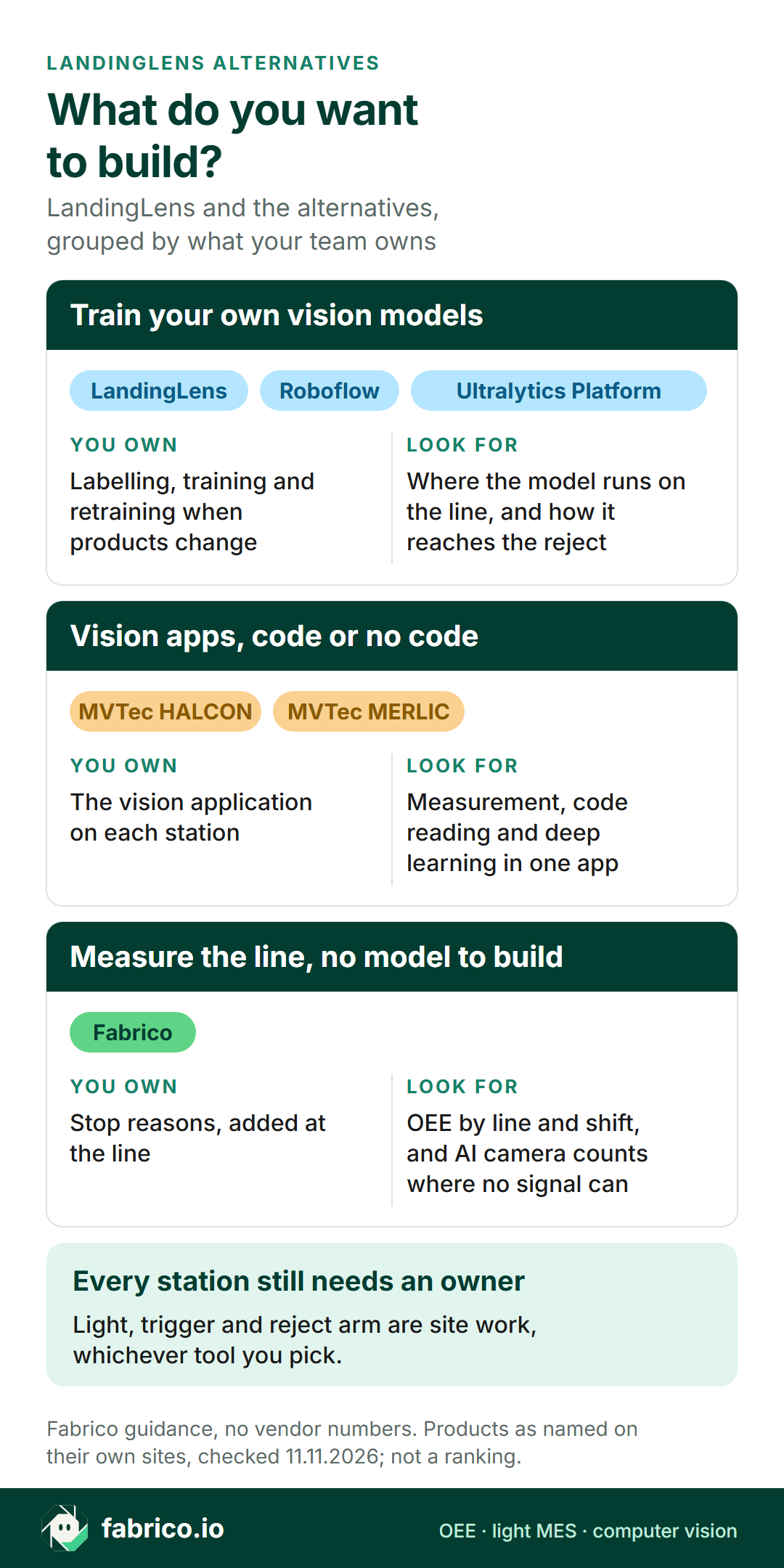
LandingLens covers the model work, and its LandingEdge app runs the model on the line; the light, the trigger and the reject arm still need an owner on site. There are two routes below: another way to build and run vision models, or a tool that does a whole job without a model project.
This page covers both: what LandingLens is according to Landing AI's own site and docs, when it fits, and four alternatives grouped by how much you build yourself. Fabrico wrote this page and is one of the four. For the wider field, see our machine vision software comparison for OEE.
What LandingLens is (as of 11.11.2026, per Landing AI's site and docs)
Landing AI names Andrew Ng as its founder and Executive Chairman on its about page. Its homepage and about page lead with Agentic Document Extraction, its product for turning documents into structured data. LandingLens, its computer vision platform, has its own product page and documentation.
- What it is. A deep-learning vision platform to create and test AI projects without complex programming. The workflow is upload, label, train and deploy (product page, docs overview).
- Project types. Object detection, classification, segmentation, anomaly detection, and visual prompting, which the docs label beta. Anomaly detection is meant for cases with few or no images of bad parts (project types).
- Labelling. A label book to agree class definitions across a team, automatic detection of mislabelled images, and labelling by several people at once (product page).
- Deployment. A cloud endpoint, the LandingEdge app, or a self-hosted Docker container, plus Python and JavaScript libraries (docs). LandingEdge runs on Windows and Linux, does not need the internet, takes images from USB, GenICam, a folder or an API call, and can communicate with PLCs (LandingEdge overview).
- Your own cloud. LandingLens VPC runs in your AWS, Azure or GCP environment on Kubernetes (LandingLens VPC). The docs also cover a version that runs on Snowflake (docs overview).
- Recent updates. The release notes list a LandingLens release on 2 September 2026 that adds API access to per-sample prediction data (release notes). LandingEdge v2.12.74, dated 7 May 2026, adds GPU support up through Blackwell cards (LandingEdge release notes).
When LandingLens is the right pick
- Someone on your team will own the model: labelling, retraining and checking results when products change.
- You want to choose your own cameras and PC, and run inference at the edge without internet.
- Your defects are specific to your product, and you have images of them, or few bad samples and a need for anomaly detection.
- Your IT team wants the platform in its own cloud, through the VPC option.
Ask in the demo: how LandingEdge connects to your camera and PLC, and who retrains the model when a product changes.
If that matches, LandingLens is built for the job. The alternatives below fit when you want a different way to build, classic machine vision tools next to deep learning, or OEE rather than inspection.
A model is one part of an inspection station
Model platforms shorten the training step. A working station on a line still has more parts, and each needs an owner before the pilot starts.
Agree up front who owns the light, the trigger and the reject. They need as much attention as the model score. If you would rather buy a finished inspection system, our visual quality control guide covers that route, and our Cognex In-Sight review covers one vendor's smart cameras.
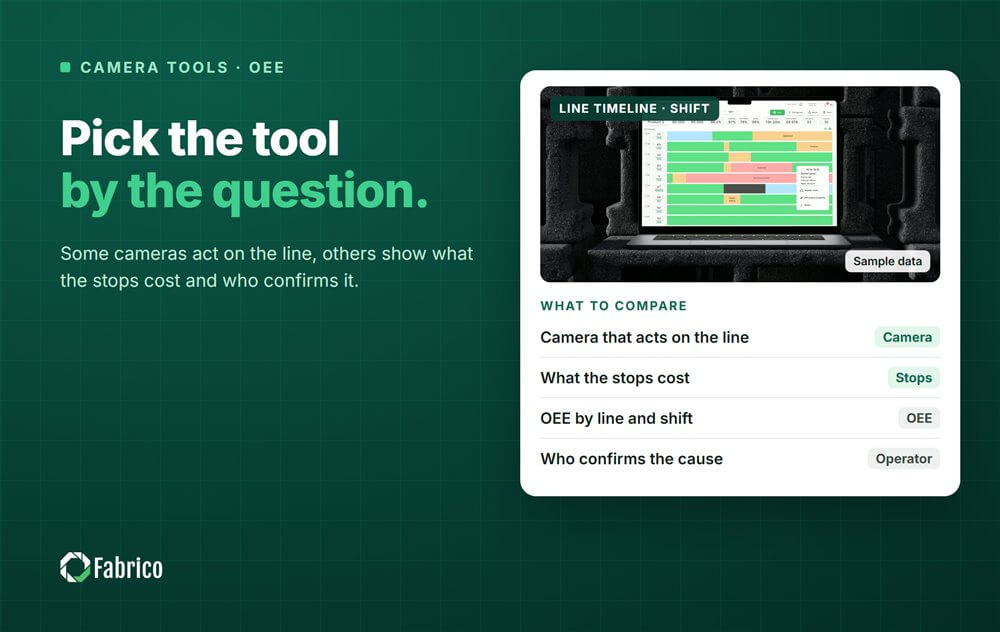
Inspection and OEE are also different jobs. A model decides whether a part or pack passes. OEE needs stop times, counts and reasons for the whole line. The two meet at the reject count, as our page on label and code vision vs an OEE camera explains.
Comparison table: LandingLens and four alternatives
Facts as of 11.11.2026, from each vendor's own site, linked in its section below.
| Tool | Who builds the model | Where it runs, per its site | Main job |
|---|---|---|---|
| LandingLens (for reference) | Your team, no code | Cloud, LandingEdge, Docker, your own cloud | Build and deploy vision models |
| 1. Fabrico | No model to build | Cloud; web, iOS and Android apps | OEE and light MES |
| 2. Roboflow | Your team, with AI-assisted labelling | Managed cloud, self-hosted, embedded | Vision apps and workflows |
| 3. Ultralytics Platform | Your team, on Ultralytics YOLO models | Cloud training; export to 23 formats; deploy to 42 regions | Label, train, export YOLO models |
| 4. MVTec HALCON, MERLIC | Your team: code (HALCON) or no code (MERLIC) | Multicore, GPU; MERLIC on Siemens Industrial Edge | Machine vision with deep learning |
Want to see OEE on a line without a model project? Book a demo and bring one line's downtime log.
1. Fabrico: OEE software, with AI cameras as an add-on
Fabrico wrote this page, and it is not a model-building platform. Fabrico is a cloud OEE and light MES platform that does one job end to end: it measures how a line runs, shift by shift.
Today, per fabrico.io:
- The machine signal comes first. A PLC, sensor or counter gives stops and counts. Operators add the stop reason on a tablet or phone at the line.
- Reports by line and shift: OEE, downtime and losses in money, on the web, iOS and Android.
- Camera add-on, on request: AI cameras count output at manual steps and at machines with no usable signal. From the shift timeline you can open the camera video for any moment. Video is streamed on request and, in the standard setup, not stored in Fabrico.
- Rejects: if your inspection station gives a reject signal or counter, it can feed the quality part of OEE.
- Data out: a REST API, webhooks, and Excel or CSV export.
- Roadmap, not live: stops detected by the camera itself, jam zones, and a camera proposing a likely stop reason for the operator to confirm.
- Not Fabrico: defect inspection, or a platform to train your own models.
Custom AI modules exist as custom work on request, but they are not the place to start.
Ask in the demo: how a camera count compares with a hand count at one of your manual stations, and how your reject signal reaches the quality part of OEE.
Fits plants that need OEE and the cost of downtime by line and shift, including manual stations, without running a model project to get there. See the screens in our OEE software overview, and size the camera side with how many cameras a line needs.
2. Roboflow: build and run your own vision apps
Roboflow is a platform that turns images, video and streams into results your systems can act on (roboflow.com). As of 11.11.2026, its site says:
- AI-assisted labelling annotates images with frontier models and custom filters.
- Workflows combine models, trigger actions, update databases and plug into industrial systems.
- Models run in its managed cloud, or self-hosted on your cloud, servers or embedded devices (Deploy).
- Fleet tools configure devices and cameras across sites, show GigE camera streams and push updates over the air (Deploy page).
- Its manufacturing page names quality inspections and equipment effectiveness, and lists MQTT, OPC-UA, REST APIs and webhooks for connecting to plant systems (manufacturing).
- It publishes open source tools, such as its supervision and inference libraries (homepage).
Compared with LandingLens: both cover label, train and deploy. Roboflow's pages put more weight on workflows that chain models and actions, and on managing many devices. LandingLens's pages put the weight on data-centric labelling and its LandingEdge app.
Ask in the demo: who keeps the workflows running when a product or camera changes, and where images and predictions are kept.
Fits plants with developers who want to build vision applications across many jobs, not only inspection.
3. Ultralytics Platform: YOLO models from labels to export
Ultralytics Platform takes raw images to production-ready Ultralytics YOLO models, with labelling, training, evaluation, export and deployment in one workflow. As of 11.11.2026, the platform page says:
- Datasets can be auto-labelled with 25 vision models from 12 providers, and each box is reviewed before training.
- It can generate extra training images of the same subjects in new settings, viewpoints and light.
- Training runs on cloud GPUs, with live metrics and experiments compared side by side.
- Models export to 23 formats, including ONNX, OpenVINO and TensorRT, and deploy to 42 global regions.
Compared with LandingLens: Ultralytics centres on its own YOLO models, exported to the runtime you choose or deployed from the platform. LandingLens lists a cloud endpoint, its LandingEdge app and a Docker container.
Ask before you start: who writes and maintains the code that links an exported model to the camera, the reject and the PLC.
Fits teams with machine learning engineers who want YOLO models and control over the runtime.
4. MVTec HALCON and MERLIC: deep learning inside machine vision software
MVTec's machine vision software includes HALCON and MERLIC, both with deep learning built in. As of 11.11.2026, its pages say:
- HALCON is a 2D and 3D machine vision toolbox for developing, deploying and operating vision applications, from image acquisition to deep learning in one package.
- HALCON supports GPU acceleration and runs deep learning with Intel OpenVINO and NVIDIA TensorRT. Calibration tools support subpixel measurement.
- MERLIC builds vision applications without code, by combining standard tools set directly on the image.
- MERLIC combines deep learning with rule-based tools for classification, measurement and counting, inspection and testing, OCR, barcode and 2D code reading, and 3D on height maps.
- MERLIC on Edge runs MERLIC applications on Siemens Industrial Edge devices.
Compared with LandingLens: LandingLens is a deep learning platform, run in Landing AI's cloud or your own (VPC). MVTec puts deep learning next to classic tools such as measurement and code reading, in software your engineers program (HALCON) or configure (MERLIC).
Ask in the demo: which edition and licence fit your stations, and who writes and supports the application on the line.
Fits plants and integrators that need measurement, code reading and deep learning in the same application.
Which one fits your plant
- You want a no-code platform with edge and private cloud options, and an engineer to own it: LandingLens.
- Your developers want vision workflows across many jobs and sites: Roboflow.
- Your ML team wants YOLO models and its own runtime: Ultralytics Platform.
- You need measurement and code reading next to deep learning, in one application: MVTec HALCON or MERLIC.
- You need line OEE, the cost of downtime and output counts at manual stations: Fabrico.
A plant that builds its own inspection models still needs line OEE: the model's reject count is only the quality part. For a page in this format about a camera agent vendor, see Cerrion alternatives. To choose camera or sensor per machine on the OEE side, see camera or sensor for OEE by machine.
Worked example: test any model on your own images
Whichever platform you pick, score the model on images from your own line before it drives a reject arm. This is sample data for a test set of 1,000 images of cans with 60 real defects mixed in. It is not a customer's line and not a product screen.
The model flagged 71 images: 57 real defects and 14 good cans. It missed 3 defects.
Recall is 57 of 60, or 95.0%: the share of real defects it caught. Precision is 57 of 71, or 80.3%: the share of flags that were real.
The false alarms matter on the line. 14 of 940 good cans is 1.5%. On a line making 40,000 good cans a shift, that is about 600 good cans rejected. Those rejects count against the quality part of OEE unless someone checks them and puts them back. A missed defect never shows in OEE at all, which is why both numbers matter.
Ask every vendor for both numbers on your images, and agree the threshold with quality before the pilot. On the counting side, our page on AI visual counting covers how counts are checked.
Questions to ask before you build
- Who owns the model after the pilot? Labelling, retraining and sign-off when a product changes.
- What runs on the line? An edge app, a container or your own code, and on which PC.
- How does a decision reach the reject? Which PLC protocols are supported, and who wires it.
- How is a new SKU handled? How many images it needs, and how long retraining takes.
- Where are images kept? The vendor's cloud, your own cloud or on site, and for how long. Cameras at manual stations see people, so read GDPR and production line cameras first.
- What are the support terms? Roadmap, updates and help for a line that runs three shifts.
- What drives the quote? Users, deployments, devices, stations and training. Send each vendor the same scope.
What people ask next
What is LandingLens?
LandingLens is Landing AI's computer vision platform. You upload images, label them, train a model and deploy it to the cloud, the LandingEdge app, Docker or your own cloud. Project types include object detection, classification, segmentation and anomaly detection.
Is LandingLens available today?
Yes. As of 11.11.2026, landing.ai has a live LandingLens product page, a LandingLens VPC page and LandingLens docs, and the release notes list a LandingLens release on 2 September 2026. As with any vendor, ask about the roadmap and support terms before you commit.
Can LandingLens models run on the line without internet?
Yes, according to its docs. The LandingEdge app runs locally on Windows or Linux, does not need the internet, takes images from USB or GenICam cameras and can communicate with PLCs. Check your exact camera and PLC with Landing AI.
Is LandingLens OEE software?
Landing AI describes LandingLens as a platform to build and deploy computer vision models. OEE needs stop times, run time, counts and reasons for the whole line. A model's reject count can feed the quality part of OEE in an OEE system, if it is connected to one.
How is Fabrico different from LandingLens?
LandingLens is Landing AI's platform for building and deploying your own computer vision models. Fabrico is OEE software: stops and counts from the machine signal, reasons from the operator, OEE and losses in money by line and shift, and AI cameras that count output where no signal can. Fabrico does not train inspection models.
What does a LandingLens alternative cost?
Pricing models differ between vendors, so compare quotes on the same scope. Give every vendor the same list of lines, stations and cameras, and add lighting, mounting, integration and training to the total.
Want to see OEE on a line like yours? Book a demo, or contact us with your line list.
Related articles



Latest from our blog



Real Fabrico tiles, sample data.