

Key takeaways
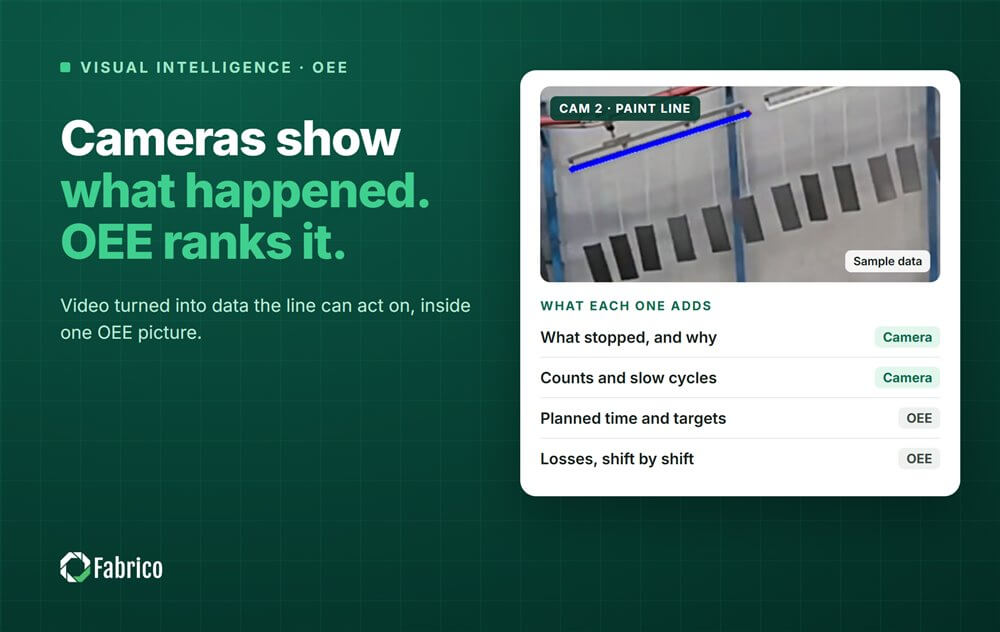
AI visual counting is the use of computer vision to count products on a production line. A camera watches a fixed zone, a trained model recognizes your product, and every unit that crosses the zone increments the count.
The output is a live, timestamped production count: per line, per shift, per product. Fed into an OEE platform, it becomes the backbone of your Performance calculation and a cross-check on your Quality numbers.
OEE stands or falls on an accurate count. In practice, counts are often the least trustworthy input a plant has.
Manual tallies drift. Operators count at the end of a run, under time pressure, from clickers, scrap bins, and memory.
Machine counters count cycles, not products. A machine can report ten thousand cycles while double feeds, empty cycles, and rejects mean fewer sellable units actually came off the line.
Photo eye sensors are blind to context. A beam break counts anything that crosses it: a hand, a jam being cleared, two products stuck together registering as one.
When the count is wrong, performance and quality are wrong, and every improvement decision built on them inherits the error.
1. Mount a camera over a counting zone. Usually above a conveyor with a clear view of passing products.
2. Train the model on your products. The system learns to recognize each product and variant, including packaging changes.
3. Count in real time. The model tracks each unit through the zone so nothing is counted twice, even when products touch or overlap.
4. Stream counts to your OEE dashboard. Counts join stop data and quality data, so computer vision based OEE updates live instead of at shift end.
Processing usually happens on an edge device inside the plant, so the count travels to the cloud rather than the video. Our article on edge AI inference on the factory floor explains that architecture.
| Method | How it counts | Where it struggles |
|---|---|---|
| Manual tally | People count at the end of a run | Drift, gaps, no timestamps |
| PLC cycle count | The machine reports completed cycles | Counts cycles, not good units; needs PLC access |
| Photo eye sensor | A light beam break equals one unit | Double counts, no product recognition, one fixed point |
| AI visual counting | A camera recognizes and tracks each unit | Needs a clear line of sight and initial model training |
With a trustworthy count, the performance factor becomes real: actual output against ideal cycle time, continuously. Gaps between counted output and expected speed point straight at micro-stops and slow cycles.
Counting also strengthens quality data. The same camera that counts units can flag visible defects and count rejects, as covered in our visual quality control guide.
Fabrico uses AI cameras for exactly this: visual counts, stop detection, and micro-stop detection feeding one real-time OEE dashboard, with an AI assistant to interrogate the results. It is one pillar of a full AI OEE software stack.
Want to see a camera counting your product? Book a demo and we will walk through a real line setup.
It is automatic counting of products on a production line using a camera and a machine learning model. Each unit that passes a defined zone is recognized and counted in real time.
Accuracy depends on camera placement, lighting, and model training, which is why a proof of concept on your own line matters more than a datasheet number. A well set up system counts each unit individually instead of estimating.
Yes. The camera needs no connection to machine controls, which makes it a strong fit for OEE monitoring on lines without PLC access.
Often, yes. Counting and visible defect detection use the same underlying computer vision pipeline, so reject counts can feed the quality factor of OEE automatically.
In a privacy first setup, video is processed at the edge for object events and the footage itself is not the product. Involve your works council early and design zones that watch product flow, not people.
See how Fabrico unifies OEE and maintenance in one platform.
Request a demo









 Login
Login
 Blog
Blog