
Co packers live and die by two things: throughput and trust. Brand owners want the agility and cost advantages of outsourcing, but they also demand hard proof that every line is hitting its commitments. Line level OEE gives co packers a common language to prove performance with trusted data that both sides can stand behind.
For plant managers, operations leaders and maintenance heads in co packing environments, the challenge is not only to run efficiently. You must also demonstrate that efficiency to customers, quickly and transparently, without turning your teams into manual data clerks. This is where a modern MES and OEE platform like Fabrico, with built in maintenance management, becomes central to how you operate and how you communicate with brand owners.
Any manufacturer can track OEE at plant or area level. Co packers need a sharper lens. Performance is negotiated, reported and often billed at the level of a specific line, product or campaign. Averages across a department are not enough when a brand owner is asking why the latest promotion ran short or a changeover took longer than expected.
Line level OEE gives you that precision. It breaks performance into availability, performance rate and quality for each individual line, and for each SKU or run. When this is captured automatically from machines instead of spreadsheets, it becomes a trusted reference point for both you and your customers.
In fast moving CPG co packing, where product mixes shift daily and run lengths are short, traditional weekly or monthly reports are already out of date when they reach a customer.
Line level OEE that updates in real time lets you manage each run while it is still in progress, not just explain it after the fact. For more context on how this plays out in consumer goods operations, see this article on OEE for CPG manufacturing.
Many co packers still rely on manual counts and operator logs to report performance. This creates three problems when you face demanding brand owners:
Fabrico collects production counts and downtime events straight from your machines. It timestamps each stop, reason code and speed loss, then calculates line level OEE automatically. Because data collection is automated and consistent, you remove the subjectivity that often undermines trust between co packers and brand owners.
If your teams are exploring how real time information can change day to day decisions on the shop floor, you may also find this overview of real time OEE useful.
Co packers compete on more than price. Reliability, responsiveness and transparency are often the deciding factors when brand owners choose or retain a partner. Line level OEE, captured and presented through Fabrico, directly supports these conversations in several ways.
Contract discussions often involve service levels and expected throughput. With Fabrico, you can define target speeds, planned hours and changeover standards per line and per product. OEE then reflects how each line performs against these expectations.
Instead of debating subjective impressions, you can show customers historical OEE by line and SKU, highlight trend improvements and agree realistic targets backed by evidence. This builds confidence that your commitments are grounded in data, not guesswork.
When an order under delivers on volume or ships later than planned, the first question from a brand owner is usually why. Line level OEE in Fabrico does not stop at a single number. It breaks losses down into categories such as changeovers, micro stops, speed losses, quality issues, planned maintenance and unplanned breakdowns.
Because downtime reasons are tied to specific timestamps and machines, you can walk a customer through a run in detail. For example, you can demonstrate that a delay was driven by late material arrival or label quality, or show that you absorbed a machine failure by adding overtime on another line. This level of transparency turns difficult conversations into joint problem solving.
Brand owners want to see that performance is not static. Fabrico lets you compare OEE and loss structures across time periods and between lines, which makes it easier to demonstrate the results of improvement initiatives.
When a brand owner asks what you are doing to improve, you can share before and after OEE and loss breakdowns. This moves the conversation from promises to proven results, and it also supports negotiations on volumes or long term agreements.
Reporting OEE is not enough. Co packers need to act on what the data is telling them, while runs are still live. Fabrico does this by linking real time OEE and downtime data to clear maintenance and production workflows.
When a recurring fault triggers unplanned downtime, maintenance actions can be created directly from the event, scheduled and tracked within the same platform. When a changeover regularly overruns its standard, you can link that loss to a production action, such as updating a work instruction, training operators or rebalancing tasks.
Because maintenance management is built into Fabrico, teams do not need to juggle separate systems for OEE and work orders. The same data that exposes the loss also drives the action to prevent it. This reduces the gap between identifying a problem and fixing it, which is critical when contract performance is under close scrutiny.
Real time line level OEE is not only about dashboards on a control room wall. For co packers, it becomes the operational heartbeat that production, maintenance and management use to coordinate their decisions.
Typical use cases include:
For strategic discussions with brand owners, this same data can be shared in summary form. Instead of static spreadsheets, you can provide periodic views of performance by product, line and campaign, with clear explanations of where and why losses occurred. If you are exploring how IoT connectivity and smart manufacturing practices fit into this approach, see how Fabrico supports this in driving OEE excellence through IoT and smart manufacturing.
Co packing environments are often complex. Short runs, frequent changeovers, many stakeholders and strict quality demands place pressure on every function. Misalignment between production, maintenance and commercial teams can quickly erode performance and trust.
Fabrico helps align these teams around a single version of the truth.
When each function can trace line level OEE back to concrete events and actions, it is easier to align internal priorities with what matters to the customer. This reduces friction, supports faster decisions and helps you deliver consistent performance.
When you evaluate MES and OEE platforms for a co packing operation, it is not enough to track basic OEE numbers. You need capabilities that reflect how you win and retain contracts. Key aspects include:
Fabrico has been designed around these needs, particularly for manufacturers and co packers that want a practical way to raise OEE, reduce losses and prove performance without adding reporting burden to the shop floor.
For many co packers, OEE is still treated as an internal metric. When it is backed by trustworthy, machine generated data and connected to practical actions, it can also become a commercial differentiator.
Line level OEE from Fabrico helps you:
In a market where brand owners can switch partners if they doubt reliability, the ability to prove performance with trusted data is a powerful asset. Line level OEE, supported by a cloud based MES and OEE platform with built in maintenance management, gives co packers that edge.
If you want to see how this could work on your own lines, or explore how Fabrico fits into your existing infrastructure and processes, there are two simple next steps:
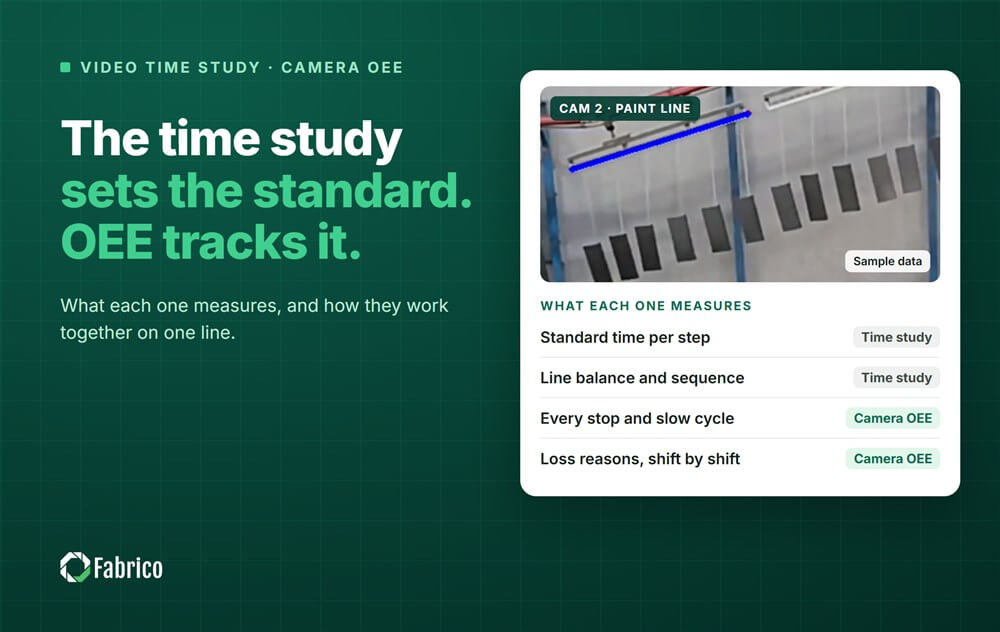
For co-packers, a customer audit asks for proof, not only a number. Fabrico's camera-based OEE software adds the clip behind each stop and changeover to the line-level OEE record, so the performance you report to the brand owner has visual evidence behind it.
See how Fabrico unifies OEE and maintenance in one platform.
Request a demo




 Login
 Blog