
Automotive tier 1 suppliers live in a narrow band between strict OEM requirements and constant cost pressure. Every shift, you must hit takt time, keep lines balanced, and prove compliance with IATF 16949 and customer-specific requirements. Overall Equipment Effectiveness, when connected directly to machine data, becomes a practical way to manage all three from a single source of truth.
This article looks at how tier 1 manufacturers use OEE to improve takt-time adherence, balance complex lines, and support IATF-ready traceability, and how Fabrico helps unify production, quality and maintenance information in one cloud-based MES and OEE platform with a built-in CMMS.
For many manufacturers, OEE is a performance KPI. For automotive tier 1 suppliers, it is directly connected to on-time delivery, premium freight exposure, and customer scorecards that influence sourcing decisions.
Typical tier 1 requirements bring several challenges:
When OEE is calculated from real machine data, not from delayed spreadsheets or manual counts, it becomes a day-to-day control tool. You see where you are losing availability, performance and quality, and you can act before missed takt turns into late shipments or containment.
Many tier 1 plants still calculate OEE at the end of the shift or the end of the day. Operators fill out paper sheets or stand-alone terminals, then someone consolidates this information in Excel. By the time you see that Line 3 missed its takt for two hours after a tool change, the damage is already done.
A modern OEE platform changes this by:
If you currently rely on manual data collection, this overview of OEE tracking provides a useful perspective on why automated, machine-centric capture is critical for accurate automotive performance management.
For automotive programs, takt time is non-negotiable. OEM schedules are built around it, logistics flows assume it, and buffer inventory is often minimal. OEE gives you a structured way to monitor and protect takt-time adherence, provided you link your cycle times and targets directly to your production data.
On a typical tier 1 line, you define:
Fabrico takes these standards and compares them continuously to what is actually happening on the line. This gives you:
Many teams see that takt is being missed, but do not always know why. Fabrico converts performance losses into structured downtime and speed-loss reasons that can be acted on.
Because Fabrico includes a built-in maintenance layer, repeated performance losses can be escalated into maintenance tasks and inspections rather than chasing the same symptom every shift.
Request a demo
Automotive tier 1 lines often combine high-speed automation with manual assembly and inspection. Some stations are chronic bottlenecks, others wait in starvation or build up excess WIP. Without detailed data per station, line balancing remains trial and error.
OEE, when visualized at the cell or station level, exposes the real constraints. Instead of relying on perceived bottlenecks, you see:
With this visibility, you can:
Tier 1 suppliers frequently face decisions about automation upgrades, additional lines, or layout changes. Unified OEE and downtime data helps build the business case based on actual losses:
If your operations involve machining, stamping, cutting or welding, the scenarios discussed in OEE for metal fabrication will feel familiar, because many of the same bottlenecks and setup-related losses appear on automotive metal lines.
IATF 16949 and OEM-specific requirements place a heavy emphasis on traceability and risk management. You must know which parts ran on which machines and when, under which conditions and with which nonconformities. Traditional traceability focuses on serial numbers, labels and quality records. OEE data enriches this by adding context about how the line was performing at the time.
When a customer asks for a containment or an 8D, you do not just need to know which lots are affected. You also want to understand:
By linking OEE events to order, batch, or serial-level production data, Fabrico helps teams reconstruct the conditions around a nonconformity. This strengthens root cause analysis, supports robust 8D responses and improves FMEA updates by grounding them in actual operating history.
Because Fabrico includes maintenance management as part of the platform, machine interventions, PMs and breakdown repairs are inherently linked to your production and OEE data. This has several implications for traceability:
The result is not just compliance with traceability requirements, but a richer data set for preventive actions and lessons learned across product families and plants.
Request a demo
For tier 1 plants, the cost of poor visibility can be measured in premium freight, customer chargebacks, and overtime to recover schedules. Fabrico turns losses discovered through OEE into structured actions for production and maintenance.
In Fabrico, each downtime event, speed loss or quality loss can trigger predefined workflows. Examples include:
Because this is all driven from the same production data that feeds OEE, the gap between measurement and action is reduced. Teams focus less on collecting and reconciling data and more on fixing the causes of lost capacity and quality.
Many automotive suppliers are on a long-term journey to connect more assets, standardize data models and apply analytics across plants. Fabrico is designed to fit into this environment through direct machine connectivity and cloud-based analytics that can be rolled out across multiple facilities.
If you are evaluating how IoT and smart-manufacturing initiatives can improve OEE and reliability, the scenarios in Fabrico driving OEE excellence through IoT and smart manufacturing provide additional context on how machine data can be used beyond basic monitoring.
For automotive tier 1 suppliers, Fabrico acts as a single environment for:
This helps plant managers, operations and continuous-improvement leaders move from reactive firefighting toward structured improvement, while giving quality and customer teams the data they need to respond confidently to OEM requests.
Request a demo
If you are evaluating MES and OEE platforms for automotive tier 1 operations, consider these questions as you compare options:
Fabrico is built to address these needs for mid-size and large manufacturers that supply the automotive industry. If you want to explore how this could work in your plants, you can either Request a demo or Contact us to discuss your specific lines, programs and constraints.
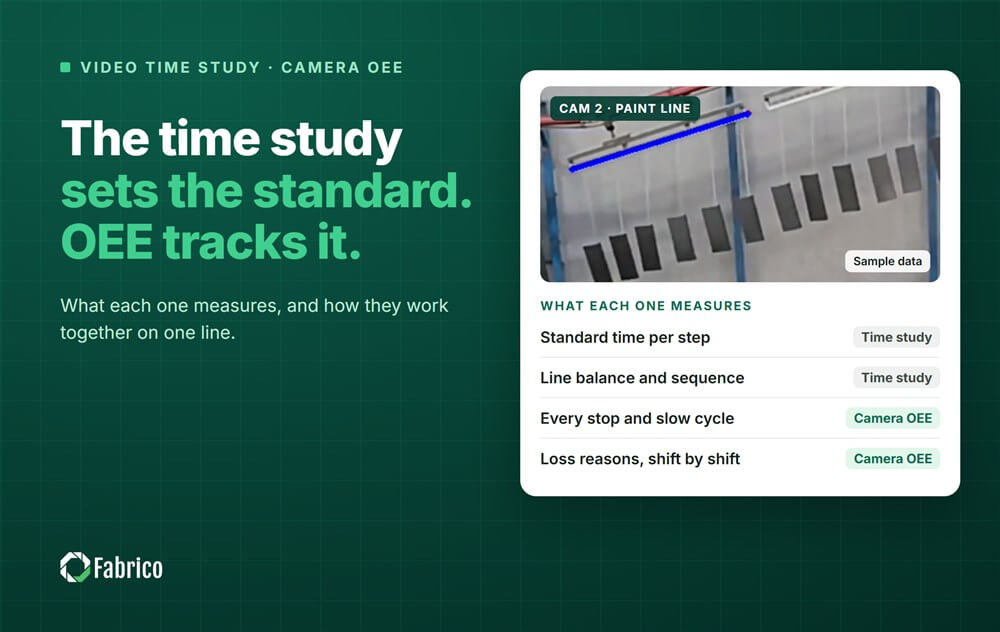
Cameras close the gaps that line signals leave on a Tier 1 line: a station waiting for parts, a manual rework loop or a jam between stations. Fabrico's camera-based OEE software ties each of those moments to the takt and OEE timeline, so every stop has a reason and a clip behind it.
See how Fabrico unifies OEE and maintenance in one platform.
Request a demo





 Login
 Blog