
Key takeaways
Camera based production monitoring is the use of a vision system, a camera plus AI models, to observe a production line and turn what it sees into production data. The camera does not control anything and does not touch the machine. It watches, and the model extracts events: a unit passed, the line stopped, the stop lasted 74 seconds, a label is missing.
This matters because most monitoring projects stall on data access. Controls engineers are booked, machine vendors charge for data interfaces, and the oldest machines have nothing to connect to. A camera sidesteps that whole queue, which is the core idea behind OEE monitoring without PLC access.
Counts. Every unit crossing a zone is recognized and counted, which feeds the performance factor of OEE with real output instead of estimates.
Stops and micro-stops. The system sees motion stop and start, so every interruption is timestamped, including the short ones nobody logs. Those short stops are usually the largest hidden loss on fast lines; our micro-stop guide breaks down the pattern.
Cycle rhythm. The time between units reveals slow cycles and creeping speed loss even when the line never fully stops.
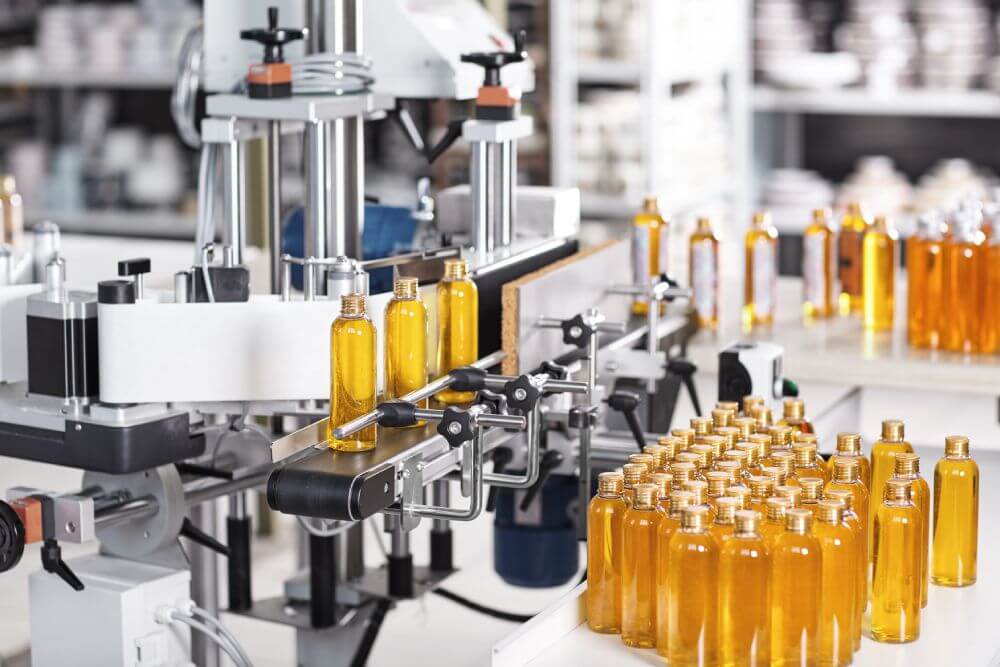
Visible defects. The same pipeline can flag missing caps, misaligned labels, or damaged packaging and count rejects, as covered in our visual quality control software guide.
| Component | Its job | What to check |
|---|---|---|
| Camera | Sees the line | Frame rate vs line speed, mounting point, lighting |
| Edge device | Runs the AI models in the plant | Local processing, so raw video does not stream to the cloud |
| Model | Recognizes products and machine states | Training effort per product, changeover handling |
| Dashboard | Turns events into OEE and alerts | Real-time updates, stop reasons, maintenance handoff |
On the model and edge parts, our piece on edge AI inference on the factory floor goes deeper.
If a machine already exposes clean PLC signals, use them. The camera earns its place on machines that cannot be connected, on vendor locked equipment, and on whole line views that no single PLC can give. The tradeoffs are laid out in computer vision vs PLC for OEE.
Platforms like Fabrico combine both: AI cameras where wiring is impractical, PLC and IoT sensor connections where they exist, and one AI OEE picture on top.
Production cameras raise a fair question: are we filming employees? A well designed system is aimed and trained at product flow and machine states, processes frames at the edge, and stores events rather than footage. Bring employee representatives in before the first camera goes up, and read our guide to cameras on the line without surveilling people.
For European plants, data residency belongs in the same conversation. Fabrico is built in the EU and offers EU data residency for production data.
Honesty keeps projects alive. A camera measures what is visible. Torque, internal temperatures, and pressures need IoT sensors. Poor lighting and blocked sightlines degrade accuracy until fixed. New packaging can require model retraining. And a camera reports the line; it does not replace the improvement work the report should trigger.
None of these are reasons to wait. They are reasons to run a proof of concept on your hardest line first. Book a demo and we will scope one with you.
It is production monitoring that uses cameras and AI models to extract counts, stops, cycle times, and visible defects from a live view of the line, with no machine integration required.
No. It complements them. Cameras cover what is visible and machines that cannot be connected; sensors and PLC tags cover internal signals. Most plants end up with a mix.
The physical part is small: mount a camera and connect an edge device. The real timeline driver is validating the model on your products and lighting, which is why a scoped proof of concept beats a big rollout.
Design the system around products and machine states, process video at the edge, store events rather than footage, and involve employee representatives early. See our dedicated guide on non surveillance camera setups.
Camera events roll straight into Availability, Performance, and Quality. If you are new to the metric, start with our the OEE meaning guide.
Most disappointing rollouts of vision systems for manufacturing fail on physics, not on the model. Work through these before anyone trains anything.
To see this on your own lines, look at Fabrico's camera-based OEE software, which puts camera events and machine data in one OEE timeline.
See how Fabrico unifies OEE and maintenance in one platform.
Request a demo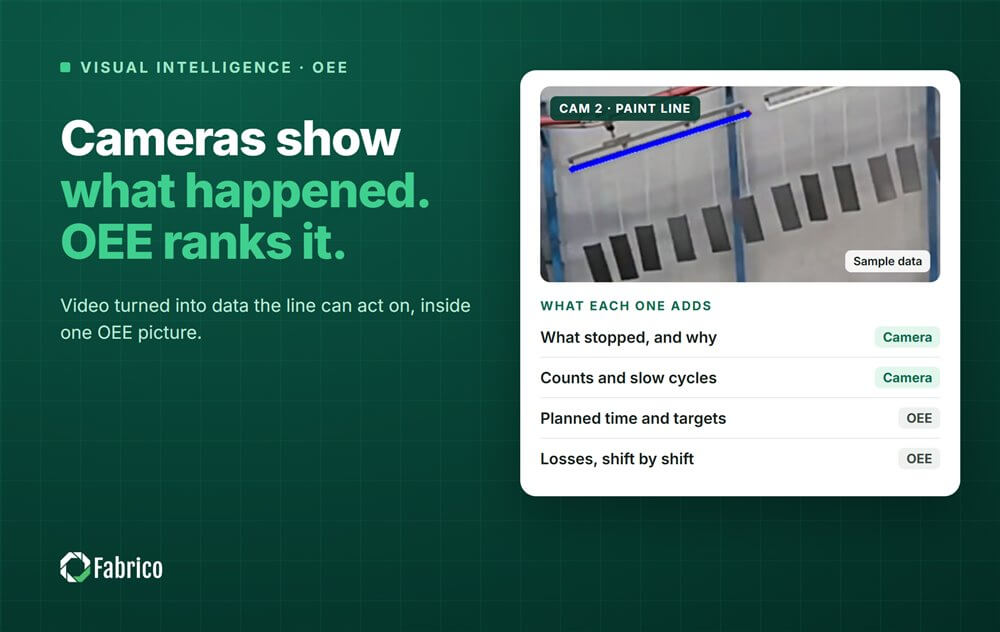







 Login
Login
 Blog
Blog