
On a surface mount line, most defects are decided long before anyone looks at a board. A slightly worn stencil, a feeder that picks at an angle, a reflow profile that drifted with the room: each one leaves a trace that inspection finds later, when fixing it costs more.
First pass yield, the share of boards that pass every check the first time without rework, is the number that shows whether those early steps are under control. This guide covers where SMT defects usually start, how to count first pass yield so it means something, and how it connects to OEE.
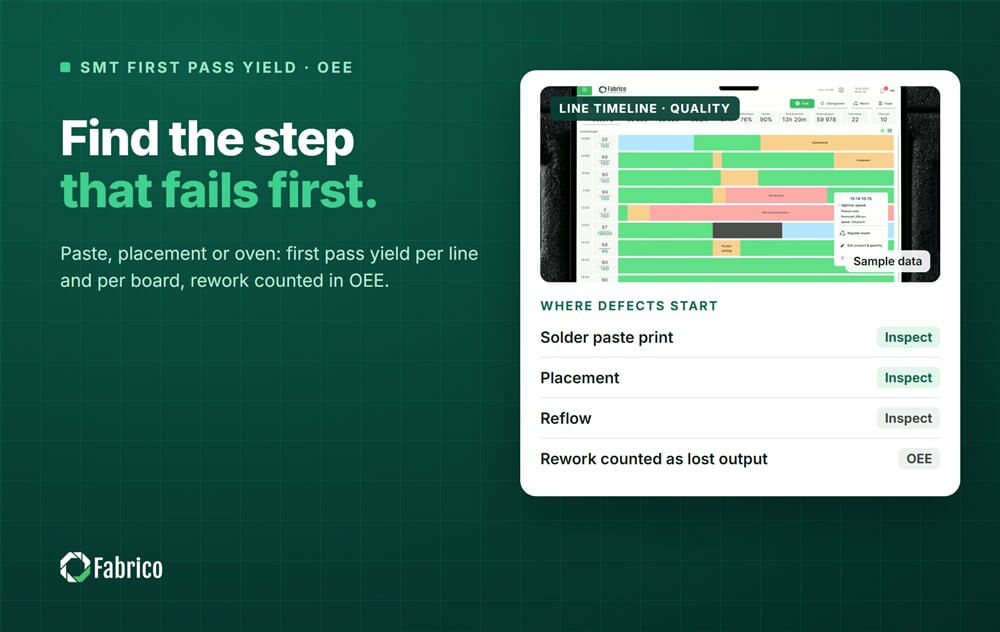
Solder paste printing: too much or too little paste, smears and bridging. Many teams find this is the largest single source of defects, which is why paste inspection sits right after the printer on many lines.
Placement: missing, shifted or rotated parts, often traced to a feeder, a nozzle or a component reel.
Reflow: cold joints, tombstoning and voids when the oven profile no longer matches the board.
Handling and manual steps: through-hole insertion, hand soldering and rework benches add their own defects.
The definition is simple: boards that pass every inspection step the first time, divided by boards that entered the line. Our guide to first pass yield covers the formula and the difference from final yield. On an SMT line, three choices decide whether the number is useful:
Count per line and per board: a plant-wide figure hides the one product that keeps failing.
Count a reworked board as a first pass failure: even if it ships, it did not pass the first time, and the rework took time and people.
Record where it failed: paste inspection, optical inspection, test or final check, so the fix goes to the right step.
Our comparison of yield and first pass yield explains why the final yield can look healthy while first pass yield shows the real cost.
A long list of defect codes that nobody uses is worse than a short one that everybody does. Start with a handful of reasons per inspection step, written in the words the operators already use, and grow the list only when a reason keeps coming up under "other".
Review the top reasons with the shift every day. A pattern that repeats on one board, one feeder position or one shift is usually a setup or method problem, and those are the cheapest to fix.
OEE multiplies availability, performance and quality. On an SMT line the quality factor is close to first pass yield: boards that need rework or are scrapped count as lost good output. That makes the cost of defects visible in the same number the plant already uses for stops and slow running, instead of in a separate quality report.
It also changes the conversation. A line can run without a stop all shift and still lose a large share of its output to rework. Our article on scrap and rework covers how to count both.
Pick the board with the lowest first pass yield on your busiest line.
Find the step where it fails most, using the inspection step recorded with each failure.
Check the setup behind it: stencil condition, feeder and nozzle, the reflow profile for that board.
Change one thing, then watch the next runs of the same board before moving on.
Fabrico is a light MES: machine data collection, production monitoring, OEE and downtime analytics, and integration with SAP and other ERP systems, with maintenance built in. It records stops and counts from the PLC or an IoT device, operators add the reason, and the quality factor of OEE shows where good output was lost. A camera can cover manual stations such as rework benches and hand assembly. Genealogy, routings and BOMs stay in your ERP.
Installing the devices and connecting the machines takes about one month. Full rollout across the lines you choose takes 3 to 4 months.
For changeovers on the same lines, see our guide to reducing SMT changeover time; for the wider picture, our OEE guide for electronics manufacturing.
They are close on an SMT line, but not always identical. The quality factor counts good output against total output; first pass yield counts boards that passed without any rework. If reworked boards are counted as losses in OEE, the two line up.
For first pass yield, no: it failed the first time. It may still ship, but counting it as a failure keeps the cost of rework visible.
Start with paste printing on the board that runs the most. It is often where the largest share of defects begins, and improvements there show up quickly in the next inspection step.
Book a demo to see first pass yield and OEE on your own SMT line.








 Login
 Blog