
On a surface mount line, a changeover is rarely one big stop. It is a chain of small ones: feeders swapped at the machine, a stencil that is not ready, a program that loads but does not match the reels, a first board that waits for an inspection nobody is free to do. Each link is short. Together they decide how many boards the line builds in a shift.
This guide goes through the parts of an SMT changeover that can move off the line, the parts that cannot, and how to measure the result so the improvement holds.
Feeders and reels: removing the last job's feeders and loading the next set, often the largest part of the stop.
Stencil and paste: changing the stencil, setting the squeegee and making sure the right paste is ready.
Programs: loading the placement, printer and inspection programs for the new board.
Conveyor and tooling: adjusting widths, support pins and nozzles for the new board.
First article: building and checking the first board before the line runs at rate.
The principle behind every improvement below is the one from SMED: separate the work that needs the line stopped from the work that can happen while the previous job is still running, then move as much as possible into the second group.
Loading reels into feeders at the machine is the clearest case of work that does not need the line stopped. With spare feeder banks or trolleys, the next job's feeders are loaded and checked offline while the current job runs. At changeover, the team swaps whole banks instead of single feeders.
Scanning each reel against the job's component list during offline setup catches the wrong part before it reaches the machine, which is far cheaper than finding it on the first board.
Many changeovers stall on something small that is missing: a reel still in the store, a stencil in the cleaner, a nozzle in another line's drawer. A kitting cart for the next job, prepared and checked against a list before the changeover starts, turns those waits into a routine.
Reels and loaded feeder banks for the next board.
The cleaned stencil and the right paste.
Support pins, nozzles and any board specific tooling.
The programs, already checked against the current revision.
When consecutive boards share part of their component list, fewer feeders change between them. Grouping jobs into families that share common parts, and running a family together, shortens each changeover without any new equipment. Our guide to changeover sequence optimization covers how to build that order without starving urgent orders.
The first board has to be right, so the check cannot be skipped. What can be fixed is the wait around it: an inspector who is not there, a program that has not been verified, a question about the revision. Agree who checks the first article on every shift, what they check, and what happens if it fails, and the line waits for the check instead of for a person.
The same discipline protects quality: a changeover that rushes the first article usually shows up later as rework and a lower first pass yield.
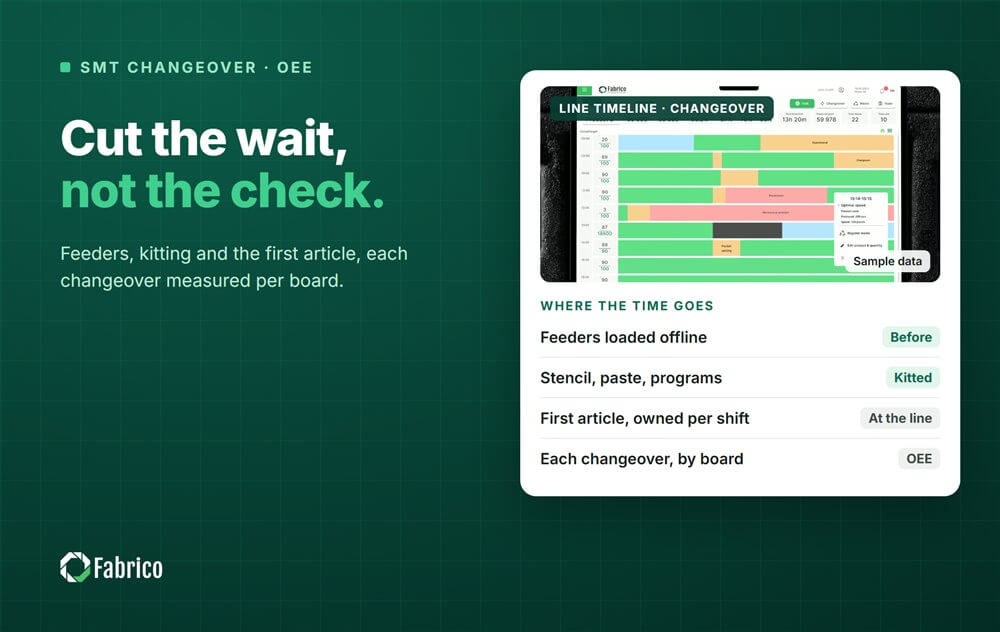
Improvement that is not measured fades. Record each changeover as its own stop with a start, an end and the job it led into, so you can see:
Which boards take the longest to change into.
Which part of the changeover takes the time: feeders, stencil, programs or the first article.
How the same changeover differs between shifts, which points to method rather than to the product.
In OEE, changeover time usually counts against availability. Some plants treat it as planned time instead; either way, decide once and apply it to every line, so the trend means the same thing next month. Our article on changeover time covers how to measure it consistently.
Fabrico is a light MES: machine data collection, production monitoring, OEE and downtime analytics, and integration with SAP and other ERP systems, with maintenance built in. On an SMT line it records stops from the PLC or an IoT device, the operator's reason marks which of them were changeovers, and a camera can cover manual stations such as hand assembly and rework benches that have no signal to read. Job routing, BOMs and genealogy stay in your ERP.
Installing the devices and connecting the machines takes about one month. Full rollout across the lines you choose takes 3 to 4 months.
For the wider picture of OEE on electronics lines, see our OEE guide for electronics manufacturing, and for line connectivity standards, our article on IPC-CFX and Hermes. The general principles are in our guide to reducing changeover time.
On most lines it is the feeders: unloading the last job and loading the next one at the machine. Moving that work offline, with spare feeder banks or trolleys, is usually the first and largest gain.
In most definitions it is an availability loss. What matters more is consistency: pick one rule, apply it to every line and keep it, so the trend can be compared over time.
Not necessarily. Shorter changeovers make smaller batches affordable, which is often the point on high-mix lines. Bigger batches hide the problem instead of solving it.
Book a demo to see changeovers and OEE on your own SMT line.








 Login
 Blog