
Most factories already have cameras. They watch doors, docks and aisles, and almost nobody looks at the footage until something goes wrong. Visual intelligence is the idea that the same kind of camera, pointed at a line and paired with software that understands what it sees, can turn video into data the plant uses every day.
The term comes from vendors, so it is used loosely. This guide explains what it means on a shop floor, what it can and cannot do on its own, and how it fits with OEE.
Visual intelligence is software that watches camera footage and turns what happens in it into structured events: a machine stopped, a part passed, an operator left the station, material ran out at the infeed. Each event gets a time stamp and a place, so it can be counted, searched and compared like any other production data.
Under the hood it is computer vision: models that detect objects, people and states in each frame and follow them over time. The difference is the output. Instead of a recording someone has to watch, you get a list of what happened, with the clip attached.
A PLC knows what the machine reports. It does not know why an operator walked away, why a case jammed on the conveyor, or what happened at a manual station with no controller at all. Cameras fill those gaps:
Manual and semi-automatic stations, where there is no signal to read.
Older machines where connecting to the controller is slow or not possible.
The cause of a stop: the jam, the missing material, the changeover that ran long, seen at the moment it happened instead of guessed at the end of the shift.
Short stops that never reach the shift report because they are over before anyone writes them down.
For a wider look at what cameras can track on a line, see our guide to camera based production monitoring.
Video tells you what happened. It does not tell you how much it cost you, or whether the line met its plan. For that, the events need a frame: the planned production time, the ideal cycle time of the line, and the count of good and rejected parts. Without that frame, a dashboard full of detected events is easy to admire and hard to act on.
It also needs people. Someone has to own the stop reasons, review the events that matter and decide what changes on the next shift. And it needs care with privacy: cameras should look at the process, staff should know what is recorded and why, and the footage should be kept only as long as it is useful.
| What the term usually means | |
| Computer vision | The technology: models that detect and track objects, people and states in images and video. |
| Video analytics | Software that applies computer vision to video streams and reports events, counts and alerts. |
| Visual intelligence | A vendor term for video analytics aimed at operations: turning footage into decisions, not just alerts. |
| Video AI | Another vendor term for the same idea, often with a focus on searching and summarising footage. |
The labels overlap, so look past them. The useful question is what the software produces and whether it connects to the numbers your plant already runs on.
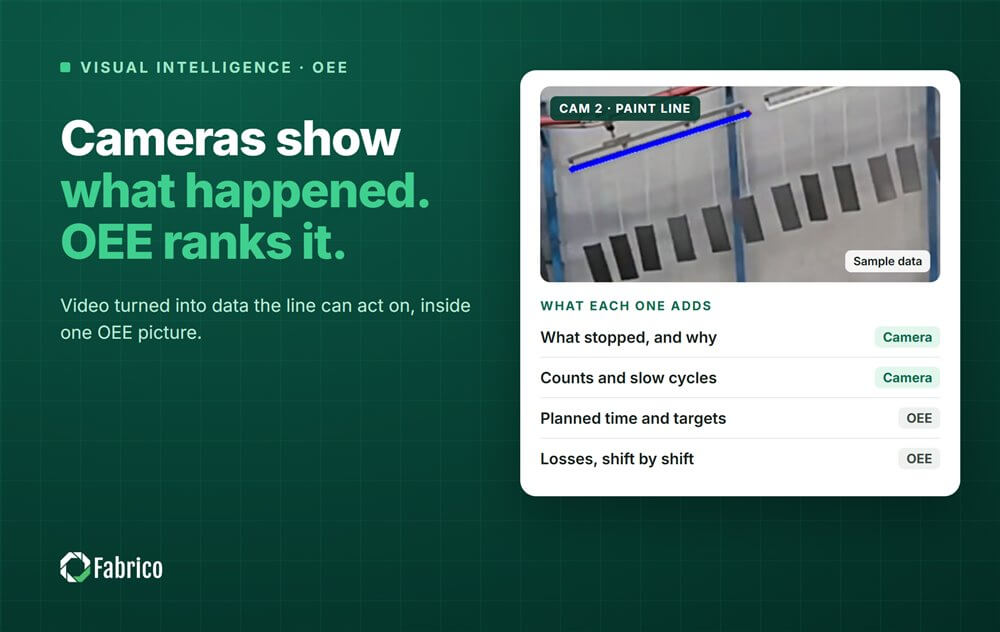
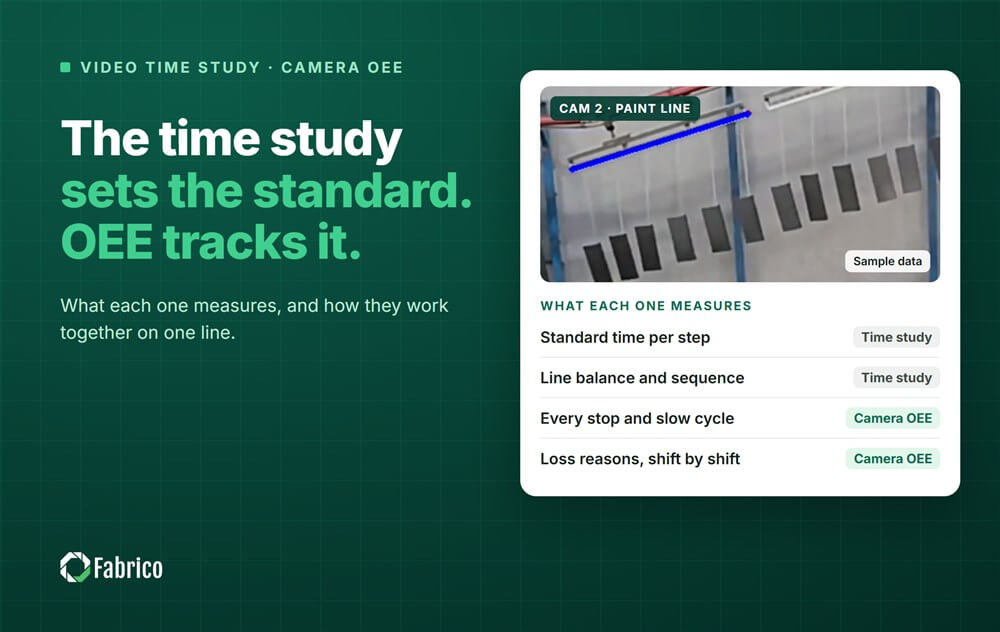
OEE splits the planned time of a line into three losses: availability, performance and quality. That is the frame visual intelligence is missing. Put the two together and every detected stop lands in a loss category, every slow cycle shows up against the ideal cycle time, and every reject is counted once.
The result is a daily picture of where the planned time went, with the footage of the biggest losses one click away. The camera explains the stop; OEE says how much it mattered.
Does it tie each video event to the machine record, the product and the shift, or does it stay a separate screen?
Does it work with the cameras you already have, or do you need new ones? Ask the vendor to show it on your own footage.
Where does the processing run: on site, in the cloud, or both? Our article on edge vs cloud computing in manufacturing covers the trade-offs.
Who reviews the events, and how does a detected problem turn into an action?
How are privacy, retention and access to the footage handled?
If you are comparing tools, our review of manufacturing video analysis software lists the main options.
Fabrico is a computer vision enabled Manufacturing Performance Platform: an MES and OEE platform with maintenance built in, where computer vision is one of the data sources next to the PLC and IoT sensors. Fabrico's vision AI connects camera data with operator activity, work orders and machine states, so when a line stops, the footage, the machine record and the operator's reason sit in one place.
Installing the devices and connecting the machines takes about one month. Full rollout across the lines you choose takes 3 to 4 months. If you are deciding how much MES you need around it, our guide to light MES walks through the functions closest to the machine.
Computer vision is the technology underneath. Visual intelligence is how some vendors describe applying it to operations, so that footage becomes events and decisions rather than recordings.
No. It fills the gaps they leave, such as manual stations and the cause of a stop. The strongest setups put camera events on the same timeline as machine signals.
You can start without it, but OEE gives the events their weight: it shows which stops cost the most planned time, so the team knows which footage to watch first.
Book a demo to see computer vision OEE on your own line.



 Login
 Blog