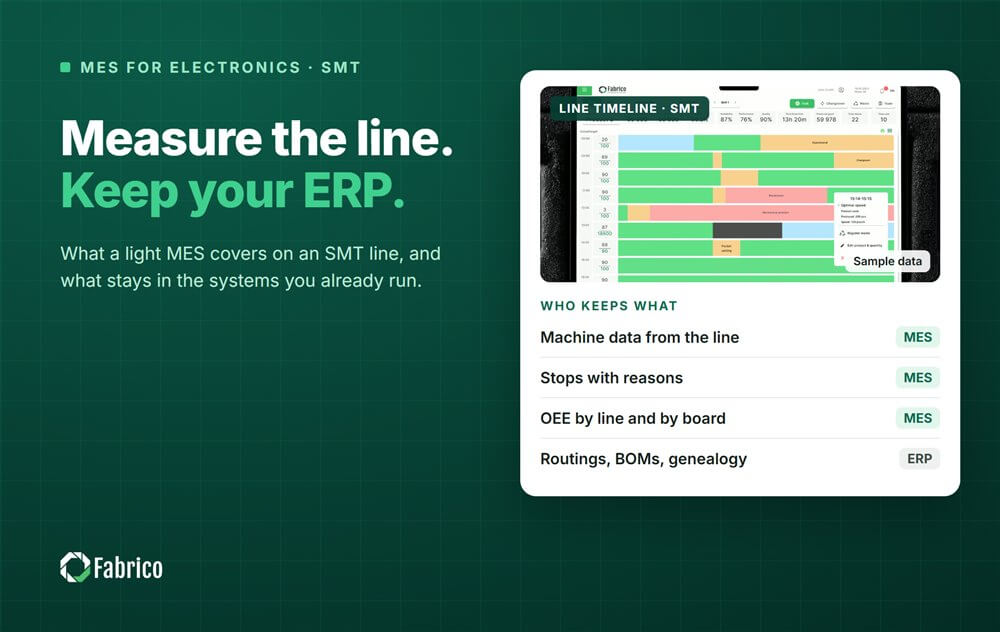

Electronics plants that search for an MES usually want one of two things. Some need a system that runs the whole order: routings, work instructions, component traceability for every board. Others need to see, line by line, where the time goes and why the placement line stopped again. Both are called MES, and they are very different projects.
This guide explains what an MES does on an electronics line, what a light MES covers, what stays in your ERP, and how to decide which one your plant needs first.
On an SMT line, a manufacturing execution system sits between the ERP, which knows the orders, and the machines, which do the work. The functions usually grouped under MES are:
Dispatching: releasing work orders to lines in the right sequence.
Machine data collection: states, counts and stops from printers, placement machines, ovens and test stations.
Performance analysis: OEE, downtime by reason, changeovers and output by line and by product.
Quality data: inspection results and the share of boards that pass the first time.
Traceability and genealogy: which components, reels and lots went into which board.
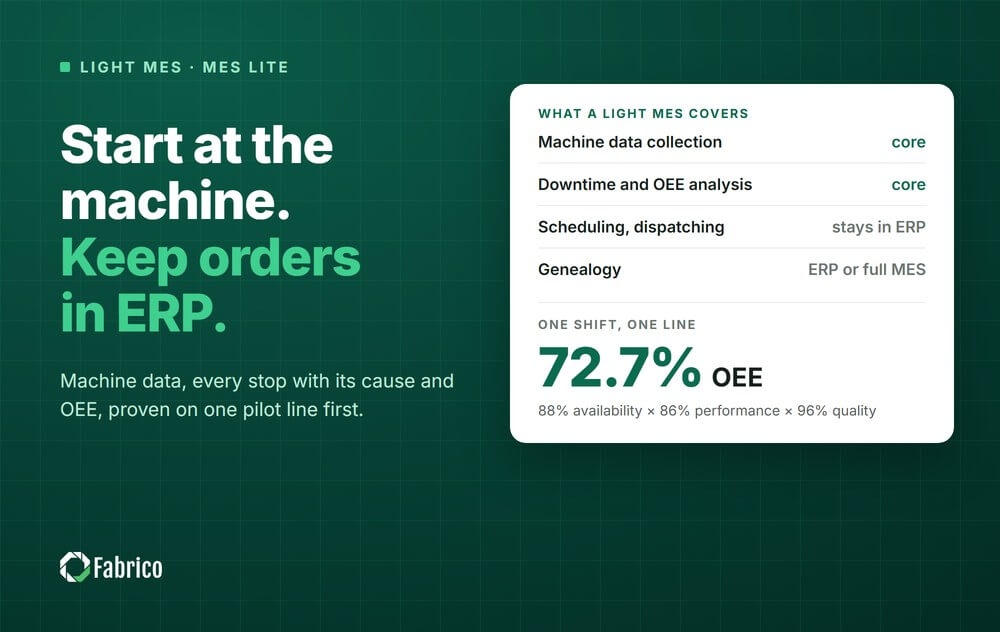
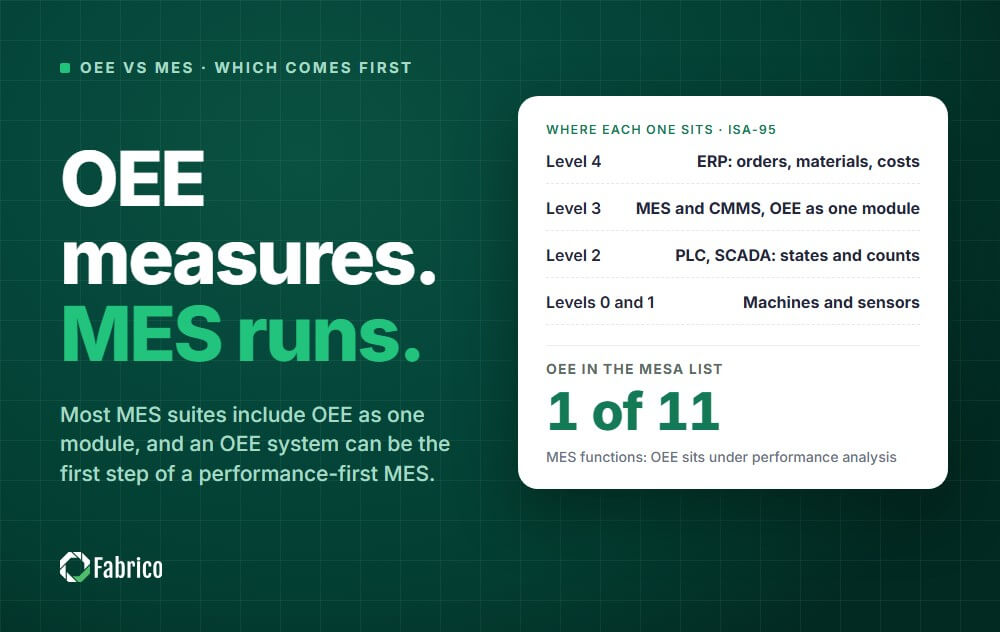
A full MES tries to do all of them. A light MES does the middle three well and leaves dispatching and genealogy to the systems that already hold that data. Our comparison of OEE and MES covers the difference in more depth.
Machine data from the line: run, stop and count signals from each machine, so the line's real state is recorded instead of typed in at the end of the shift.
Stops with reasons: every stop gets a time, a duration and a reason the operators recognise, such as a feeder, a nozzle, a missing reel or a program.
OEE by line and by product: availability, performance and quality for the placement line as one constraint, measured against the bottleneck machine.
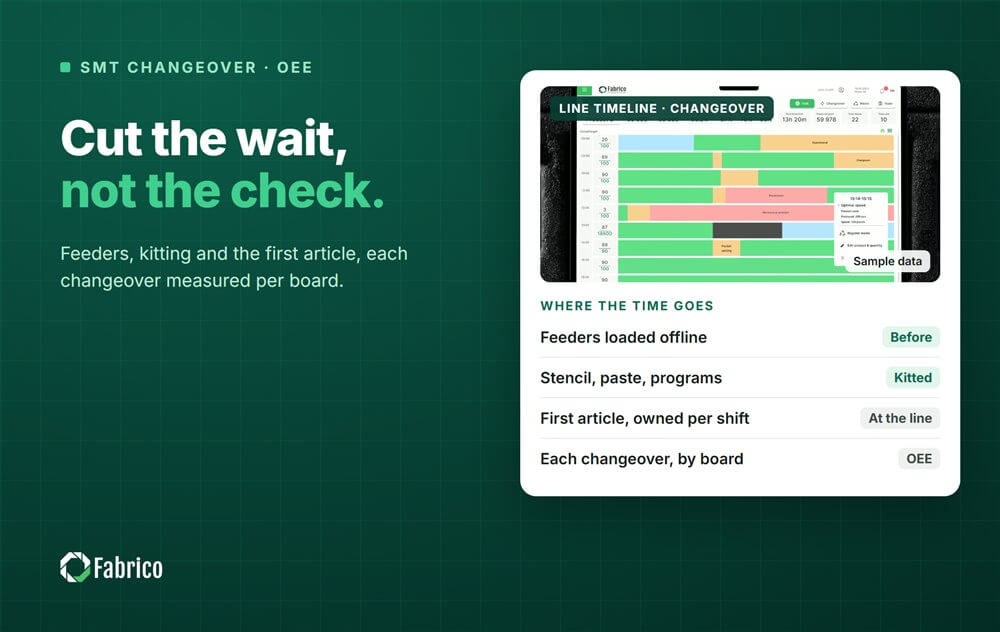
Changeovers: each changeover timed per board, so you can see which product families cost the most line time. Our guide to reducing SMT changeover time shows what to do with that data.
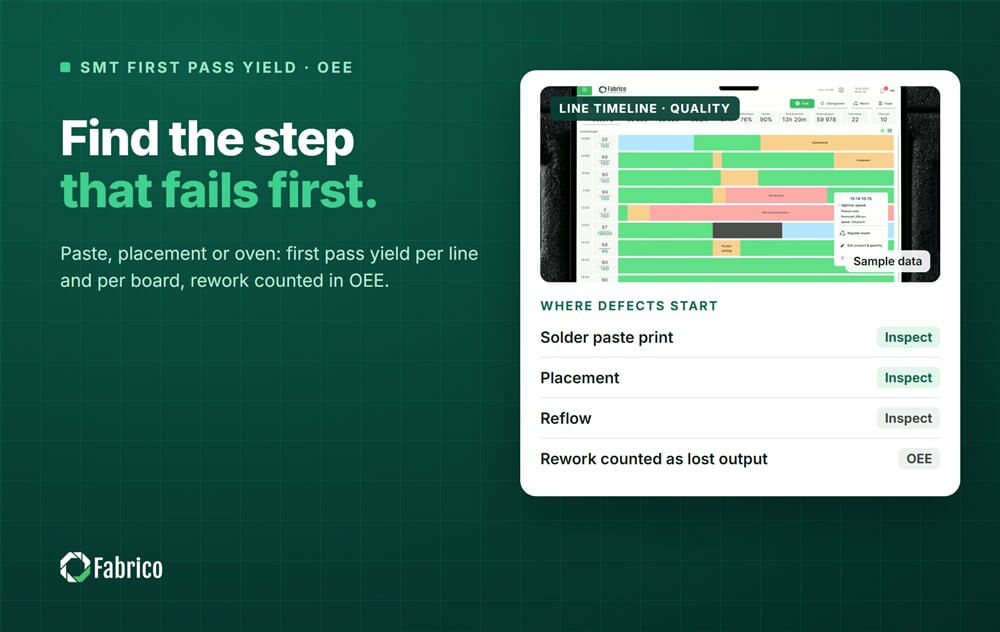
First pass yield: rework and scrap counted as lost good output inside OEE, as described in our guide to first pass yield on SMT lines.
ERP integration: orders and products come from the ERP, and output goes back to it.
Routings, bills of materials, job dispatching and genealogy stay in the ERP or in a dedicated traceability system. For many electronics plants that is the right split: the ERP already holds the order and the bill of materials, and the placement machines often record which reel fed which position. A light MES does not try to rebuild that record. It adds what is usually missing: a reliable picture of where line time and good output are lost.
If your customers or regulators ask for component traceability per board, check how your ERP and your placement machines record it today. Line connectivity standards matter here; our article on IPC-CFX and Hermes explains how SMT machines share data with each other and with plant systems.
If the main question is "why did the line stop and what did it cost": start with a light MES. Machine data, stop reasons and OEE answer it, and the rollout touches the line, not the ERP.
If the main question is "which lot went into which board": start with traceability in your ERP and the machines' own records, then add line performance on top.
If you need both: keep them as two clear layers. Genealogy in the ERP, line performance in the MES, connected so that orders and output match.
An SMT line is several machines working as one. The printer, the placement machines and the oven each have their own cycle, but the line can only run as fast as its slowest step, so OEE is measured against that bottleneck. Short stops at feeders and nozzles add up to more lost time than a single breakdown, and they only show up when the machines report them. Our OEE guide for electronics manufacturing covers the line view in detail.
Fabrico is a light MES: machine data collection, production monitoring, OEE and downtime analytics, and integration with SAP and other ERP systems, with maintenance built in. It records stops and counts from the PLC or an IoT device, and operators add the reason. A camera can cover manual stations such as rework benches and hand assembly. Job dispatching, BOMs, routings and genealogy stay in your ERP.
Installing the devices and connecting the machines takes about one month. Full rollout across the lines you choose takes 3 to 4 months.
It is enough when the goal is line performance: knowing where time and good output are lost and acting on it. If you also need component genealogy per board, that stays in the ERP or a traceability system, and the light MES works next to it.
No. The ERP keeps orders, bills of materials and routings. The MES takes orders from it, records what happens on the line, and sends output back.
On the busiest line. Connect its machines, agree on a short list of stop reasons with the operators, and review the biggest losses with the shift every day before you extend to the next line.
Request a demo to see OEE and downtime on your own SMT lines.






 Login
 Blog