Login
 Blog
OEE vs MES: What Each Does and Which Your Plant Needs First
TL;DR
OEE vs MES comes down to scope. OEE is a metric, and the system that measures it: how much of the planned time a machine or line turns into good output. An MES (manufacturing execution system) is the ISA-95 Level 3 layer that runs and records production, and most MES suites include OEE as one module.
- An OEE system records machine states, part counts and stop reasons. An MES records orders, routings, material genealogy, quality checks and labour.
- Start with OEE when downtime and lost output are the problem. Choose a full-suite MES when regulated traceability or complex routings come first.
- The middle path is a performance-first MES: OEE on one line first, then orders, quality and maintenance as it grows.
- Whatever you choose, connect it to the CMMS so a logged stop becomes a maintenance work order without retyping.
Most plants meet this question in a vendor meeting: one supplier proposes a plant-wide MES project, another a screen that shows OEE by line. They answer different questions, and this guide shows what each records on a real line, how both connect to ERP and maintenance, and which to start with.
OEE vs MES: the difference in one sentence
OEE measures how well production runs; an MES runs and records production. Most of the confusion comes from the fact that one usually sits inside the other.
OEE: a metric and the system that measures it
Overall equipment effectiveness (OEE) multiplies availability, performance and quality to show how much of the planned production time became good parts at the ideal speed.
An OEE system collects the facts behind that number from the machines: when they ran, when they stopped, how fast they cycled and how many parts were rejected. It measures and explains losses; it does not run orders.
MES: the execution layer, ISA-95 Level 3
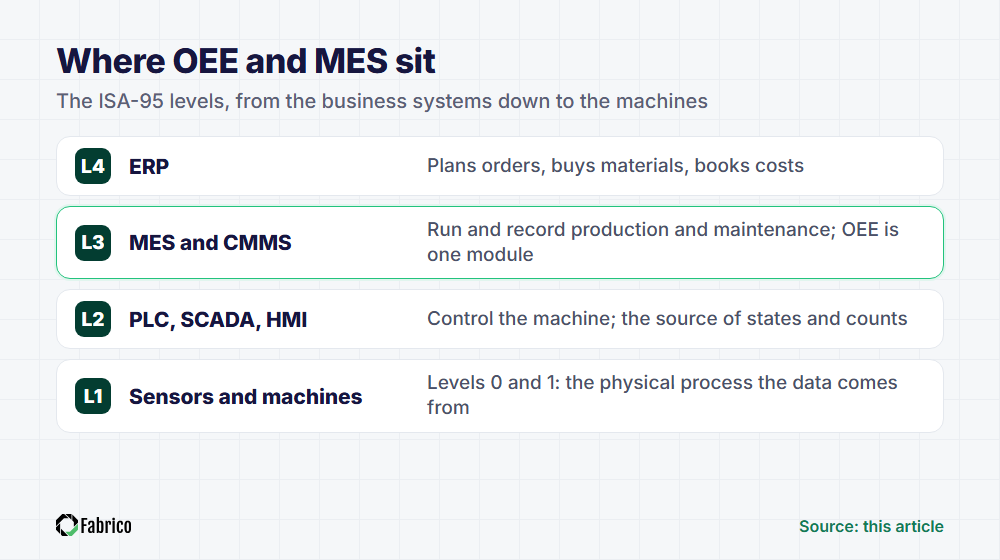
A manufacturing execution system sits between the business systems and the machine controls. In the ISA-95 model it is Level 3, manufacturing operations management, which also covers maintenance, quality and inventory operations.
An MES dispatches orders to work centers, enforces the routing, records which materials went into which product and keeps the quality and labour records that prove how each batch was made.
Above it, Level 4 is ERP, which plans orders, buys materials and books costs. Below it, Level 2 is the PLC, SCADA and HMI layer that controls the machine and is the source of states and counts. Levels 0 and 1 are the machines and sensors themselves.
How OEE and MES relate
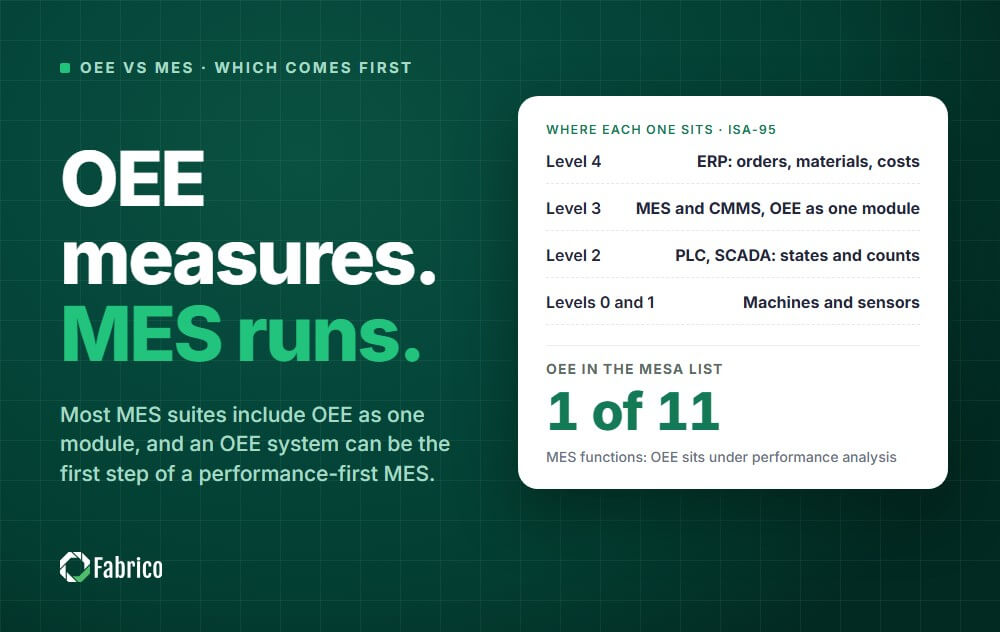
In the classic MESA list of 11 MES functions, OEE sits under one of them: performance analysis. That is why most MES suites include OEE as one module rather than as the core of the product.
The relationship also runs the other way. An OEE system can be the first step of a performance-first MES, which starts with machine data and adds orders, quality and maintenance later.
What an OEE system and an MES record on a real line
Follow one event through both systems. A filler on a bottling line stops at 10:14 with a bottle jam at the infeed and restarts at 10:28.
| What gets recorded | OEE system | MES |
|---|---|---|
| The event | Stopped 10:14 to 10:28, state read from the PLC or a sensor | Filling operation of the running order paused |
| The reason | Operator tags "infeed jam" on the line tablet | Deviation note, if the procedure asks for one |
| Output | Good and rejected bottle counts before and after the stop | Quantity booked against the order, cap and label lots in use |
| People | Who tagged the reason | Operators clocked on the order and their labour hours |
| What happens next | The stop joins the shift's downtime Pareto and, with a CMMS link, becomes a work order | A quality check on bottles filled around the stop, if the routing requires one |
| The question it answers | Where did our output go today? | What exactly did we make, from what, and who made it? |
What an OEE system records
- Machine states over time: running, stopped, idle, changeover, planned stop.
- Counts: total units and rejects.
- Stop reasons, from the machine's own fault codes or tagged by the operator.
- Speed against the ideal cycle time of the product that is running.
What an MES records
- Production orders released from ERP, with quantities and due dates.
- Routings: the sequence of operations and the work center for each one.
- Genealogy: which material lots went into which batch or serial number.
- Quality records: in-process checks, test results, holds and releases.
- Labour: who worked on which order, for how long, with which qualification.
The data model underneath: work center, machine, order
To calculate OEE, a system needs an equipment hierarchy (site, area, line or work center, machine), a state log with a start, end and reason for every event, counts, a shift calendar and an ideal cycle time per product.
An MES adds the order layer: which order, product and operation ran on each machine in each time slice. Join the two on machine and time, and OEE can be split by product, order, shift or crew.
That join is where many projects stumble. If the MES books orders against a work center but OEE is measured per machine, decide early which level carries the ideal cycle time. The OEE calculation guide shows how each factor is computed.
MES vs OEE software: a side-by-side comparison
Three options usually end up on the shortlist: a standalone OEE system, a full-suite MES, and a performance-first MES that starts with OEE and grows. The table compares them on the points that decide a purchase.
| Dimension | OEE system | Full-suite MES | Performance-first MES |
|---|---|---|---|
| Main job | Measure and reduce losses on machines and lines | Run and record every production order end to end | Measure losses first, then add orders, quality and maintenance |
| Scope | Machines, lines, shifts | Orders, routings, materials, quality, labour, genealogy | Machines and lines first, then orders and work orders |
| Typical first data | Machine states, counts, stop reasons | Orders, routings and bills of materials from ERP | Machine states, counts and stop reasons, then the order feed |
| Who uses it daily | Operators, shift leads, improvement engineers | Operators, quality staff, planners, supervisors | Operators, shift leads, maintenance technicians, plant managers |
| Integration points | PLC or sensors, optional ERP order feed | ERP, PLC and SCADA, quality and warehouse systems | PLC, sensors or cameras, ERP, CMMS |
| Rollout effort | Light: one line at a time, little process change | Heavy: process mapping, master data, training, validation in regulated plants | Light to start, then one module and one line at a time |
| Biggest risk | A good number that nobody acts on | A long project the shop floor never adopts | Growing without a plan, so modules sit unused |
Read the rollout row twice. A full suite asks the plant to describe every process before go-live, while an OEE system asks for a machine signal and a list of stop reasons.
Close relatives: production monitoring
A fourth option sits close by. If live machine status and counts are all you need, production monitoring software may be enough. A shorter companion piece covers the difference and when you need both.
OEE first, a full MES, or both: how to decide
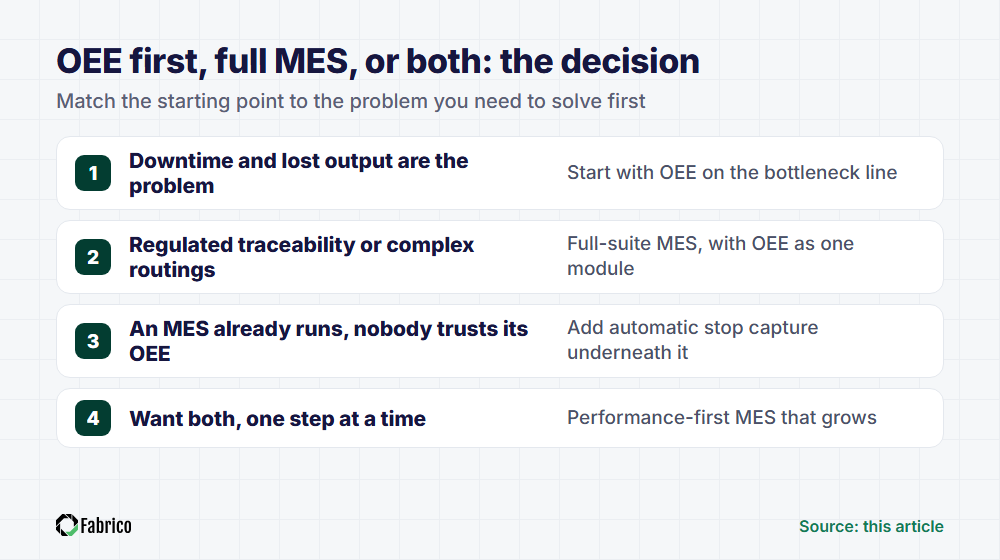
Start with OEE when
- Downtime and lost output are the problem, not traceability.
- Nobody trusts the current OEE number, or it comes from hand-filled shift sheets.
- One bottleneck line sets the output of the whole plant.
- ERP and paper travellers handle orders well enough for now.
In that situation, start with OEE on the bottleneck line, the core of a light MES. It answers the question that matters first: where the hours go. Dedicated downtime tracking software covers part of the same ground.
Choose a full-suite MES when
- Regulators or customers require electronic batch records, device history records or full part genealogy, as in pharmaceuticals, medical devices and aerospace.
- Routings are complex: many operations per part, rework loops and alternative machines that must be enforced step by step.
- The system must block a step before it starts, for example a wrong material lot or an operator without the right qualification.
- Several plants need one standard execution model.
With regulated traceability or complex routings, choose a full-suite MES, with OEE as one module.
Already running an MES?
If an MES already runs but nobody trusts its OEE number, add automatic stop capture underneath it rather than replacing the MES. The MES keeps the orders and records, and the machine data makes the loss figures believable.
The hybrid path: a performance-first MES that grows
Many plants want both, one step at a time, because they cannot stop for a long project. The hybrid path starts with OEE on one line and adds MES functions in the order the plant needs them:
- Connect the bottleneck line: machine states, counts and stop reasons.
- Add the order feed from ERP, so OEE splits by product and order.
- Link stops to maintenance work orders in the CMMS.
- Add quality checks and operator instructions where they matter most.
- Roll out line by line, then plant by plant.
How MES and OEE connect to ERP and CMMS
Most of the value of either system shows up at its boundaries. Two connections matter most: ERP above it, and maintenance beside it.
ERP: orders in, quantities out
ERP sends production orders, product master data and planned quantities down. The MES or OEE system sends back good and scrap quantities, order confirmations and machine hours, which ERP uses for inventory and costing.
One trap: standard times in ERP routings are often set for costing, with allowances built in. Do not copy them in as the ideal cycle time, or performance will look better than the line really runs.
CMMS: from stop to work order
The OEE system knows that a machine stopped, when, for how long and why. The CMMS knows who repaired it, which parts were used and what the failure was.
Joined, they turn a logged stop into a work order with the machine, time, reason and operator note already attached. When the technician closes it, the repair time and cause flow back to the stop record.
That gives production and maintenance one shared clock. Availability, mean time to repair and mean time between failures come from the same events, so the morning meeting argues about causes instead of numbers.
Choosing MES OEE software: demo questions, pilot and mistakes
Whether you shortlist OEE software or full MES software, run every vendor through the same script. The MES selection guide with 12 questions covers production and maintenance in one list.
MES with built-in OEE: five checks
Many MES platforms include OEE and downtime analytics. A full-suite MES usually treats it as one module, and a performance-first MES starts from it. Run these five checks on either kind.
- Where the states come from. Machine signals, or order bookings and operator entries? Without machine states, short stops and slow running go missing from the number.
- Micro-stops. Can you set the shortest stop that counts for each machine, and see micro-stops as their own events?
- The math. Can the vendor rebuild one shift by hand from the raw events? See how MES OEE calculations differ.
- The split. Can OEE split by product, order and shift, and does the ideal cycle time sit at the right level?
- The scope. Is OEE in the first phase or a later module, and can you start on one line before the order side is live?
Questions to ask in the demo
- Show a stop arriving from a real machine signal, with nobody typing it.
- How are short stops handled, and who sets the line between a short stop and a downtime event?
- Where is the ideal cycle time stored: per machine, per product, or both?
- How do you connect older machines that have no usable PLC?
- Show the operator screen on a tablet. How many taps does a stop reason take?
- Show a stop becoming a maintenance work order, and the repair time coming back.
- Which data comes from ERP, which goes back, and who maintains the interface?
What a one-line pilot should prove
Run the pilot on the line that limits plant output, not on the easiest one. By the end it should show that:
- Stops captured from the machine match what the shift lead saw on the floor.
- Operators tag reasons for most stops without a supervisor chasing them.
- Production and maintenance agree on the top three losses of the line.
- At least one action was taken on a top loss, and its effect shows in the data.
- The effort to add the next line is known: hardware, configuration and training.
Mistakes to avoid
- Buying a full-suite MES just to get an OEE number.
- Trusting an OEE figure typed in by hand at the end of the shift.
- A reason code list so long that operators pick the first entry.
- Keeping OEE and maintenance in separate systems, so a stop never becomes a work order.
- Comparing OEE across plants that define planned production time differently.
- Treating MES adoption as an IT project: if operators do not use the screens, the data stays empty.
Where Fabrico fits
Fabrico is a cloud-based MES and OEE platform for manufacturers with maintenance management (CMMS) built in. It follows the performance-first path described above.
It logs stops automatically from the PLC, an IoT sensor or a camera. Operators tag stop causes on a tablet, and a technician opens the work order straight from the logged stop in the built-in CMMS.
For OEE with hardware, connecting the machines takes about a month and the full rollout 3 to 4 months.
Results so far: ABB 20% less downtime, and Ficosota's factory-wide OEE up from 53.1% to 59.6%.
Fabrico holds ISO/IEC 27001, ISO/IEC 20000-1 and ISO 9001 (DNV), is an SAP Silver Partner and is hosted on AWS in an EU region. Production planning and scheduling are on the roadmap, not in the product today, so weigh that if detailed scheduling is a day-one requirement.
See how Fabrico unifies OEE and maintenance in one platform.
Request a demoFrequently asked questions
Does an MES include a CMMS?
Some MES suites include a maintenance module, and ISA-95 places maintenance operations at Level 3 next to production. Many plants still run a separate CMMS. What matters is the link: a stop logged on the line should open a work order without retyping, and the repair time should flow back to the stop record.
Can a simple OEE tool integrate with our existing CMMS?
Usually, through an API or a file export, but check what actually crosses: a stop should create a work order automatically, with machine, time and reason attached, and the closed work order should send repair time and cause back. A one-way export that someone re-keys is not an integration.
When is a traditional enterprise MES the right choice?
When the plant must enforce and prove how every unit is made: electronic batch or device history records, part genealogy, or complex routings with checks before each step. If the main problem is downtime and lost output, a full suite is more than the plant needs as a first step.
Is OEE part of MES?
In most suites, yes. In the MESA list of 11 MES functions, OEE falls under performance analysis. Check how the MES module gets its data, though: if it derives OEE from order bookings and operator entries rather than machine states, short stops and slow running will be missing from the number.
What does MES stand for in manufacturing?
MES stands for manufacturing execution system: the software layer that runs and records production between the business systems (ERP) and the machine controls (PLC and SCADA). In ISA-95 terms it sits at Level 3, manufacturing operations management, alongside maintenance, quality and inventory operations.
What is cloud OEE, and can an MES run in the cloud?
Cloud OEE means the software runs on hosted servers: a PLC link, IoT sensor or gateway sends states and counts, and people open the dashboards in a browser or on a tablet. Many cloud-based MES systems now work the same way. Ask where the data is hosted, which certifications cover it and what happens when the network drops.
How do we compare MES platforms for OEE tracking?
Score every platform on the same points: stops captured from the machine signal rather than typed, support for older machines, OEE split by product, order and shift, a direct path from stop to maintenance work order, and the effort to add the next line. Ask to see each point live, not on slides.
Do we need to replace older machines or systems to track OEE?
No. Machines without a usable PLC can be monitored with an IoT sensor on a signal such as motor current or a stack light, or with a camera (see machine connectivity for new and older machines). The OEE system runs alongside the existing ERP and paper processes, so the first line can go live without an IT overhaul.
Related articles