
On a high-mix SMT line, the board changes several times a shift. One run is a dense controller board, the next a small sensor board, then a prototype for a new customer. Every one of them has a different cycle, a different setup and a different set of risks. If OEE is calculated as if the line made one product all day, the number punishes the line for the mix it was built to handle, and the shift stops trusting it.
This guide shows how to keep OEE honest on a high-mix electronics line: what to measure per board, how to treat changeovers, and how to read the result by product family.
The single most common mistake on high-mix lines is one target rate for the whole line. A dense board and a simple board cannot run at the same pace, so a single rate makes some runs look excellent and others look slow, whatever the line actually did. Set the ideal cycle time per board from the bottleneck machine for that board, and calculate performance against it. Our OEE guide for electronics manufacturing explains how to measure the line against its bottleneck.
New boards are the exception. Until a board has run a few times, its ideal cycle is an estimate. Mark those runs, review the cycle once the board is stable, and avoid comparing a first run with a mature product.
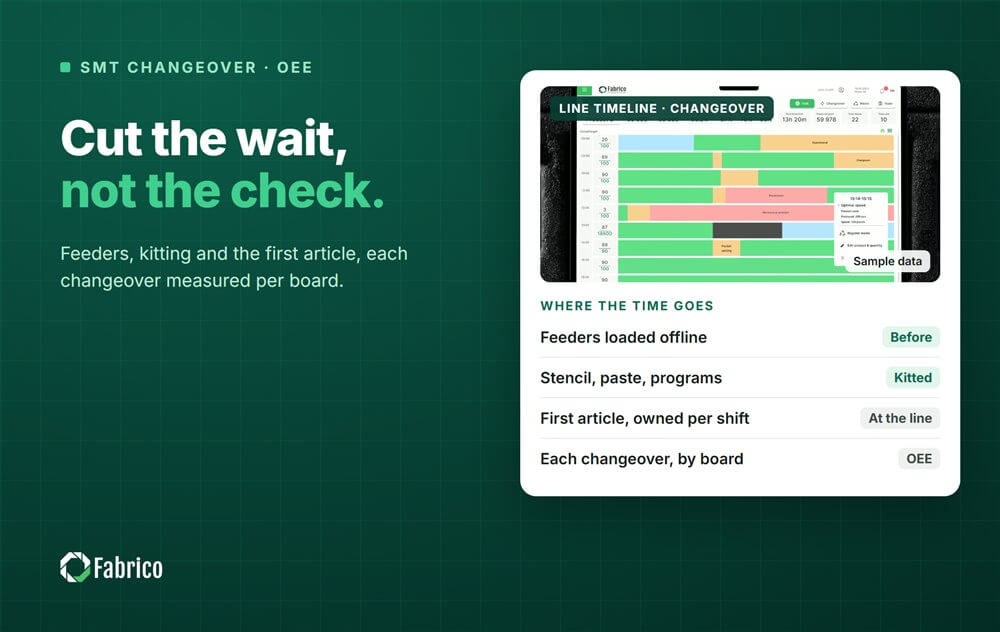
On a high-mix line, changeovers are often the largest availability loss, simply because there are so many of them. Count each changeover as lost time, timed from the last good board of one run to the first good board of the next, and record it per board pair. That shows which transitions cost the most and which product families should run back to back.
The fixes are mostly preparation: feeders loaded offline, kitting for the next board, stencils and programs ready, and a first article check that does not leave the line waiting. Our guide to reducing SMT changeover time covers each step.
High-mix lines also invite a quiet adjustment: calling a long changeover or a material wait "planned" so that OEE looks better. Decide once what counts as planned time, usually breaks, planned maintenance and scheduled meetings, and leave everything else inside the calculation. A changeover belongs to the line's losses even when everyone knew it was coming.
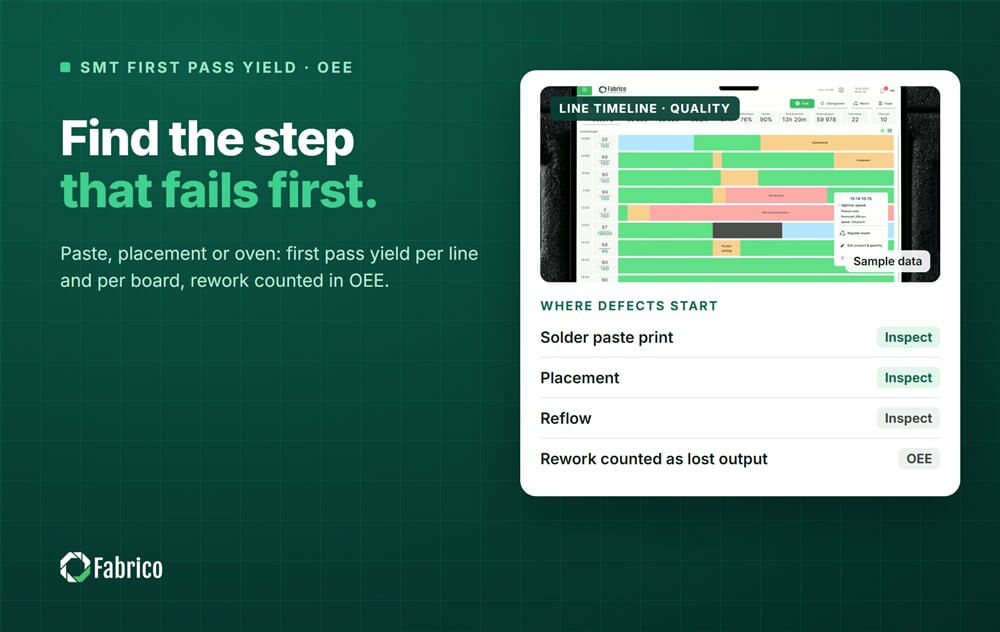
A line's weekly OEE on a high-mix line mixes very different products. Group boards into families with similar size, density and process, and look at OEE, changeovers and first pass yield per family. Patterns that disappear in the line average become visible: a family with a long setup, a family that keeps failing paste inspection, a family that always waits for material.
That view also helps planning. If two families share most of their feeders, running them back to back shortens the changeover; if a family needs a different stencil thickness, grouping its runs avoids repeated swaps.
Prototype and short runs add work that a stable product does not need: program checks, extra inspection, engineering at the line. Give that work its own stop reasons, so it shows up as what it is instead of hiding in general downtime. It is a real cost of a high-mix business, and it is easier to price and to plan once it is visible.
Every count belongs to a board and an order, taken from the ERP, so OEE can be split by board and family.
Every stop has a time, a duration and a reason, recorded from the machines, with a short list of reasons the operators recognise.
Every changeover has a start and an end, and the board pair it connects.
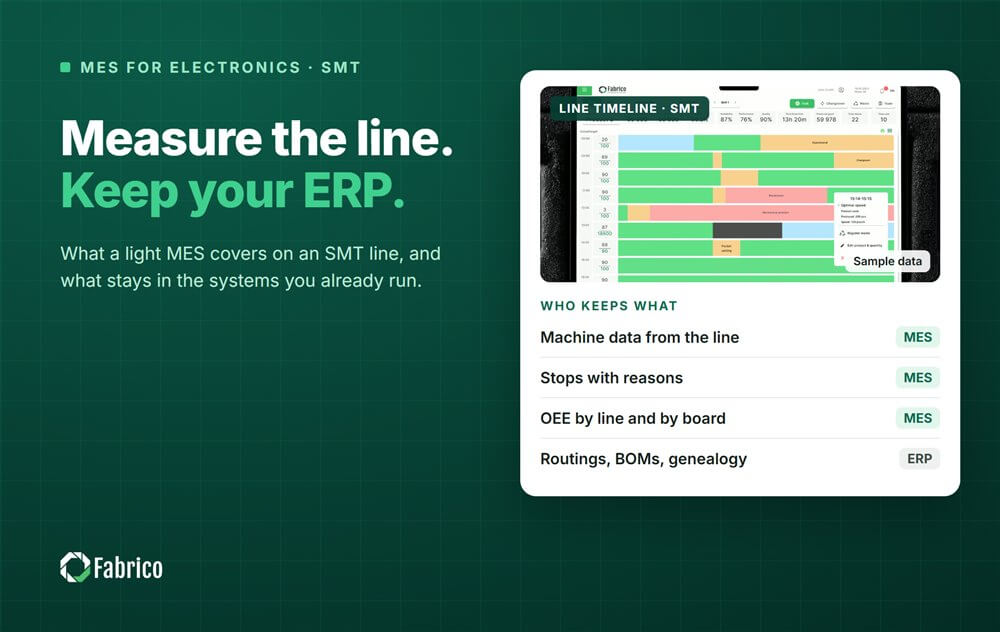
Our guide to MES for electronics manufacturing explains what a light MES records on an SMT line and what stays in the ERP. For the wider strategy behind high-mix production, see our high-mix, low-volume manufacturing guide.
Fabrico is a light MES: machine data collection, production monitoring, OEE and downtime analytics, and integration with SAP and other ERP systems, with maintenance built in. It records stops and counts from the PLC or an IoT device, operators add the reason, and orders and products come from the ERP. A camera can cover manual stations such as rework benches and hand assembly. Job dispatching, BOMs, routings and genealogy stay in your ERP.
Installing the devices and connecting the machines takes about one month. Full rollout across the lines you choose takes 3 to 4 months.
One target for the line is fine as a direction, but performance should be calculated against an ideal cycle time per board. Otherwise the mix decides the number, not the line.
No. They are planned in the schedule, but they are time the line does not produce good boards, so they belong inside OEE as an availability loss.
Group boards into product families and compare within a family. Comparing a dense controller board with a small sensor board says little about the line.
Request a demo to see OEE and downtime by board on your own SMT lines.





 Login
 Blog